The central bank weighed stubborn inflation against a softer job market a week before the midterms

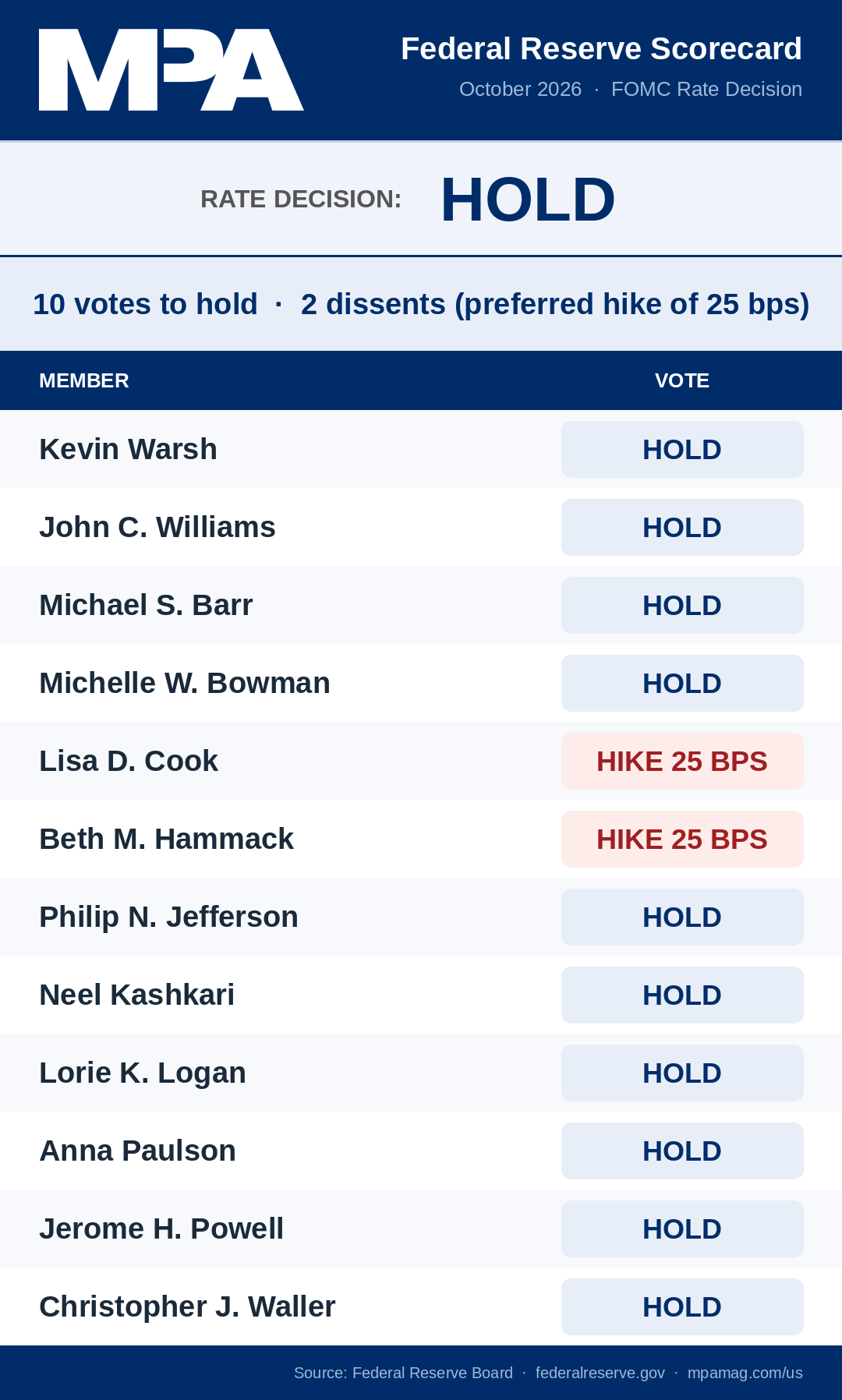
After its first rate hike in three years in September, the Fed decided to push pause on a further rate move at its next-to-last meeting of 2026.
The Federal Reserve decided Wednesday to leave interest rates unchanged, holding the Federal funds rate between 3.75% and 4.00% as inflation and the job market sent conflicting signals.
After September's 25 basis point increase, its first since 2023, the central bank paused.
Wednesday's decision came less than a week before the Nov. 3 midterm elections, with consumer prices up 3.7% in September from a year earlier and core inflation at 2.6%, according to the Bureau of Labor Statistics. Markets had expected the hold, with CME FedWatch putting the odds at 90.6% as of Wednesday morning, against 9.4% for a quarter-point increase.
Sam Williamson, senior economist at First American, said ahead of the meeting that the data would decide it, not the calendar.
"Election day may command the headlines, but the economic data will ultimately drive the Fed's next move," Williamson told Mortgage Professional America. "And in September, the data painted a mixed picture, with inflation coming in hotter than expected and job growth surprising to the downside."
Why the Fed held
A softer-than-expected September jobs report had already moved markets from a likely October increase to a hold. On Sept. 25, CME FedWatch put the odds of an increase at 64.2%.
That is the trade-off built into the Fed's dual mandate, which asks it to weigh stable prices against maximum employment. Melissa Cohn, regional vice president at William Raveis Mortgage, said before the meeting that the Fed was boxed in.
"It's quite likely that the Fed will do nothing next week," Cohn said. "It's a week before the election. I think that if oil prices continue to soar, then the Fed should be raising rates in December."
Williamson said unity on the goal doesn't guarantee unity on the pace. The September vote was unanimous.
"The Fed remains united on the goal of bringing inflation down, but not necessarily on how quickly to get there," he said. "As policymakers weigh persistent inflation against the risk of overtightening, differences over the timing and pace of further hikes could lead to more dissent in the months ahead."
What it means for rates
Mortgage rates have eased from this month's highs but remain elevated. Freddie Mac's 30-year average was 7.32% on Oct. 22, down from 7.40% a week earlier, and the 10-year Treasury yield peaked at 5.36% on Oct. 7.
"Treasury yields may have retreated from their recent highs, but the forces pushing them higher have not," Williamson said. "Stubborn inflation, resilient growth, and expectations for further Fed tightening will likely keep interest rates elevated through year-end."
Traders expect rates to be higher by the December meeting. As of Wednesday morning, CME FedWatch gave a 76.5% probability that the funds rate will be 25 basis points above its current level after that meeting, 7.8% for 50 basis points higher and 15.7% for no change.
FedWatch is pricing in three increases by June 2027, in December, March and June. The Mortgage Bankers Association (MBA) also forecasts further increases in December and early 2027.
Cohn said ahead of the meeting that the slowdown was already showing up in her day-to-day work. Buyers, she said, were holding off until Nov. 3.
"While I'm still doing business, the velocity of business is greatly diminished from where it was," she said. "We're at a moment where a lot of people have hit the pause button, waiting to see what happens in the election."
Stay updated with the freshest mortgage news. Get exclusive interviews, breaking news, and industry events in your inbox, and always be the first to know by subscribing to our FREE daily newsletter.