New research exposes a record gap between what sellers budget and what a home sale actually costs

Most US home sellers go into a transaction with a number in their head. Few end up anywhere near it.
New research from Clever Real Estate, a nationwide discount real estate brokerage, finds that the cost of selling a home in the US hit a record in 2026 — far exceeding what sellers budgeted and driven by repair bills, closing fees, and concessions that caught most off guard.
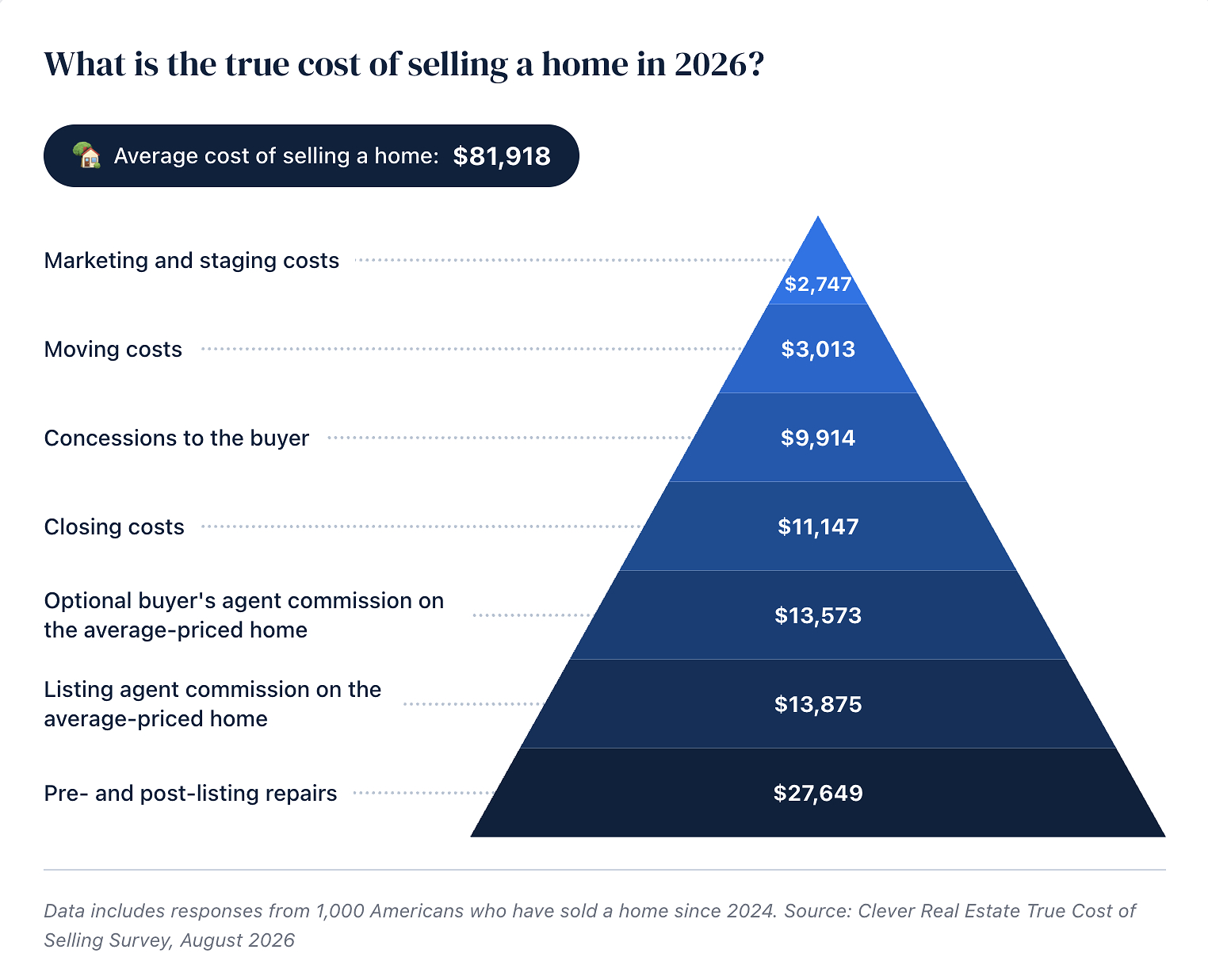
The cost of selling a home in the US hit a record $81,918 in 2026, a 22% jump from $67,245 the prior year and more than triple the $26,883 the average seller expected to pay.
The data carries direct implications for mortgage brokers, whose clients rely on sale proceeds to fund down payments on their next purchase.
Nearly one in four sellers (24%) went into debt covering selling costs. Some 46% said the transaction exceeded their budget, up from 37% in 2025.
Had they known the true cost upfront, 69% of recent sellers said they would have made different decisions, and believe they could have netted $34,139 more.
Repairs and closing costs drive the surge
Repairs were the single largest expense, averaging $27,649, up 32% year-over-year, among the 71% of sellers who made pre-sale improvements.
Closing costs surged 36% to $11,147, from $8,217 in 2025, and sellers ranked them as both the most confusing and most unexpectedly expensive part of the process.
Agent commissions added another $27,448, based on a 5.46% combined rate on the typical US sale price.
The report lands at a moment when seller concessions have reached a record high in a deepening buyer’s market, with 44.7% of August home sales including a seller contribution, according to Redfin.
More than three-quarters of sellers (78%) in the Clever Real Estate survey made concessions averaging $9,914, adding another layer to an already steep selling ledger.
Going it alone costs sellers more
Three-quarters of unrepresented sellers (75%) dropped their agent to cut commission, yet paid $10,920 in concessions on average, nearly $1,500 more than the $9,433 recorded for those with representation. Their net commission saving: just $1,136.
Kevin Odo, broker owner of Greenhaven Capital, told Mortgage Professional America that today’s market dynamics erode much of that perceived advantage.
“A more balanced market gives buyers more flexibility to maybe negotiate seller credits — seller credits can either help with their closing costs or help them get lower rates,” Odo said.
The regret numbers confirm it: 38% of unrepresented sellers later wished they had used an agent, compared to just 22% of those who did.
Overall, 64% of sellers said they would consider a low-commission realtor next time.
Despite the cost pressures, 80% of sellers still made a profit, averaging $191,304. But 39% said returns fell short of expectations because of selling costs cutting into equity.
As rising mortgage rates and elevated home prices continue to weigh on US housing affordability, the erosion of net proceeds reshapes what buyers can bring to the table next.
Kurt Strandson, president and CEO of Pinnacle Mortgage, flagged inventory as the missing variable in an earlier Mortgage Professional America interview.
“With a more normalized housing supply market with rates coming down, sellers are more likely to list because they’re now replacing with a lower rate than when they were in the 7%, 8% range,” he said.
Stay updated with the freshest mortgage news. Get exclusive interviews, breaking news, and industry events in your inbox, and always be the first to know by subscribing to our FREE daily newsletter.