Central bank raised rates for the first time in three years

NOTE: This is a live blog that will be updated frequently. Refresh often for the latest updates.
That wraps up our live blog!
3:10 p.m. ET
That wraps up our live blog for this time, but it is not the end of our coverage.
Our Fergal McAlinden will have a story tomorrow with Melissa Cohn of William Raveis Mortgage to get her thoughts on the Fed's decision. He also spoke with Sonoran Lending president and senior loan officer Jay Lessard to get his thoughts on where mortgage rates go from here. And we'll have more reaction from across the industry over the next few days.
Thank you all for joining us! We'll do it again on October 28.
Economist reaction: Are 7% mortgages the new normal?
3:00 p.m. ET
Lawrence Yun, chief economist for the National Association of Realtors, offered his thoughts about where mortgage rates go after the Fed rate hike.
“Average mortgage rates rose from 6% in late February to 7% this week, ahead of the Federal Reserve's first rate hike in three years today," Yun said. "That’s because inflation picked up after the oil price shock and continuing concerns about unconstrained inflation. The whopping, still-growing federal deficit does not help, as more government borrowing means less capital available for the private sector, including for mortgages."
Yun said there is room for rates to fall once oil prices return to a more normal level.
"Mortgage rates can come down once oil prices retreat and with a credible plan to reduce the budget deficit," Yun said. "Also, if AI technology boosts worker productivity, then inflation and long-term borrowing rates, like for mortgages, can decline. These developments are highly uncertain, at least in the upcoming months. Expect 7% as the new normal. Job additions will be the one factor that can support homebuying.”
Warsh discusses what changed since the last meeting
2:57 p.m. ET
Warsh was asked what changed from the last meeting when the Fed held steady.
“I said in Jackson Hole, trends matter,” Warsh said. “I said there we need to look outside the window and interrogate reality. My judgment some weeks ago was that the inflation summer trends weren't passing the test. I have seen very little information since then that would make me reverse that decision, so I have stuck with it.”
Another major change was attributed to geopolitical issues around the world.
“There is no hiding from hot spots around the world,” he said. “Our judgment about what is the most likely, or least likely, of the geopolitical situation has changed. All three of those things helped themselves to a firm, unanimous decision today.”
He was also asked what has impacted the bond yields and why they have increased.
“I will give you three reasons, but I would say these things tend to be overdetermined,” Warsh said. “These are complicated sets of things affecting the most important asset in the world, the 10-year Treasury. First is economic strength. Part of the reason we have seen, over the course of 2026, long-term yields go up is that the economy is strengthened.
“The second reason is the competition for capital. The surge in expenditures which I referenced in my remarks is real, so the competition for capital is real, and it partly explains the increase in yields. The third is geopolitics.”
Warsh: 'We cannot affect individual prices'
2:38 p.m. ET
While acknowledging that a Fed hike doesn’t help to bring energy prices down, Warsh noted that their goal is to make sure to keep other inflation in check.
“We will ensure that any change in relative prices doesn’t broaden out and have second and third effects in the economy,” Warsh said. “That is what we are tasked to do and will do.
Of course, Warsh also didn’t promise that this would be the first of many hikes, despite the fact that the dot plot hints at a second increase later this year.
“I am not in the forward guidance business,” Warsh said. “The decision we made today was a sober decision, serious decision, responsible decision, one that we have been preparing for and thinking about in my 120 days here. I am not going to pre-judge any future decisions we make.
“You might have heard me say in Jackson Hole, I committed to a discipline, a set of principles. I committed to looking outside the window and seeing what I can observe. That is what I did in Jackson, and that is what we did today.”
Warsh: This decision delivers ‘timely’ return to 2% inflation
2:33 p.m. ET
Fed chair Kevin Warsh opened his statement by saying that Wednesday’s rate hike is a move to help get inflation back to the central bank’s 2% goal faster.
“While uncertainty remains elevated, owing in part to geopolitical developments, domestic spending has been resilient, productivity growth strong, and capital Investment is robust,” Warsh said. “Job gains have kept pace with the workforce, and the unemployment rate has changed little. But inflation remains elevated. Today's policy action will support a timelier return to the committee's 2% goal. This committee will deliver price stability.”
He said the inflation numbers this summer simply haven’t improved enough on their own.
“This summer's inflation readings do not tell me that underlying trends have meaningfully improved,” Warsh said. “Based on the most recent CPI and PPI data, the 12-month change in total PC prices likely was around 3.6% in August. Core PCE and CPI prices are running at about 3.2% and 2.4%, respectively. Many categories are still posting increases above 3% on both the 6- and 12-month basis.
“At our July meeting, we all agreed that inflation remained too high, and we expressed our joint readiness to act as circumstances might require. We must be confident that underlying inflation is moving to our objective, clearly and at sufficient speed. Today the FOMC decided that this standard has not been satisfied.”
Economist reaction: Fed met market expectations
2:30 p.m. ET
Mike Fratantoni, SVP and chief economist of the Mortgage Bankers Association, offered his thoughts on the rate move this afternoon.
“Markets were almost certain that the FOMC would hike rates at its September meeting," Fratantoni said. "With a unanimous vote, the FOMC met this market expectation for a 25-basis-point hike. The most recent inflation data remain well above the Fed’s 2 percent target, and consumer expectations about future inflation have increased, indicating that the pickup in inflation is likely to persist.
“The September round of projections from FOMC members showed similar expectations for economic growth and the unemployment rate, but a somewhat higher path for inflation and a higher path for the fed funds rate target than had been previously indicated."
Fratantoni said that long-term rates likely won't move much based on this news.
“Longer-term rates, including mortgage rates, had already baked in the expectation of hikes at this and future meetings," he said. "Thus, longer-term rates have not moved much in response to this news. Housing and mortgage activity slowed abruptly as mortgage rates moved higher over the past several weeks. MBA forecasts two additional hikes from the Fed over the next year and expects mortgage rates to stay near current levels over the forecast horizon.”
Kevin Warsh’s comments
2:27 p.m. ET
Here is the link to the YouTube video where Warsh’s comments will air. We’ll transcribe his most notable comments here.
More reaction to the Fed's rate hike
2:25 p.m. ET
Yuri Shraybman of Innovated Mortgage Brokers has also been fielding plenty of phone calls from clients leading up to this upcoming meeting. He told our Fergal McAlinden that he was also anticipating a 25 basis point rate hike.
“I’m expecting the Fed to raise the federal funds rate by 0.25%,” Shraybman told Mortgage Professional America. “The market is already pricing that in, so for mortgage rates, the bigger question is what Warsh says today about inflation and future policy. As you know, mortgage rates tend to react more to the bond market and the 10-year Treasury than directly to the Fed funds rate, but the market does not yet know what will be said.”
Like Shelton, Shraybman has had clients calling asking about rate locks before the Fed decision. He has made sure to remind them that mortgage rates may not move in the same direction as the Fed rate action.
“I have received numerous calls where current clients want to lock ahead of the Fed decision as they are extremely concerned,” he said. “I have also had numerous conversations over the past week explaining that the Federal Reserve does not directly control mortgage rates, even though Fed policy can influence the broader bond market and rate environment.”
Geopolitical challenges have made the Fed’s job more difficult, which makes predicting what’s going to happen next tough.
Selma Hepp, chief economist at Cotality, said the Fed has a lot to take in before making any rate decisions.
"The Fed faces an increasingly difficult balancing act,” Hepp said. “Recent inflation readings suggest progress toward the 2% target has stalled, but much of the pressure comes from areas not particularly sensitive to interest rates, including energy, tariffs, fiscal deficits, and the massive wave of AI-related infrastructure investment.”
In the end, the central bank has been clear that it has fallen short of delivering stable prices, and it had a need to address that side of the mandate, especially when jobs numbers remain strong. However, Hepp isn’t sure that a rate hike fights the kind of inflation that the US is currently dealing with.
“Today's decision reinforces the Fed's commitment to price stability and addresses credibility concerns,” Hepp said. “It is less clear that higher short-term rates can meaningfully reduce inflation driven by supply constraints and capital-intensive investment trends. The bigger question is whether the Fed risks fighting the wrong inflation battle. A rate hike is unlikely to lower gasoline prices, reduce tariff-related costs, or accelerate homebuilding, but it will further dampen housing demand and delay a broader market recovery.”
She also noted that the soaring bond yields and mortgage rates have already tightened financial conditions even before the Fed could act.
“The Fed's focus on preserving inflation-fighting credibility is understandable given the recent uptick in inflation,” she said. “However, rate hikes are unlikely to address many of the underlying drivers of current price pressures. Financial conditions have already tightened significantly through higher 10-year Treasury yields and mortgage rates.”
Broker reaction: Possible hike led to rate lock conversations
2:23 p.m. ET
Samantha Shelton, mortgage broker and president of Align Lending, said the lead-up to today’s decision brought some serious conversations about potential rate locks.
"Some clients may benefit from locking before the announcement. Others have flexibility to wait," Shelton told Mortgage Professional America ahead of the decision. "There isn't one answer that works for every borrower."
She said this decision brought more insecurity to her clients that any other recent Fed meeting due to the uncertainty surrounding both the decision and the overall market. This was especially true for clients looking at home equity lines of credit (HELOCs).
"Of all of the meetings that we have been through over the last, I would say, probably two years, I feel like this one specifically, there was a heightened sense of insecurity," she said. "There were a lot more conversations happening with my clients that were shopping for HELOCs. If a HELOC is something you want to do, that is going to be directly impacted."
Because so many homeowners are still hanging on to a low-rate first mortgage, second lien products like HELOCs have become a huge part of broker strategy over the last two years.
"HELOCs have been a very big key component to mortgage solutions over the last, I would say, 18-ish to 24 months, because people don't want to move off that first rate that they have on their primary residence," she said. "They don't want to give up their 2% or 3% first mortgage. So to access that equity, they're looking for other solutions."
Like so many, she will be watching and listening to Kevin Warsh’s tone in his post-decision press conference to see if there is some clue about how the Fed might proceed.
"Warsh's tone during the conference is extremely important," she said. "If he says that the Fed can be patient and watch upcoming economic reports before making another move, the markets may take that as a positive sign. If he says inflation remains a serious concern and the Fed is prepared to continue raising rates, we could see more pressure on the bond market and mortgage rates. The words following the decision could have a larger effect on mortgage rates than the actual increase itself."
Summary of Economic Projections
2:22 p.m. ET
In addition to the dot plot, there were other economic projections listed by FOMC members. Here is a summary of those projections in graphical form.
Dot plot: Where the FOMC members see rates going
2:15 p.m. ET
In addition to the rate decision, the Fed issued its latest dot plot. As was the case earlier this year, one vote is missing from the chart, which is likely the vote of Kevin Warsh, who has professed himself not a fan of forward guidance.
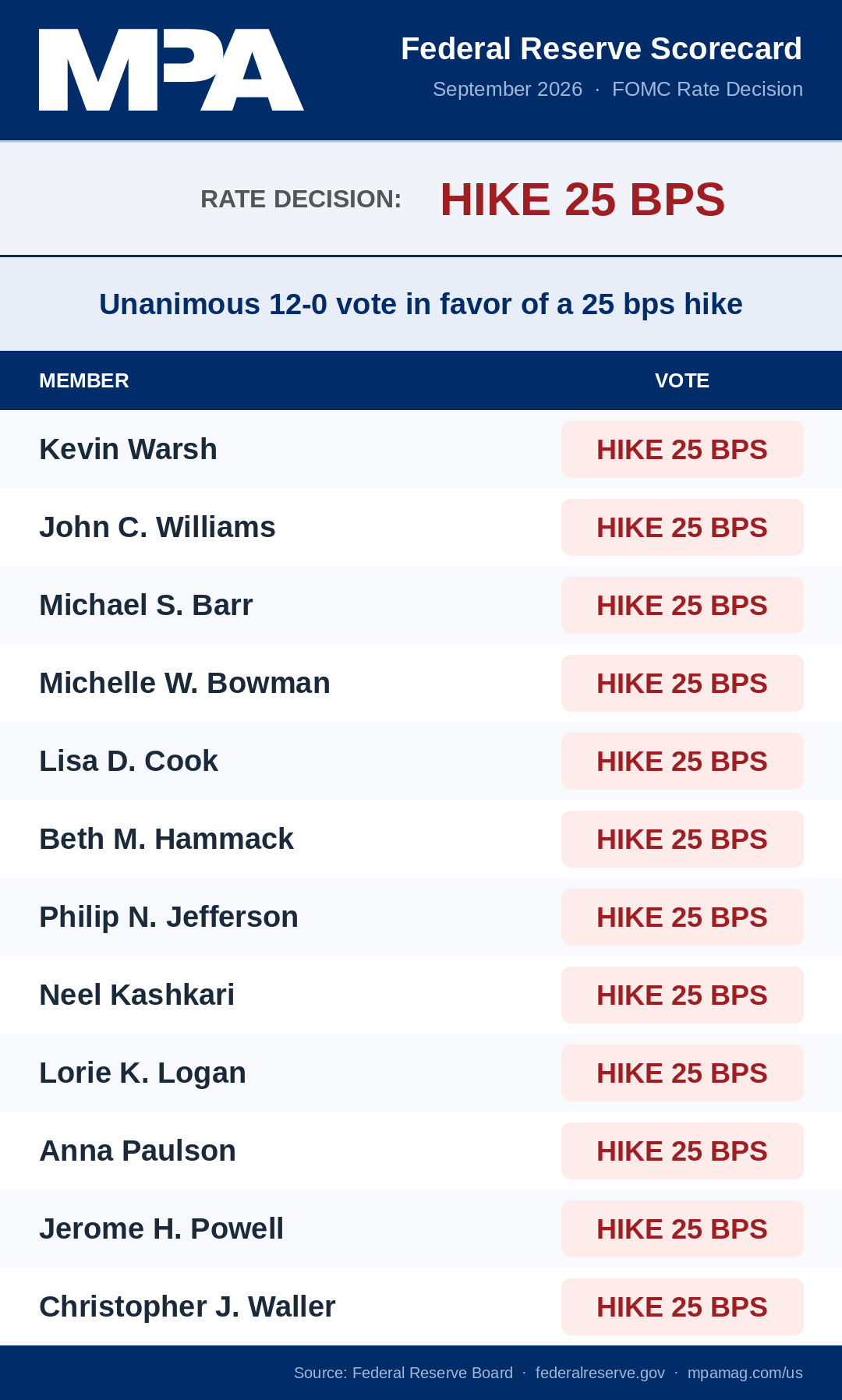
How they voted: A unanimous decision
2:10 p.m. ET
All 12 members of the FOMC voted for a 25-basis-point rate hike.
See the chart below for the breakdown:
Breaking: Fed announces rate decision - it's a rate hike
2:00 p.m. ET
The Federal Reserve has officially announced its rate decision. For the first time since 2023, the Fed has announced a rate hike.
The central bank announced a 25 basis point rate hike after its September meeting, moving the Federal funds rate to between 3.75% and 4.00%, ending a stretch of five straight rate holds. It was a unanimous decision, with all 12 FOMC members voting for a rate hike.
Fed chair Kevin Warsh will discuss the decision coming up at 2:30 p.m. ET. You can watch his press conference at the link below.
North of the border: Hold two weeks ago as trade war heats up
1:40 p.m. ET
The Bank of Canada decided to keep its trendsetting rate steady for the seventh straight meeting two weeks ago, holding at 2.25%. The beginning of a new trade war with the United States is a new factor that the central bank will have to keep an eye on.
Sal Guatieri, director and senior economist at BMO Capital Markets, told our Fergal McAlinden that the new tariffs would likely impact the market.
“I definitely think the housing market will be impacted more by the escalating trade war than the Iran war,” he said. “Yes, higher oil prices and gasoline prices are not good. They tend to drain spending power, but that will have more of a negative impact on broader consumer spending as opposed to the housing market.
“But it is the concern that if we see more tariffs and an escalating trade war, people start worrying about their jobs and they’ll be in no position to make one of the biggest investments of their lives by buying a house. So until we see some clarity and de-escalation of trade tensions, I think the housing market could remain pretty fragile for a while.”
He noted that sales were starting to stabilize in parts of the country that had been slumping.
“We were seeing clear signs of stability in the harder-hit regions – Ontario and British Columbia more recently,” he said. “Sales were stabilizing, if not picking up. Prices were starting to stabilize. But I think any hopes of a meaningful recovery could be on the back burner if the trade war continues to escalate.”
The next Bank of Canada rate decision will once again coincide with the Federal Reserve decision, on October 28.
Keep an eye on: How the bond market reacts
1:30 p.m. ET
Anybody who keeps a close eye on the bond market has watched in horror as the 10-year Treasury yields moved above 5% earlier this week.
However, one veteran bond trader who uses fundamental theory predicted it was going to happen.
Billy Abrams, who spent decades in institutional fixed income before moving into correspondent business development at AD Mortgage and taking the role of president of Imperial Fund Securities, saw yields headed back up as part of the normal cycle of the bond market. He believes that if the Fed raises rates today, it could bring yields back down.
"I personally think that if the Fed were to shock everybody and raise rates, I think the bond market would firm up," Abrams told Mortgage Professional America. "A more aggressive Fed claiming they're going to fight inflation would actually help the long end of the bond market."
Using the Elliott Wave Theory, he projected yields would surpass 5% before eventually dropping back into the mid-3s. However, he also predicted that after that dip, bond yields could push higher in the 7% to 8% range in the future.
Nevertheless, he believes that the movers and shakers whose moves drive the Chicago Mercantile Exchange’s CME FedWatch have been telegraphing the next move for a while.
"The people with the big money don't disagree with the fact that the next move by the Fed is a rate hike," he said. "JP Morgan, Goldman Sachs, Morgan Stanley — they move the markets. If they thought the Fed funds futures were wrong, they'd make a play."
While we’re waiting to see what happens, here’s a chart of the Fed funds rate since 2010. This reflects the actual overnight funds rate rather than the range that the central bank operates within.
Comparing US rates to the rest of the world
1:20 p.m. EDT
Here is a chart and an interactive map showing how the US Federal Funds rate compares to central bank rates around the world:
| Country | Central Bank Rate |
|---|---|
| Switzerland | 0.00% |
| Japan | 1.00% |
| Singapore | 1.07% |
| Canada | 2.25% |
| Eurozone | 2.65% |
| China | 3.00% |
| South Korea | 3.00% |
| United States | 3.50% – 3.75% |
| United Kingdom | 3.75% |
| Saudi Arabia | 4.25% |
| Australia | 4.35% |
| India | 5.25% |
| Indonesia | 5.75% |
| Mexico | 6.50% |
| South Africa | 7.00% |
| Brazil | 14.00% |
| Russia | 14.00% |
| Argentina | 29.00% |
| Türkiye | 37.00% |
Fed Preview: Rate hike ‘not an open-and-shut case’
1:00 p.m. EDT
Sam Williamson, senior economist at First American, said that while all the signs point to a potential Fed rate hike today, that doesn’t mean that it’s guaranteed.
"The case for holding rates steady is getting harder to make," Williamson told Mortgage Professional America. "August's labor and inflation data suggest inflation is still running too hot, while job growth is still holding up and unemployment remains low. That mix gives policymakers room to lean harder against inflation, tipping the balance toward a rate hike this week and keeping further increases on the table. Still, the decision may be a close call and could draw dissent from less hawkish officials."
There has been an increase in pressure from the White House to cut, not raise, the Fed funds rate. President Trump threatened to cut off trade with certain countries if the Fed didn’t lower rates. Williamson said political pressure likely will have no impact on what the Fed decides today.
"Political pressure adds to the noise, but is unlikely to alter the course of monetary policy," he said. "The FOMC is a consensus-driven committee, and its credibility rests on keeping monetary policy tethered to the economic data. If markets perceive policy as politically driven, calls for lower rates could produce the exact opposite result by increasing inflation expectations and policy-risk premiums, pulling Treasury yields and mortgage rates along with them."
Because the bond market has increased in recent weeks, a potential rate hike has likely already been accounted for.
"A rate hike remains likely at this week's meeting, but it is not an open-and-shut case," he said. "The bond market has already done some of the Fed's work by pushing long-term yields higher and tightening financial conditions, reducing the need for immediate policy tightening. Even so, August's firmer core inflation reading raises the concern that this market-based tightening may not be enough to bring inflation under control, keeping a rate hike squarely on the table."
Welcome to the live blog!
12:40 p.m. EDT
Welcome to our sixth live blog of 2026 at Mortgage Professional America. Today, we are covering the Federal Reserve’s sixth rate announcement of the year. The markets are expecting a rate hike this afternoon of 25 basis points. However, economists, including First American's Sam Williamson, believe it's not a guarantee that the central bank will raise rates.
It's going to be an interesting afternoon. We'll be previewing the decision here until 2 pm ET, when we'll have the official word from the Fed. Then we'll bring you industry reaction and Fed chair Kevin Warsh's thoughts afterwards.
Refresh often for the latest, and buckle up for the latest Fed decision.