Reaction from Fed chair Jerome Powell and from across the mortgage industry

That’s a wrap on our live coverage
3:25 p.m. ET
Thank you so much for joining us for our live coverage of the Federal Reserve rate decision. Before you go, there are a couple more stories posted today that you can check out.
Check out my story on Jerome Powell deciding to remain on the Fed board after his term is over.
Our Fergal McAlinden will have our regular reaction story from Melissa Cohn, regional vice president of William Raveis Mortgage. He also has a story with reactions from brokers Hunter Bolling and Jay Lessard.
And in a non-Fed story, check out my interview with UWM president and CEO Mat Ishbia and former Rocket exec Mike Fawaz about Fawaz’s new company, Origna8.
Powell: Trying to get to 2% over time
3:17 pm ET
Despite the challenges to both sides of the mandate, Powell said the Fed is still committed to getting inflation back down to 2%. It just may take some time.
“We're committed to bringing inflation back down to 2%, and sustainably,” he said. “That's our goal, and we will stick to it until that happens. We keep getting these events happening, which keep driving up costs. The best thing we can do is to use our tools to guide inflation back down to 2%. I think trying to get there really quickly could be very costly in terms of job loss. But we tried to get there over time in a way that does the least damage possible. And our commitment to that is never-ending and unshakeable.”
Powell said some of the inflation is still due to tariffs, and they are still hopeful that those will pass through eventually.
“Inflation is a thing we need to work on, and it's partly tariffs, which we think that that inflation should subside over the course of this year because it's a one-time increase that shouldn't be repeated,” he said. “That should start happening pretty soon. The energy inflation that we're getting should go through fairly quickly. We'll just have to see how that works out.”
Powell: Policy is a good place to wait and see
3:01 pm ET
Despite the fact that three people dissented in the overall vote, he doesn’t believe they are calling for rate increases.
“The three dissenters and nonvoters who preferred it all supported the rate decision,” Powell said. “People are not saying we need to hike now.”
Powell did say there were concerns that the energy shocks could bleed into core inflation.
“Those prospects are real,” he said. “The good news is we think our policy stance is in a very good place for us to wait and see. We're right kind of at the high end of neutral or perhaps mildly restrictive. The labor market shows more and more signs of stability. Whereas inflation is kind of misbehaving. So maybe a little bit of restriction or the high end of neutral is the right place to be.
“We can wait here and see how things work out before we act. And we'll see how much comes through in the core. You see it already in airfares, but you may see it in many other places. You know, we just don't know yet, because how long will the Strait of Hormuz be closed? You can develop any number of scenarios that you want, but we really won't know until we know. Fortunately, we're in a good place to wait and let things develop.”
Broker: Fed waiting to see what happens
2:51 p.m. ET
Oliver Orlicki of Orlicki Group told our Fergal McAlinden that he wasn’t surprised by today’s rate decision.
“There was 100% pretty much guarantee they weren't going to move rates today,” Orlicki said. “It was, we think, Powell's last Fed announcement. So a lot of people aren't going to take much into consideration about his press conference.”
Orlicki said it’s tough to look at rate easing with the current market conditions. He thinks that will make things tough for Kevin Warsh to cut rates.
“It's tough to have an easing bias in the current environment, especially with what's going on now in Iran,” he said. “I think everybody's sitting back and waiting to see what happens to energy prices and natural gas prices. Once that sorts itself out, I think that they can get a clearer path.
“Unfortunately, a lot of the inflation and employment reports are coming in hotter than expected, which are the two mandates the Fed wants to use to cut interest rates. So, although we have a new Fed chair coming in, I'm not really sure how easy it's going to be for him to cut rates as quickly as other people want him to.”
BREAKING: Powell will continue to serve as a governor for a period of time
2:38 p.m. ET
Powell stated that he will remain on the board after his time as chair ends next month, although he will keep a low profile.
“I've said that I will not leave the Board until this investigation is well and truly over with transparency and finality, and I stand by that,” Powell said. “I am encouraged by recent developments and watching the remaining steps in this process carefully. My decisions on these matters will continue to be guided entirely by what I believe is in the best interest of the institution and the people we serve.
“After my term as chair ends on May 15th, I will continue to serve as a governor for a period of time to be determined. I plan to keep a low profile as a governor. There's only one Chair of the Federal Reserve Board. When Kevin Warsh is confirmed and sworn in, he will be that Chair."
“My concern is really about the series of legal attacks on the Fed, which threaten our ability to conduct monetary policy without considering political factors,” Powell said. “These legal actions by the administration are unprecedented in the 113-year history and there are ongoing threats of additional actions.
“I worry these attacks are battering the institution and putting at risk the thing that matters to the public, which is the ability to conduct monetary policy without taking into consideration political factors. It is so important for our economy and the people that we serve that they can depend on a central bank that operates that way, free of political influence. It's part of the absolute foundation of this amazing economy that we have.”
Powell was asked if staying meant he was taking a political stance by not allowing President Donald Trump to appoint his successor to the board.
“I don't see that at all,” Powell said. “As I mentioned, I'm literally staying because of the actions that have been taken. I had long planned to retire. The things that have happened in the last three months have left me no choice but to stay until I see them through. I don't see how this will interfere. My intention is not to interfere.”
Powell offered his congratulations to Kevin Warsh, who is expected to be confirmed as the new Fed chair in the coming days. He also said he wasn’t sure when he would exit the Fed board.
“First, I want to congratulate Kevin Warsh on his advancement out of the Senate banking committee this morning,” Powell said. “This is an important step forward, and I wish him well as that process continues. In terms of when I will leave, I will leave when I think it's appropriate to do so. I'm waiting for the investigation to be well and truly over with finality and transparency. And I'm waiting for that. And I will leave when I think it's appropriate to do so."
Powell: Middle East contributing to uncertainty
2:35 p.m. ET
Fed chair Jerome Powell said elevated energy prices due to the conflict in Iran have caused inflation to rise.
“Inflation has moved up and is elevated in part reflecting the recent increase in global energy prices,” Powell said. “Developments in the Middle East are contributing to a high level of uncertainty about the economic outlook, and we will remain attentive to risks of both sides of our dual mandate. Inflation has moved up recently and is elevated relative to our two percent longer-run goal.
“Estimates based on the consumer price index and other data indicate that total PCE prices rose 3.5% over the twelve months ending in March. Boosted by the significant rise in global oil prices that has resulted from the conflict in the Middle East.”
How long the conflict continues will determine the eventual impact on the economy.
“Economic outlook remains highly uncertain, and the conflict in the Middle East has added to this uncertainty,” Powell said. “In the near term, higher energy prices will push up overall inflation. Beyond that, the scope and the duration of the potential effects on the economy remain unclear, as does the future course of the conflict itself.”
Jerome Powell’s comments
2:25 p.m. ET
These should be some very interesting comments, especially considering that CME FedWatch is now pricing in a much better chance at a rate hike between now and April 2027 than a rate cut.
Also, vote in our poll on our LinkedIn page! Did the Fed make the right decision?
Here is the link to the YouTube video where Powell’s comments will air. We’ll transcribe his most notable comments here.
Broker reaction: Interested in what Powell says, where the Fed goes
2:15 p.m. ET
Most people in the mortgage industry expected another rate hold. Most of them also want to hear what Powell has to say in the aftermath.
Mark Gelbman, mortgage advisor with Union Home Mortgage, said he wasn’t surprised by the decision but awaits Powell’s comments.
“I didn’t expect any movement by the Fed,” Gelman told Mortgage Professional America. “They won’t reduce rates because of energy inflation caused by the Iran war. I also don’t believe that they will raise rates due to a lack of data to support that. I will be interested in what is said, though. With Powell leaving the chair position in May, I am curious as to what the narrative will be.”
Gelbman said he was a bit skeptical when Powell was chosen as chair. However, his main issue is with the Fed as a whole. He thinks changes are needed, and he’s interested to see how Kevin Warsh tackles those changes.
“When Powell was chosen as Fed chair, I was a bit skeptical,” he said. “Not saying he isn’t really smart, but he is an attorney by trade. I believe that the Fed chair should be a finance guy. My beef is more with the Fed board in general. The reports that we use are antiquated. Case in point is the “owners’ equivalent rent” stat that is used in the inflation reports. The average homeowner has no idea what their home would rent for, and it is a totally bogus number.
“The Fed always looks in the rear-view mirror and is not very good at looking forward. While I am not all in for Warsh, I am very interested in what he will bring to the Fed. He has a very different perspective on the economy and the Fed’s role.”
Glen Weinberg of Fairview Commercial Lending told our Fergal McAlinden that he didn’t expect a rate move today, and he doesn’t think a new Fed chair is going to change things much.
“I would have been very surprised if they moved on rates one way or another,” Weinberg told Mortgage Professional America. “There is no impetus to do anything based on the current data. I don’t foresee many, if any, cuts as the economy seems to be holding up, and inflation is also holding steady.
“On top of that, the budget deficit is continuing to run high, which will ultimately keep longer-term rates higher. I don’t think the rest of the Federal Reserve board has an appetite for much in the way of cuts, as the threat of inflation and stagflation is real.”
Hunter Bolling, of the HB Mortgage Team, told McAlinden that he feels like customers have accepted where rates are and are more focused on what monthly payments look like.
“I think so much has changed from the end of February, when rates really dipped down and then went up because of Iran,” Bolling told Mortgage Professional America. ”I think just a lot of people caught wind that mortgage rates went up since Iran, and it just hasn't really been a huge topic of conversation over the last couple of weeks. Over the last couple of weeks, I think everyone kind of settled into, ‘Hey, this is what's going on, and we're dealing with it.’”
How the Fed voted: Most dissenting votes since 1992
2:10 p.m. ET
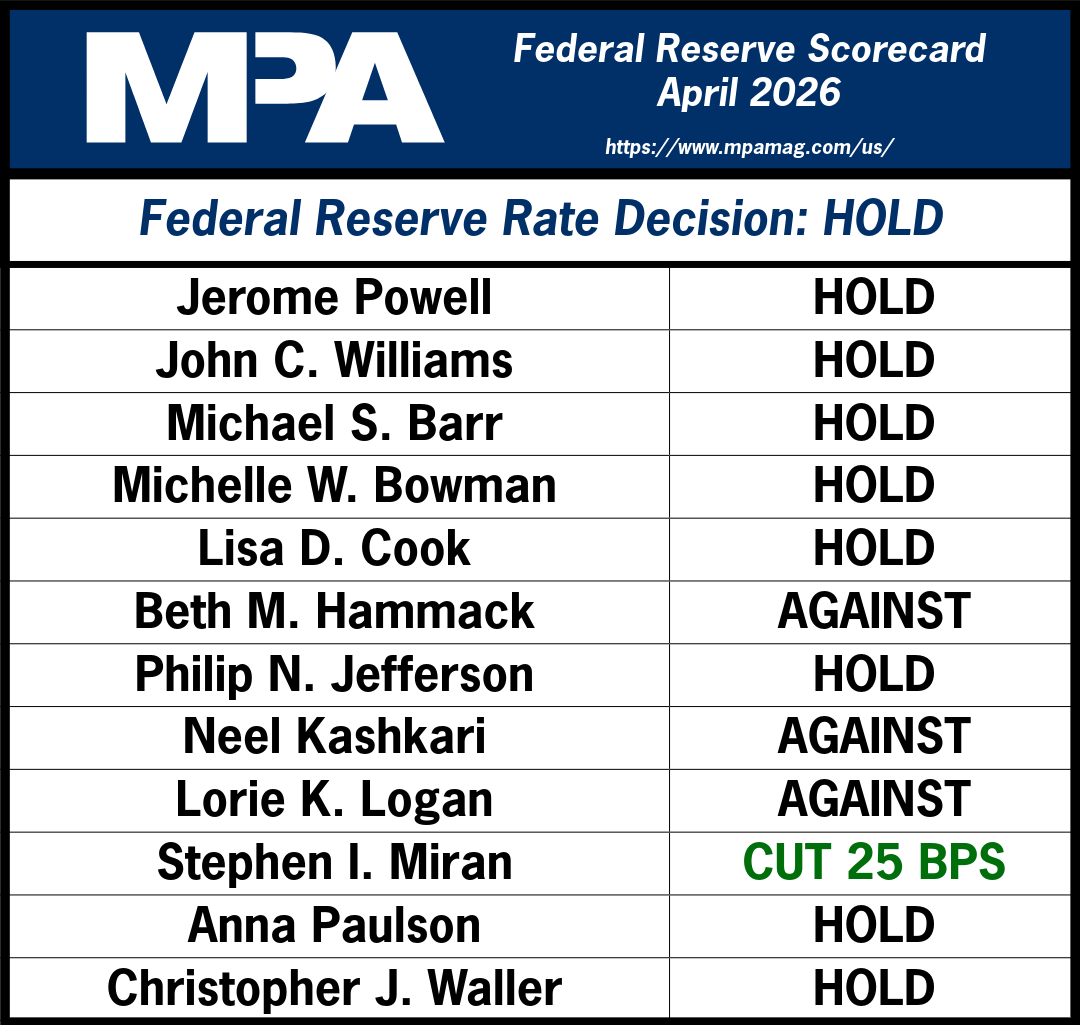
Here is the scorecard for how the Fed members voted. The vote went 8-4, with the largest number of dissenting votes on a fed rate decision since October 1992.
Only Stephen Miran voted to cut the rate at this meeting. He favored a 25-basis-point cut.
However, three other members voted against the monetary policy, with the statement saying that Beth Hammack, Neel Kashkari, and Lorie Logan “supported maintaining the target range for the federal funds rate but did not support inclusion of an easing bias in the statement at this time.”
While unclear exactly what that means, Mike Fratantoni, SVP and chief economist with Mortgage Bankers Association, said this could be a sign that inflation is worrying the Fed.
“There were four dissents to today’s decision, one to cut rates by a quarter of a percentage point, and three to remove the “easing bias” in the statement," Fratantoni said. "Clearly, there are growing concerns regarding the inflation risk in this environment."
Breaking: Fed announces rate decision
2:00 p.m. ET
The Federal Reserve has officially announced its rate decision. As expected, the Fed has announced it will keep rates steady for the third straight meeting to open the year.
The FOMC announced it was keeping its funds rate steady, keeping rates between 3.50% and 3.75%.
Stay tuned for broker reaction in the next 30 minutes, followed by comments from Fed chair Jerome Powell.
Here is the link to the YouTube video where Powell’s comments will air in 30 minutes.
North of the border: Hold again, but a pivot possible
1:40 p.m. ET
It was yet another rate hold north of the border in Canada today, as announced by the Bank of Canada shortly before 10 a.m. ET.
Canadian central bank governor Tiff Macklem said the current rate was “appropriate,” but doesn’t rule out a pivot.
“Our baseline forecast assumes oil prices will come down and US tariffs will remain at the current levels. If this holds true, a policy rate close to current settings looks appropriate to support adjustment in the economy and return inflation to target,” Macklem said.
“There may still be a need to adjust the policy rate depending on how the risks evolve. But if the economy evolves broadly in line with the base case, changes in the policy rate can be expected to be small.”
In a topic that will likely carry over to Jerome Powell’s comments later today, Macklem is keeping a close eye on energy prices, which have spiked due to the conflict in Iran.
“If oil prices continue to increase, and particularly if they remain elevated, the risk that higher energy prices become ongoing generalized inflation increases. If this starts to happen, monetary policy will have more work to do – there may be a need for consecutive increases in the policy rate,” he said.
Even so, he noted that “so far, there is little evidence that higher oil prices have fed through to other goods and services prices more broadly. But it is early days, and we will be watching this closely.”
Comparing US rates to the rest of the world
1:20 p.m. EDT
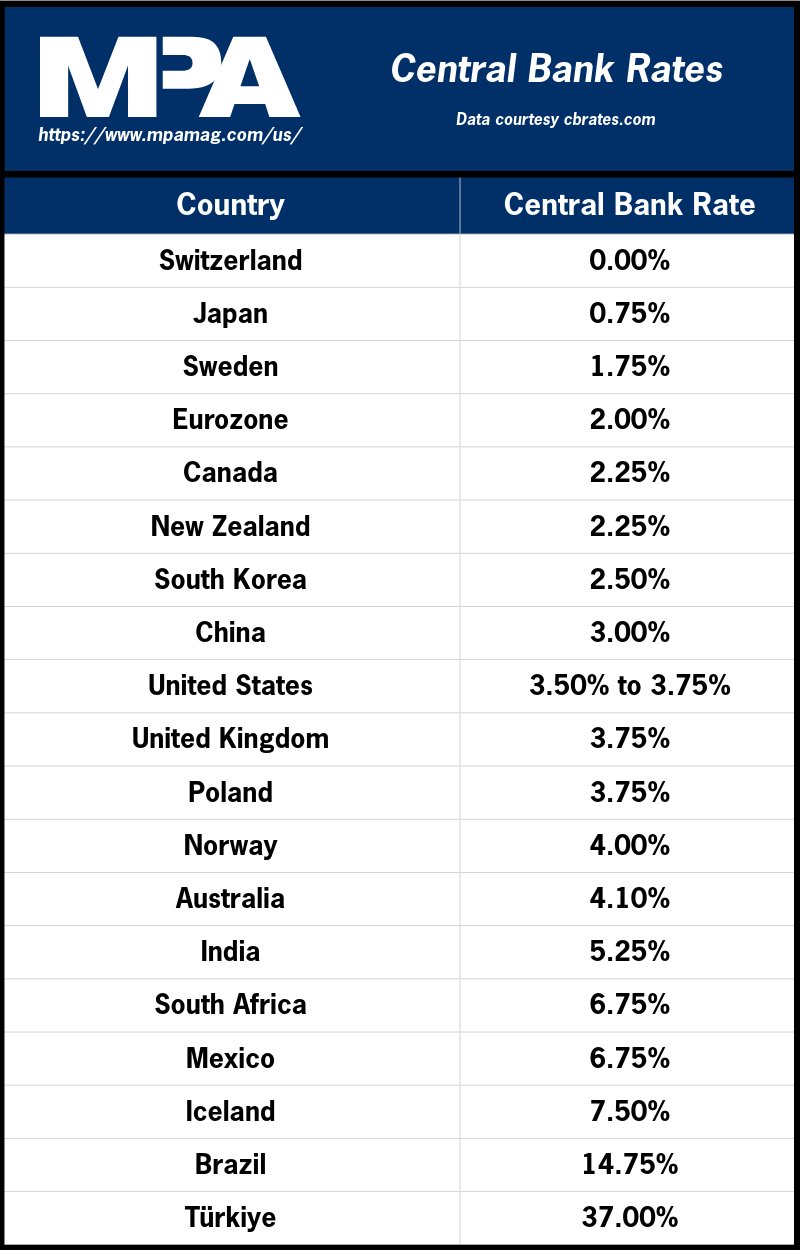
Here is a chart showing how the US Federal Funds rate compares to central bank rates around the world:
Fed Preview: Two paths to future cuts
1:00 p.m. EDT
We checked in with Sam Williamson, senior economist at First American, for his thoughts on what the Fed will do. He said there were two paths to future rate cuts. The first would be an end to risks in the energy market, which would likely be caused by an end of hostilities in the Middle East. That would give the central bank confidence that inflation will resume its drop toward 2%.
The other path is a little more grim. It would involve a deterioration of the jobs market, which would require the Fed to cut rates.
“The alternative path would be a clearer labor-market deterioration, especially a sustained rise in unemployment, that shifts the balance of risks toward growth,” Williamson said. “Without one of those two signals, policymakers are likely to stay cautious.”
Fed chair Jerome Powell has been focused on the interesting state of the jobs market for the last few months. He has mentioned on several occasions the “low hire, low fire” environment that is currently in place.
Williamson said the central bank will keep a closer eye on unemployment rather than small changes in jobs numbers.
“Smaller payroll gains, or even an occasional negative jobs print, are unlikely to carry the same policy weight as in previous cycles,” Williamson told Mortgage Professional America. “The key distinction is that today’s labor force is barely growing, which has sharply lowered the number of jobs needed to keep unemployment steady. That makes the unemployment rate—the Fed’s preferred measure of labor-market slack—the more important metric for the policy path.
“If weak hiring begins to translate into a sustained rise in unemployment, the case for cuts would strengthen. Until then, payroll weakness alone is unlikely to shift the policy path given the upside inflation risks on the other side of the Fed’s mandate.”
Welcome to the live blog!
12:40 p.m. EDT
Welcome to our third live blog of 2026 at Mortgage Professional America. Today, we are covering the Federal Reserve’s third rate announcement of the year.
The actual rate decision may be one of the least newsworthy things that come out of today’s meeting. It is widely expected that the Fed will continue to hold rates steady amid ongoing stress on both sides of its mandate.
Jerome Powell, during his post-announcement press conference in March, discussed the decision.
“Near-term measures of inflation expectations have risen in recent weeks, likely reflecting the disruptions in oil,” Powell said. “Longer-term expectations remain consistent with the 2% goal. The median for the total inflation is 2.7% and 2.2% next year, a bit higher than projected in December.
“The implications of the events in the Middle East for the US economy are uncertain. In the near term, higher energy prices will push up overall inflation. It is too soon to know the scope and duration of the potential effects on the economy.”
In addition to the rate decision, we may get some clarity on the future for Jerome Powell. This likely will be his final Fed meeting as chair, as it is widely expected that Kevin Warsh will be confirmed before the central bank meets again in June.
But the bigger decision will be whether Powell remains on the central bank at all. In the past, it has been customary for the chair to resign from the Fed completely once their term as chair ends. However, Powell may feel inclined to stay through the end of his term in 2028, which will likely draw backlash from the White House.
It’s likely going to be an interesting meeting. We’ll have some news leading up to the decision at 2 p.m., and then we’ll have Powell’s comments covered beginning at 2:30 p.m. Refresh the page often for the latest!