Friday’s failure is a reminder that client relationships in are built by voice, not virtual inboxes

There was a time when a mortgage broker’s most important technology was a pair of good shoes.
Before inboxes, CRM portals and lodgement platforms, deals were done on doorsteps and kitchen tables. Brokers knocked on doors, sat down with families, and rang bank managers they knew by first name.
A file moved because someone picked up the landline and asked where it was. Trust was built one conversation at a time, and a broker’s book was only as strong as the relationships behind it.
Marco Meloni lived it. As a Bankwest accountant in Western Australia in the early 1990s, he signed one of the first third-party broking agreements an Australian bank ever put its name to – and delivered commission cheques to brokers in person.
Loans were handwritten on two pages, front and back, and faxed to the bank. Brokers stayed in touch through pagers and pay phones, and Meloni even had a car phone – “a clunky device with a spiral cord attached to the car”.
Ian Rakhit, Bankwest’s general manager of home buying distribution, remembers brokers walking a client’s paper file into the local branch to talk it through, long before the bank had a single business development manager (BDM).
For better or worse, on Friday 13 November, the global Microsoft Outlook outage gave a lot of Australian brokers a brief taste of that world again.
The trouble started in the early hours, just past 3am AEDT, when Microsoft’s Exchange Online servers began failing. By the time most of the country sat down at its desk, Outlook, Teams, SharePoint and Copilot were all down. Downdetector logged more than 120,000 Outlook reports worldwide by 4.30am, and Australian reports climbed from more than 2,500 at 7.30am to about 5,000 by 9am.
Microsoft said a number of servers had become unavailable after failing automated health checks, leaving the remaining infrastructure to carry the load. Its early fixes did not hold and at the time of writing, the MS suite of virtual software on which almost all global commerce operates was out to lunch.
Service NSW, Queensland Health, NSW Parliament and several state and territory governments were hit. The Australian Security Intelligence Organisation (ASIO) and the Australian Federal Police (AFP) were also affected, and Home Affairs Minister Tony Burke said the government had activated an agreement with Microsoft to prioritise Australian restoration. Burke said Microsoft had told him it did not believe a cyber attack was behind the failure.
The mortgage industry was not spared. The Mortgage & Finance Association of Australia (MFAA) posted a notice on its website that its systems were running but the outage was affecting its ability to receive emails.
Across the Tasman, settlements were disrupted badly enough that the New Zealand Law Society suggested lawyers temporarily use alternatives such as text messages (the horror!) – while verifying any new contact details through a known phone number.
A snap MPA poll suggests most brokers are weathering the disruption, if not enjoying it. At the time of writing, 45% said the outage was annoying but survivable, although 36% called it an absolute nightmare. Just 9% said it was business as usual, and another 9% asked: what outage?
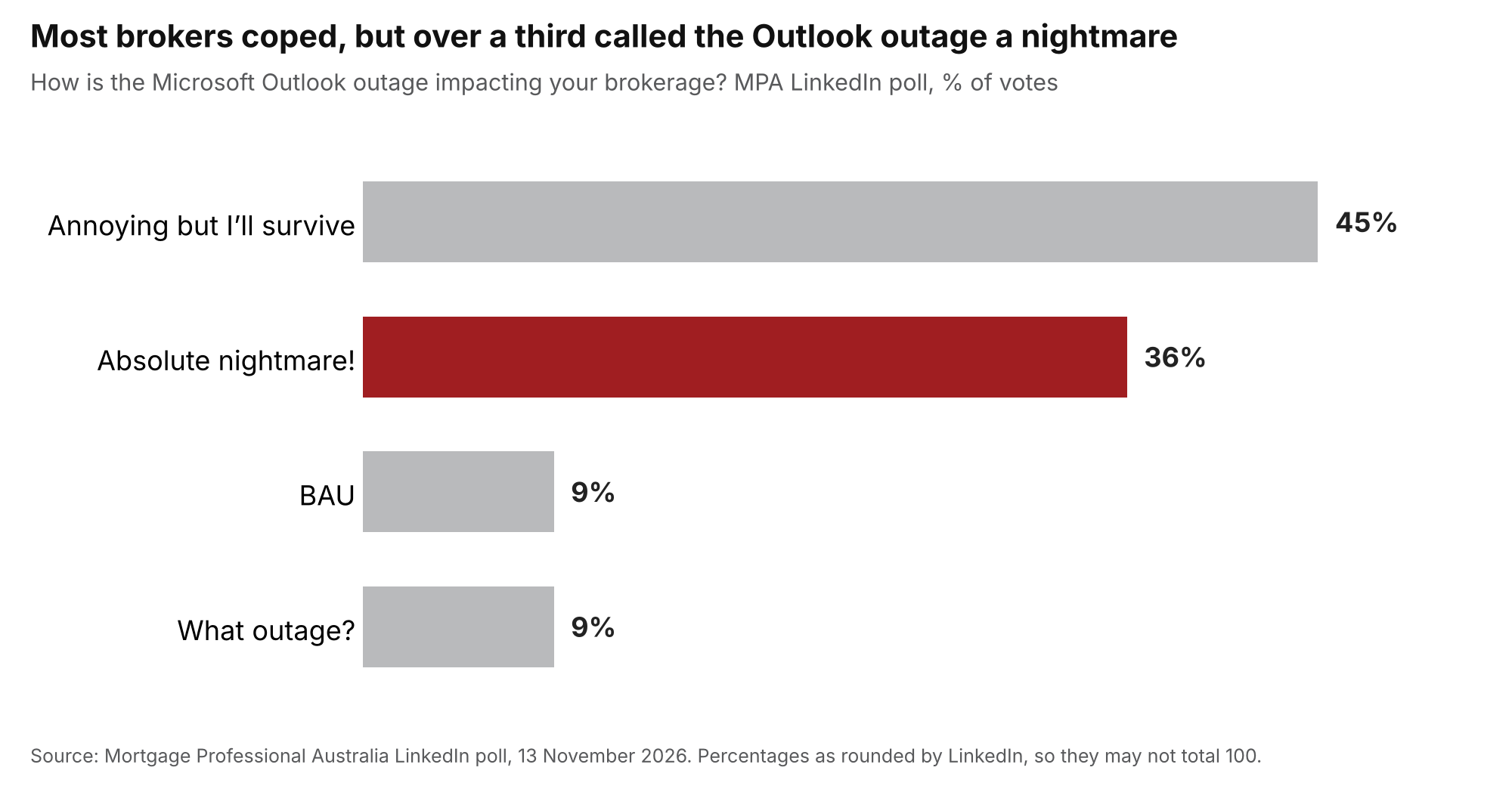
For more than a third of respondents, a morning without email meant a morning the business could not run properly – a telling sign of how much of broking now lives in the inbox.
Why human contact is the broker’s edge
Brokers did not come to write the majority of Australian home loans because they had the slickest software. They got there because clients trust them – and trust is a human thing.
MPA has reported that again and again. In October 2024, Amanda Young, a former banker turned Loan Market broker on Sydney’s Northern Beaches, put it simply: “People bank with people – they don’t bank with banks.” She put the channel’s dominance – then nearly three in every four home loans at the time – down to the personal connections mortgage brokers offer their clients, and the loyalty those connections build.
When AMP Bank unveiled its new broker lodgement platform in July 2025, MPA asked whether all that automation risked eroding the human touch. Paul Herbert, AMP Bank’s head of lending and everyday banking distribution in Sydney, was clear: “There’s a human involved in the decision making. There’s a human involved in the communication with customers.”
In the same piece, Stephanie Coleman, operations manager at Sydney brokerage Unconditional Finance, warned that closed call lines and reduced access to live support at Commonwealth Bank (CBA) had slowed deals that “could have been quickly addressed with a real person”. Her conclusion is worth repeating: “Without the human layer, we risk turning a relationship business into a transactional one.”
Even the lenders building the technology say the same thing. CommBank told MPA last year that its approach to AI and automation was designed to enhance broker human connections rather than replace them.
The uncomfortable irony of Friday is that Copilot, Microsoft’s artificial intelligence (AI) assistant, went down with everything else. The tool sold to us as the future of productivity could not help anyone while the platform underneath it was failing.
The industry is moving fast in that direction. Lenders are channelling support through portals and chatbots, and Commonwealth Bank reportedly cut 45 roles in July 2025 specifically to replace them with AI – a move that drew broker concerns over AI as Commonwealth Bank wielded the axe.
Of course, used well, AI clears admin and frees brokers to do the part of the job that actually earns trust. But Friday showed what happens when every channel runs through one pipe.
MPA’s sister publication InsuranceBusiness noted that a continuity plan moving staff from Outlook to Teams offered no backup when both sat on the same Microsoft infrastructure, and that some workers were locked out of unrelated apps because their two-factor codes arrived by email.
Then came the scammers. Banks moved quickly to warn customers that fraudsters would exploit the outage, with ING telling customers to expect fake “tech support” approaches, InsuranceBusiness reported. For brokers, the risk is sharpest around settlement, when clients are waiting on messages about large transfers and a convincing email about changed bank details can cost them their deposit.
Why the phone call matters more than ever
This is where the oldest tool in the kit becomes the most valuable. A phone call cannot be spoofed as easily as an email from a lookalike address. A familiar voice confirming a settlement date or bank details is a security control as much as a courtesy.
It is also the thing clients remember. Nobody recalls the automated status update that landed on the morning of their settlement. They remember the broker who rang to say it was done.
So here is a suggestion for every mortgage broker reading this: before the next outage – and there will be one – make sure you hold a current phone number for every active client, every BDM and every referral partner, stored somewhere that does not depend on your inbox.
Ring clients with settlements due in the coming days rather than emailing them. Tell them plainly that you will never change bank details by email, and that any message claiming otherwise should be checked by calling you.
And do not wait for a crisis to make the call. The brokers who built this channel did it with shoe leather, a landline and, in Meloni’s case, a car phone on a spiral cord. Rakhit recalls branch managers who knew every customer by name; today that trust sits with the broker – across the kitchen table or on the phone. The technology has changed beyond recognition, but the thing that wins and keeps a client has not.