From typewriters and car phones to a fully online, broker-only model, Bankwest's broking story runs deeper than most

LONG BEFORE broker-first was a marketing line any bank could claim, Marco Meloni was delivering commission cheques to brokers in person, because that was simply how the job got done.
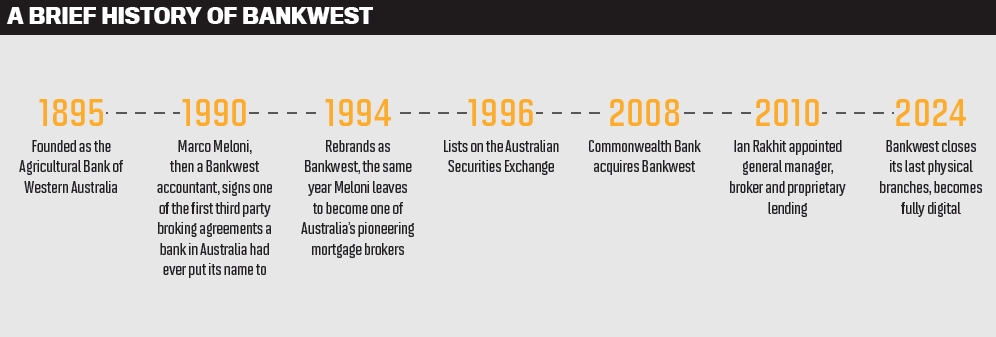
As a Bankwest accountant in the early 1990s, Meloni signed one of the first third-party broking agreements a bank in Australia had ever put its name to – a moment that became an entirely different way of working.
"Home lending looked very different back when I signed the first loan for brokers partnering with Bankwest," he tells MPA. "It's an industry that has undergone significant growth and change."
To understand quite how different, Meloni sets the scene: loans were handwritten on just two pages (front and back) and faxed to the bank; payslips were handwritten with many customers paid cash in envelopes; communication was done via pagers and pay phones while you were on the go. "I even had a car phone, which was a far cry from Apple CarPlay – a clunky device with a spiral cord attached to the car."
Broker remuneration, in those days, also bore little resemblance to today's tiered, performance-linked models. It was a one-size-fits-all approach, with brokers securing the same amount regardless of the loan size – a flat structure that held until trail commission was introduced, which, in Meloni's telling, gave the whole industry room to grow.
Pioneering the WA model
Before that shift, broking in Australia had largely meant commercial lending – residential mortgages were still a bank's own domain. Meloni credits Bankwest's home state directly with changing that.
"I do believe that the growth in residential broker deals was pioneered in WA, based on the Bankwest model," he says. It's a claim with real weight behind it: Bankwest built its home loan business almost entirely on broker relationships decades before the rest of the industry caught up, a head start that shaped the bank's identity as much as it shaped the channel itself.
That relationship ran deep enough that Meloni struggled to leave it behind when he switched to the other side of the desk.
"The strength of the relationship between broker and bank was strong personally – so much so that it was hard for me to work out which brokerage to work for when I decided to leave the bank," he recalls, having spent most of his mortgage career in broking since (indeed, CHL Home Loans, formerly Choice Home Loans Leederville, is still going strong).
What Meloni has taken from that experience is a clear sense of which lenders actually back the broker relationship with substance. "Banks that have been successful in the broker channel have prioritised those relationships and enabled brokers with dedicated support," he says. "This is something I have seen Bankwest continue to invest in, and they have earned strong regard for their BDMs and tech support for brokers."
"Banks that have been successful in the broker channel have prioritised those relationships and enabled brokers with dedicated support" – Marco Meloni, Bankwest
From paper files to portals
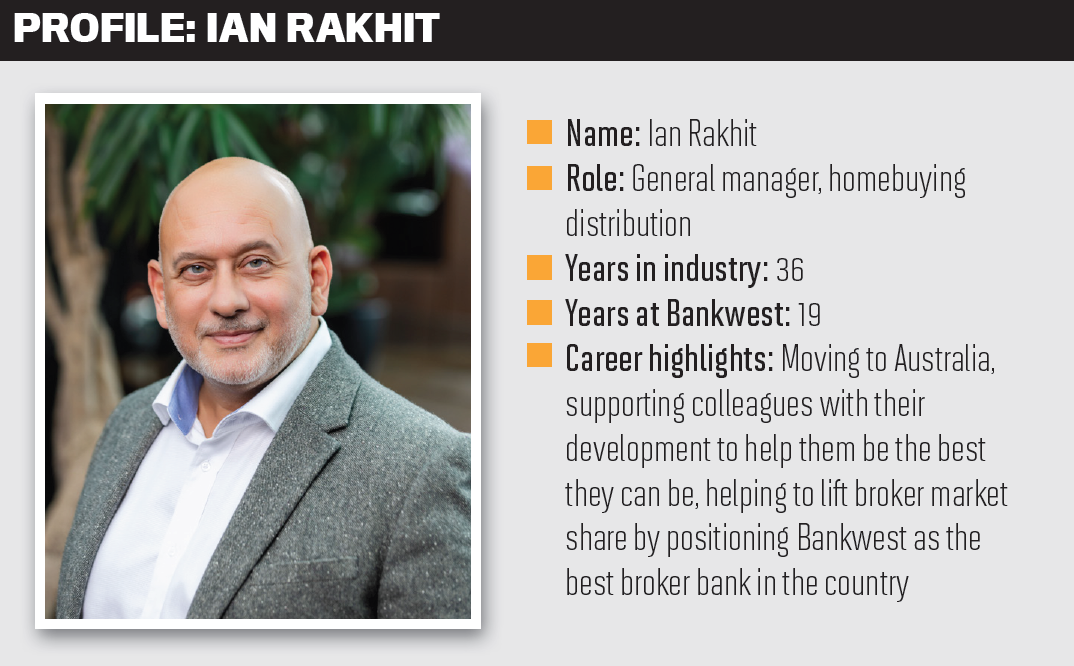
Ian Rakhit, Bankwest's general manager of home buying distribution, describes the earliest days of the channel in similar terms – manual, paper-heavy, and entirely dependent on personal relationships forged face to face.
"There were no Bankwest BDMs, and brokers would communicate with banks in person at their local branch," Rakhit explains. "Brokers would bring their client's paper file into the branch to discuss the application."
That manual, in-person world has given way to something almost unrecognisable and at Bankwest, "that same journey has evolved dramatically, from those paper-based processes to today's digital lodgement, meaning faster decisioning and far greater transparency for brokers".
Read more: Bankwest wants 11% of the broker market - here's how it aims to get there
Rakhit points to the bank's Broker Portal – giving real-time visibility, secure document sharing and simplified application management – as the clearest expression of that shift, and credits one particular event for accelerating it.
"A major disruption to customer behaviours and expectations around digital adoption was triggered by COVID," Rakhit says. "The reduction of face-to-face activity raised expectations around digital solutions in customer service broadly, not just banking."
Crucially, though, he doesn't see that as a retreat from relationships. "As the country recovered from the lockdowns... relationships remained central to delivering home lending value, and I think Bankwest and brokers have been aligned on a shared focus for genuine human support."
Built on trust
The alignment with brokers has become existential for Bankwest in a way it hasn't for most lenders. Having closed its last physical branches in 2024 to become fully digital, Bankwest now relies on brokers for the overwhelming majority of its home lending.
"Around 95% of our home lending now comes through the broker channel," Rakhit notes. "That highlights just how central brokers have become in helping customers navigate their options and make confident decisions."
Read more: Pepper Money, Bankwest clinch repeat wins at MFAA National Excellence Awards
Regulation, in Rakhit's account, has only reinforced that focus. He credits reforms from the National Consumer Credit Protection Act through to best interests duty with creating "a more consistent, transparent and equitable lending environment for all Australians".
Look how far we've come
Looking back, Rakhit paints a picture of an industry almost unrecognisable from today's. Valuations meant a Bankwest colleague physically driving out to measure a house in person – "two-storey houses and those with more customised plans were extra complex".
Loan files sat in filing cabinets rather than on a portal, settlement cheques were typed by hand and title deeds were handwritten on parchment paper. Even a single typo carried real consequences: get to the end of a document and make a mistake, and the whole thing had to be retyped from the top.
Banking itself was a more formal, perhaps more personal, affair. "Customers would dress up to visit their branch to apply for a loan, and branch managers were often pillars of their local communities, knowing their customers by name," Rakhit says.
"Buying a home remains one of the biggest financial decisions people make. Customers value trusted advice, strong relationships and someone to help them navigate the process" – Ian Rakhit, Bankwest
But that relationship hasn't disappeared so much as changed address.
Where a branch manager once knew every customer by name, that same sense of trust and personal investment now sits with the broker, across the kitchen table or on the phone, walking a client through the biggest financial decision of their life.
The formality may be gone – nobody's dressing up for a video call with their broker – but the instinct behind it hasn't. If anything, brokers have taken that old-school relationship and stretched it further than a branch manager ever could, following clients across suburbs, lenders and life stages, rather than staying fixed to one building on the corner.
And as technology continues to revolutionise how a deal is done, Rakhit remains certain the fundamentals won't change. "Buying a home remains one of the biggest financial decisions people make," he says. "Customers value trusted advice, strong relationships and someone to help them navigate the process."
As for Meloni, this year brought a fitting full-circle moment. Having left Bankwest in 1994 to become one of Australia's pioneering mortgage brokers, he was inducted into the Bankwest Hall of Fame 32 years later, in recognition of his contribution to the industry.
"I'm really proud at how far we've come and the resilience that has grown out of years of significant change," he says.