Major banks have cut almost half their branches since 2017; mortgage brokers are welcoming neglected borrowers with open arms

Jaime Savory (pictured) has borne witness to the steady exodus of major banks from regional Victoria over the years.
As founder of Bairnsdale-based brokerage Gippsland Finance Solutions (GFS), she has watched bank branch closures thin out banking services across the region.
The sharpest drop-off came after COVID-19, and even many of the surviving branches no longer have a lender on site.
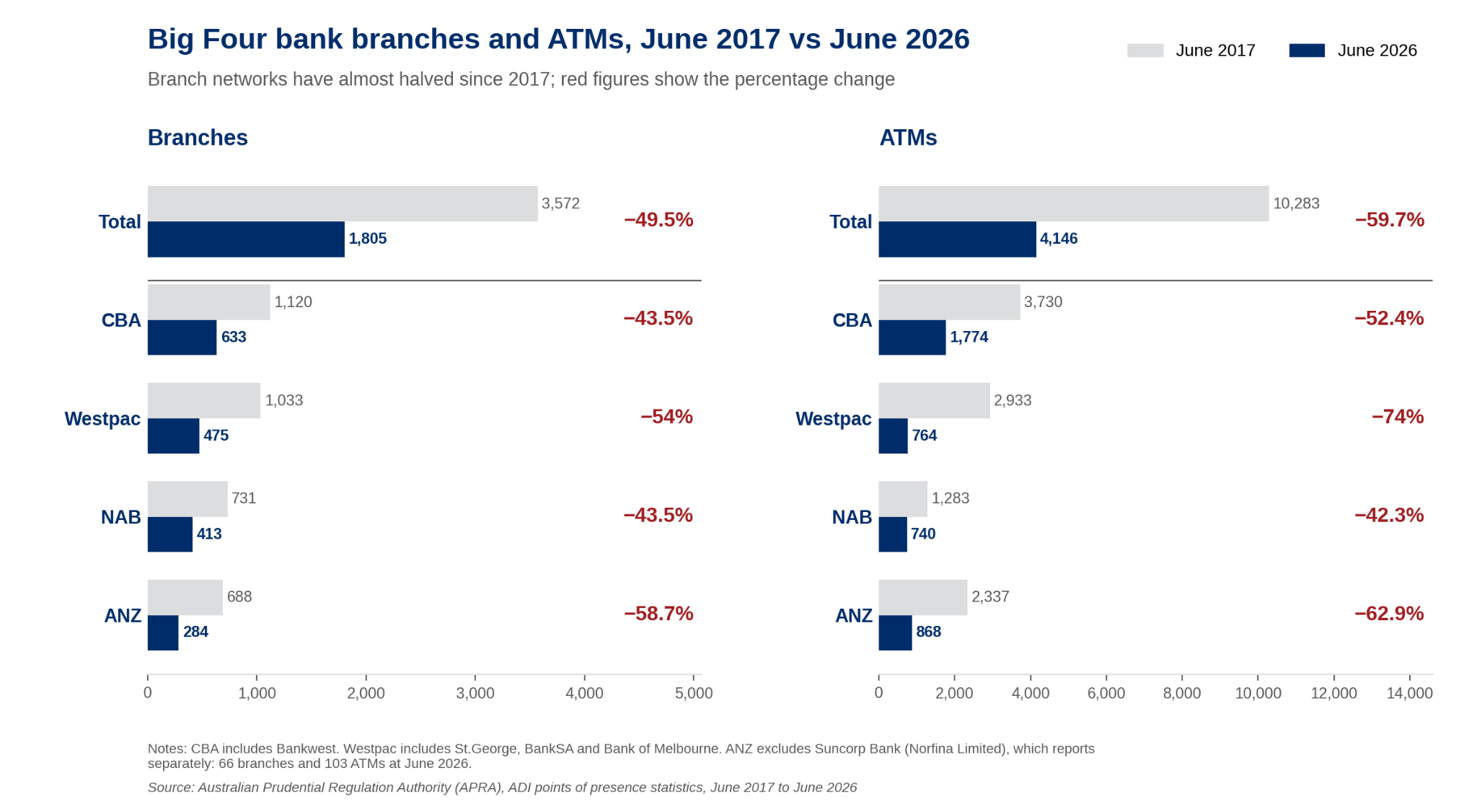
New data from the Australian Prudential Regulation Authority (APRA) confirms what Savory has seen on the ground. Australia’s biggest banks have shed almost half their branches since 2017.
And as they continue to retreat, mortgage brokers are picking up the slack with open arms.
The big branch wind-down
The latest figures from APRA show how much ground brokers like Savory are covering.
According to APRA’s authorised deposit-taking institutions points of presence statistics for June 2026, the five biggest banks – ANZ, Commonwealth Bank, NAB, Westpac and Macquarie Bank – banks ran 1,805 branches at 30 June 2026.
In June 2017 they ran 3,575 branches, so the network has shrunk by 1,770 branches, or 49.5%, in nine years. Their ATM fleets fell further, from 10,283 machines to 4,146, a drop of 59.7%.
The headline numbers don’t actually tell the whole story, because a branch that stays open is not necessarily a branch that still writes loans.
“Even where those banks, like the major banks, are still open, they’re not staffed like they used to be,” Savory told MPA. “So even though there might be a local branch in a major town, it doesn’t have a branch lender in it.”
Read more: Gippsland Finance Solutions is stepping up for regional Australia
Of the four major banks with branches in Savory’s area, two have no branch lender on site. “So yes, the branch may still be open, but how many staff are actually sitting in that branch would be the interesting data.”
For many regional borrowers, the alternative to a lender behind the counter is a video call, and that is where brokers are picking up business.
“Regionally there’s a lot of video conferencing and some regional people just don’t want to do that,” Savory said. “So that then becomes another opportunity for us where our volumes are increasing because people still do want to see people face-to-face.”
Branch closures and the rise of the broker channel
The national data shows the same pattern playing out in regional Victoria. In June 2018, Australia had 5,485 bank branches across all lenders, and brokers wrote 53.9% of new residential home loans.
By June 2026, branches had fallen to 3,108, while broker market share hit a new record of 81.6%, according to quarterly data from Cotality commissioned by the Mortgage & Finance Association of Australia (MFAA). Brokers settled $139.08 billion in new home lending in the June 2026 quarter alone.
“When more than eight in ten new home loans are being facilitated by brokers, it shows the trust consumers are placing in the channel and the value they see in having expert guidance through an increasingly complex lending market,” MFAA chief executive Anja Pannek said.
Bank by bank
ANZ
ANZ’s own figures understate the size of its network. Suncorp Bank, which ANZ acquired on 31 July 2024, still reports to APRA separately under its legal name, Norfina Limited. In the year to June 2026, ANZ held its standalone network steady at 284 branches and cut one ATM, leaving 868. Norfina closed four branches, leaving 66, and removed five ATMs, leaving 103. Together, the ANZ group ran 350 branches and 971 ATMs.
Since 2017, ANZ alone has closed 404 branches, a 58.7% fall and the steepest proportional decline of the majors. Over the same period it removed 1,469 ATMs, down 62.9%. With Suncorp’s 2017 network included, the group’s branch count has fallen by 462, or 56.9%.
CBA
Bankwest has been a division of CBA since 2008 and does not appear separately in the APRA data, so its closures show up in CBA’s numbers. CBA has closed 487 branches since 2017 (down 43.5%) and removed 1,956 ATMs (down 52.4%). In the latest year it cut 14 branches, leaving 633, and 45 ATMs, leaving 1,774.
CBA’s sharpest recent drop came in the year to June 2025. Branches fell by 49 that year, and 33 of those closures were in Western Australia. ATMs fell by 97, including 54 in Western Australia.
That timing matches Bankwest’s move to digital-only banking: the brand said it would close 45 branches by October 2024 and convert 15 regional sites into CommBank branches. Bankwest had been cutting branches and trading hours for some time before that, prompting the Finance Sector Union’s warning that branch closures had reached crisis proportions.
Westpac
Westpac’s figures include St.George, BankSA and Bank of Melbourne, which have operated under a single Westpac authorised deposit-taking institution (ADI) since March 2010.
Westpac has closed 558 branches since 2017, a fall of 54%. That includes 167 closures in the year to June 2023, the largest single-year cut by any major in the series. Its ATM fleet fell 74%, from 2,933 to 764, the steepest decline of the four big banks. In the latest year Westpac closed 17 branches, more than any other Big Five bank, and removed 14 ATMs.
NAB
NAB has closed 318 branches (down 43.5%) and removed 543 ATMs (down 42.3%) since 2017. That is the smallest proportional ATM decline of the four big banks. NAB was also the only major bank to grow its ATM fleet in the latest year, adding 21 machines for a total of 740, although it closed four branches, leaving 413.
Macquarie
Macquarie never built a branch network. It reported three branches until June 2023, none from June 2024, and no ATMs at any point in the series. Instead, it relies on the broker channel, which delivers more than 95% of its new home loan originations, according to the same MPA report.
Branch closures slow in 2026
The Big Five closed just 35 branches in the year to June 2026, a fall of 1.9%. Nationally, across all lenders, 97 branches closed, and most were in cities: branches in major cities fell by 72, while regional and remote areas lost 25.
That matches what Savory has seen on the ground. Regional branch numbers dropped off sharply after COVID-19, she said, but GFS has not seen any recent closures in its area.
“It’s obviously eased off now just due to legislation, but a lot of them had already closed prior to that,” she said.
The pause stems from an agreement announced by the federal government in February 2025. Under it, CBA, NAB, Westpac and ANZ committed to no regional branch closures before 31 July 2027. The government said 36% of regional bank branches had closed since 2017.
That moratorium now has less than a year to run. Branches in regional and remote areas have already fallen from 2,335 in 2017 to 1,434, a drop of 38.6%. If the banks resume regional closures after July 2027, brokers in towns like Lakes Entrance will again be the ones fielding the calls.