Shareholders can now pursue their Zillow Offers claims as a class, days after a federal judge let agents' Zillow Home Loans steering claims move ahead

Zillow's mortgage business is growing fast. So is the pile of lawsuits around it.
On Monday, the US Supreme Court declined to hear Zillow's appeal in a 2021 shareholder suit over Zillow Offers, the home-flipping unit it shut down that year. The order was handed down less than a week after a federal judge in Seattle allowed a separate class action to proceed. That case accuses Zillow of pressuring real estate agents to send their buyers to Zillow Home Loans.
The two cases have different plaintiffs and different legal theories. Both trace back to Zillow's push into lending.
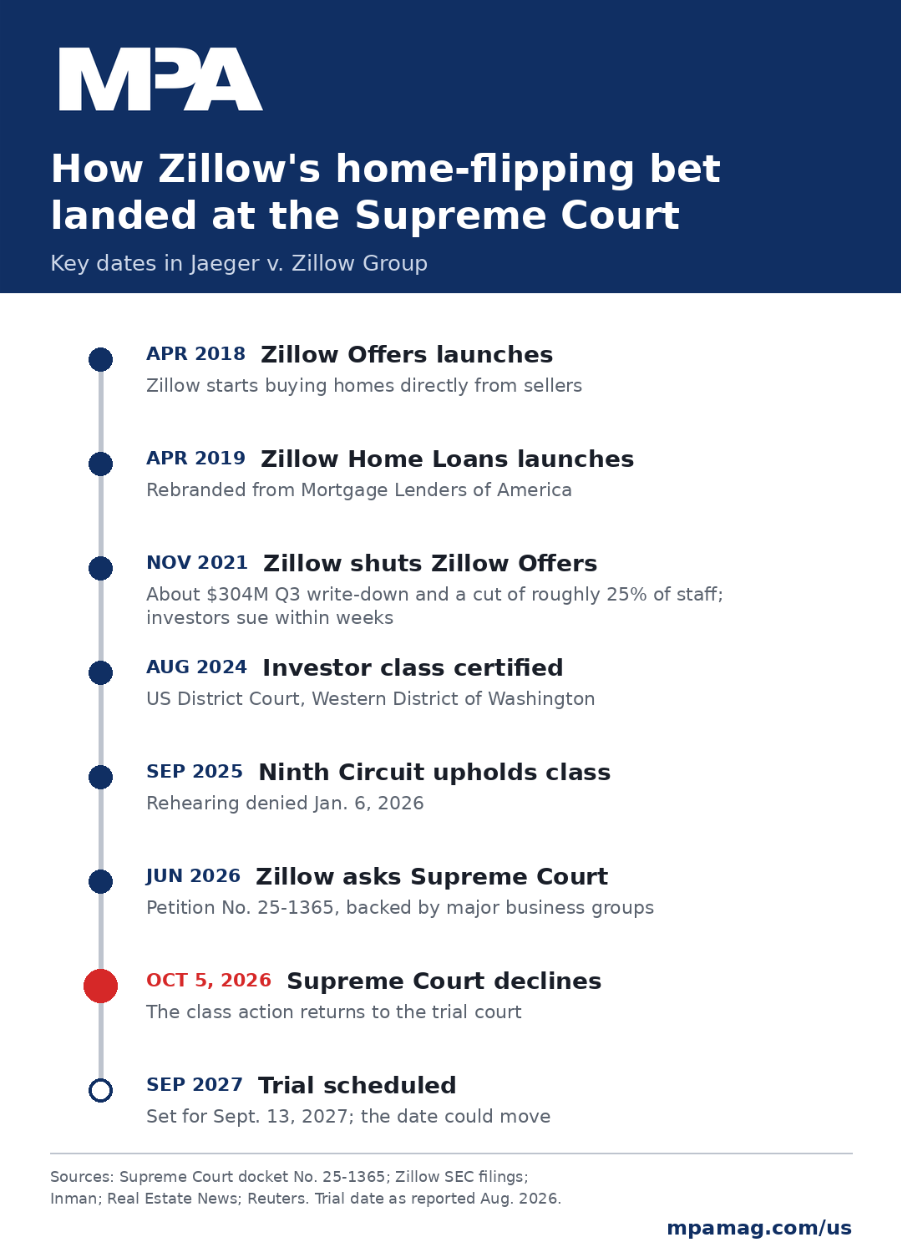
Zillow filed its petition on June 5, according to the Supreme Court docket for Zillow Group v. Jaeger. The investors' lawyers first waived their right to respond, but the court asked for a reply anyway, a sign at least one justice wanted a closer look. The justices took the case up at their Sept. 28 private conference and turned it down without comment, which is routine. A denial doesn't decide who is right. It leaves the lower courts' rulings in place, so shareholders who owned or bought Zillow stock during a roughly three-month window in 2021 can press their claims together as a certified class.
Read next: What the Zillow-Redfin settlement means for the rental market
A bet built with mortgages in mind
Zillow began buying homes directly from sellers in 2018 and quickly moved to finance the other side of those deals. It bought Kansas-based Mortgage Lenders of America that year and rebranded it when it launched Zillow Home Loans in 2019, pitching the lender as a faster way to close Zillow Offers transactions.
In November 2021, Zillow pulled the plug after concluding its pricing models could not reliably forecast home values. It had written down about $304 million of home inventory in the third quarter and planned to cut roughly a quarter of its staff. Rich Barton, then the chief executive, said the program had "served only a small portion of our customers."
Read next: A $2.6M mystery on his mortgage - now two servicers face a federal suit
Shareholders sued within weeks. The lead plaintiff, Jeremy Jaeger, is represented by the Seattle firm Hagens Berman. He says executives talked up the unit while staying quiet about how badly Zillow was struggling to price homes. Zillow denies wrongdoing. Its lawyers have argued that the company disclosed the risks of a new business that simply didn't pan out.
What the appeal was about
Securities lawyers call cases like this one price-maintenance suits. The investors don't say Zillow's statements drove the stock up. They say the statements held the price steady until the bad news came out, and the shares then fell.
Zillow asked the justices to decide how closely a company's later disclosure must match its earlier upbeat statements before a judge can certify an investor class. It leaned on the court's 2021 decision in Goldman Sachs v. Arkansas Teacher Retirement System, which cautioned judges against relying on vague, generic statements at that stage.
Appeals courts have split on the question. The Second Circuit applies a strict matching test, while the Third and Ninth Circuits require only that the statements cover the same general subject, Real Estate News reported. US District Judge Thomas S. Zilly certified the class in August 2024. The Ninth Circuit upheld that decision in September 2025 and refused to rehear it in January.
Zillow had heavyweight backing. In July, the US Chamber of Commerce, the Securities Industry and Financial Markets Association, the Washington Legal Foundation and Business Roundtable filed a joint brief urging the justices to step in. Two former SEC officials joined law professors on another brief. A third came from the Manhattan Institute and lawyers at Torridon Law, among them former Attorney General William Barr. The groups argued that a loose standard would let investors certify classes far more easily whenever an ambitious project fails.
Read next: How AI is helping solo brokers compete with big bank retail arms
The steering cases brokers should watch
For mortgage professionals, the Zillow litigation that matters most may not be the investor case at all.
In January, Stephanie Dupuis, an agent in Kitsap County, Wash., sued on behalf of agents in Zillow's Preferred and Flex programs. She says Zillow graded agents on how many buyers they got preapproved with Zillow Home Loans, and that low scorers got fewer referrals or were dropped.
On Sept. 28, US District Judge James L. Robart refused to throw out the case. He found the plaintiffs had plausibly alleged that agents "have no choice but to participate in Zillow's referral ecosystem." His ruling lets antitrust, consumer-protection and unjust-enrichment claims proceed, and it cites allegations that Zillow takes referral fees of 35% to 40% and commands about 60% of the audience for home search. Plaintiffs from Maryland and Oregon have joined the case.
The ruling doesn't mean Zillow broke the law. At this stage a judge asks only whether the claims are plausible, and the plaintiffs face a higher bar as the case moves forward. Zillow says buyers always choose their own agent and lender, that its preapprovals are free and non-binding, and that it will keep fighting.
A consumer suit that alleges the same kind of steering under the Real Estate Settlement Procedures Act was thrown out in July. Plaintiffs' lawyers revived it with a new complaint in August, and Zillow has since asked Robart to dismiss it for good so it can't be refiled.
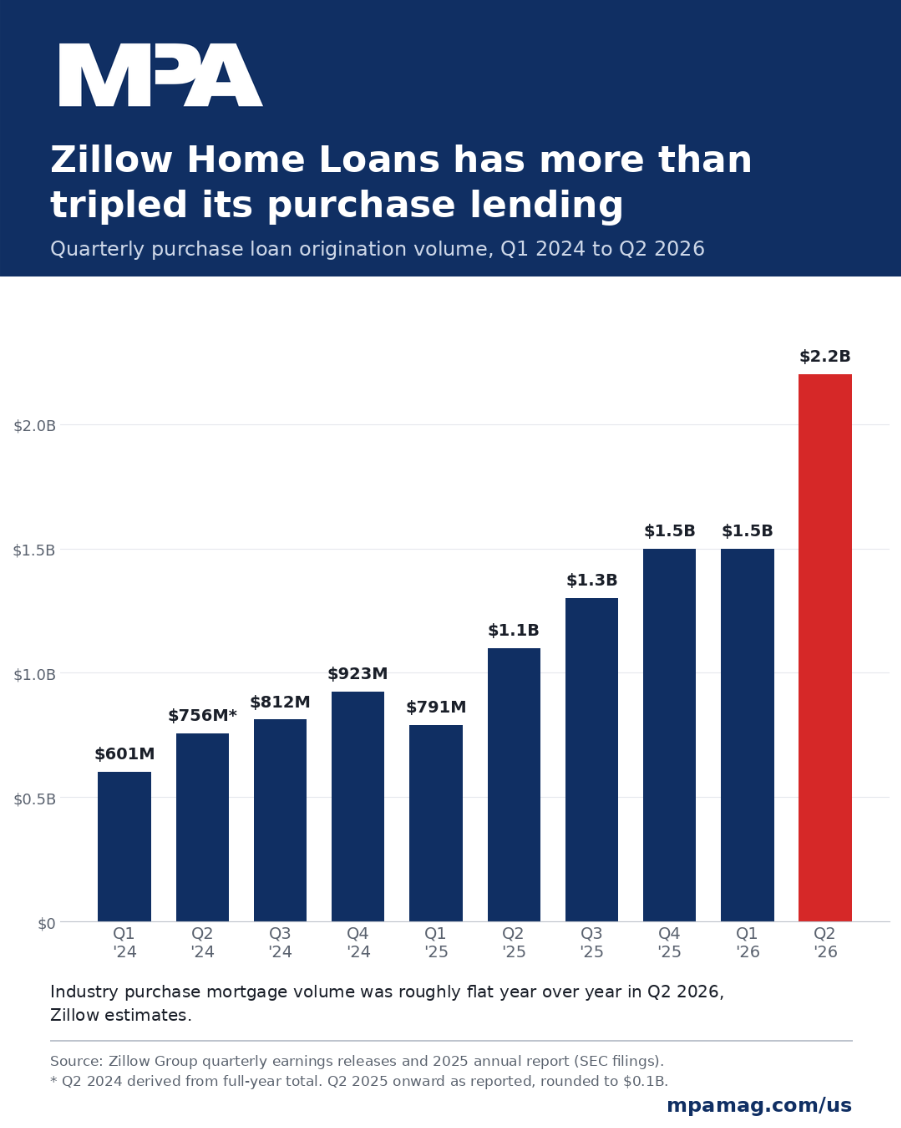
The stakes are rising along with Zillow's volume. Its purchase loan originations rose 95% to $2.2 billion in the second quarter of 2026, lifting mortgages revenue 75% to $84 million, while Zillow estimated that industry purchase volume was roughly flat. The company now calls Zillow Home Loans a top-25 purchase lender.
What comes next
The investor case heads back toward a trial thatis set for Sept. 13, 2027. Zillow faces more securities exposure, too. Its latest quarterly report discloses a separate investor class action filed in June 2026. In August, it settled federal antitrust claims over its rental-listings deal with Redfin.
Investors are already wary. Zillow's Class A shares had fallen about 62% over the 52 weeks to late September, and the company is expected to report third-quarter results around Oct. 29.
The Supreme Court's refusal also leaves the circuit split unresolved. In the Ninth Circuit, which covers much of the West, and in the Third Circuit, upbeat talk about a new product on an earnings call can still be cited to support an investor class if that product later disappoints. Listed lenders and servicers pitching new technology or loan products to Wall Street may want their lawyers to note that.
Zillow's own history shows how quickly an algorithm can misjudge the housing market. Flippers are learning a similar lesson as home-flipping profits keep sliding.
Read next: NAMB's new president says brokers must be 'debt managers' too