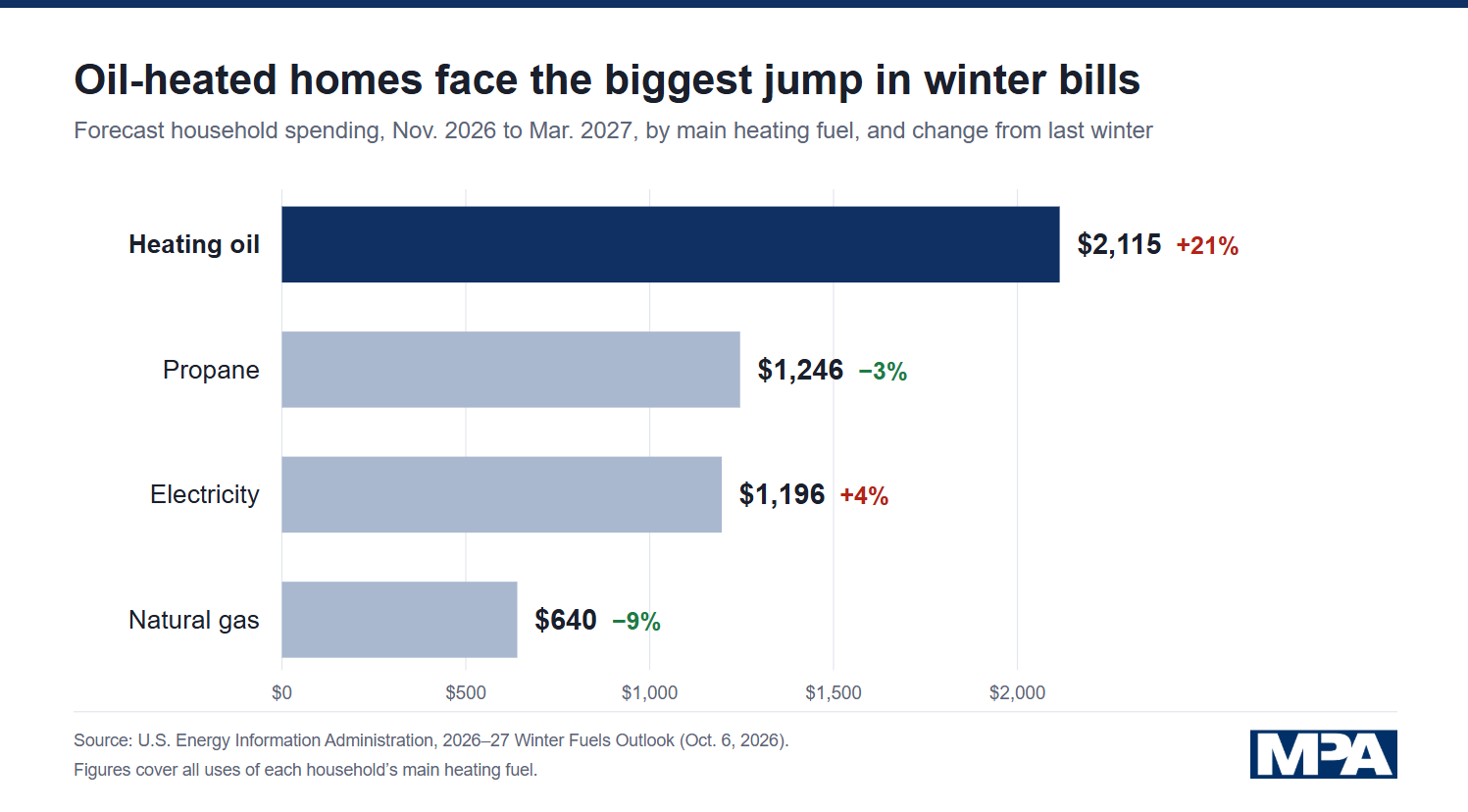
Homes that heat with oil face an average bill of $2,115 this winter, up 21%, and most of those homes are in the Northeast.

For the roughly 4.1 million U.S. households that heat with oil, this winter is shaping up to be an expensive one.
The U.S. Energy Information Administration expects heating oil to average $5.26 a gallon from November through March, 34% more than last winter, according to its 2026–27 Winter Fuels Outlook, published Oct. 6. The agency expects a milder Northeast winter to cut use to about 402 gallons per household, down 9%, FinChannel reported. That won't come close to offsetting the higher price.
The average oil-heated home is on track to spend $2,115 this season, about 21% more than last year. That is the largest increase among the four main heating fuels the agency tracks.
Read next: Hidden costs can spike homeownership burden by more than $21,000: report
Tight diesel supplies push prices up
Heating oil and diesel are, for practical purposes, the same fuel, so the supply problems hitting truckers hit homeowners as well. According to the EIA, global distillate production has fallen as refineries cut back, lifting international prices. That made imports pricier and pulled more American fuel overseas: U.S. distillate exports rose 20% in the first seven months of 2026, much of it bound for Europe. The result is thin inventories at home, which the agency expects to run about 11% below the five-year average this quarter.
EIA Administrator Tristan Abbey said oil-heat households “face higher prices because distillate markets remain tight,” Oklahoma Energy Today reported. Refinery outages in Russia and the Middle East and a pullback in Chinese fuel exports have added to the strain, and some analysts believe prices could stay elevated into 2027, according to CNBC.
Crude oil is the bigger factor. Disruptions to oil flows through the Strait of Hormuz have kept crude expensive for much of the year. The EIA now projects Brent will average $105 a barrel in the fourth quarter, $14 more than it forecast a month earlier, Yahoo Finance reported. The agency expects Brent to fall to about $84 in 2027, according to FinChannel.
Weather adds more uncertainty. Forecasters expect an El Niño pattern this winter, and the EIA warns it could produce large temperature swings away from its baseline forecast. A colder January than expected would raise both fuel use and bills. The agency's next monthly update is due Nov. 10.
Read next: Treasury yields breach 21-year high
Gas and propane homes catch a break
Not every household faces a bigger bill. Homes heated with natural gas should pay less this winter, and propane users should see a small decline. Homes with electric heat face a modest increase.
|
Primary heating fuel |
Forecast winter spend (Nov–Mar) |
Change vs. last winter |
|
Heating oil |
$2,115 |
+21% |
|
Propane |
$1,246 |
−3% |
|
Electricity |
$1,196 |
+4% |
|
Natural gas |
$640 |
−9% |
Source: EIA 2026–27 Winter Fuels Outlook, as reported by CNBC.
The EIA figures cover everything a household uses its main fuel for, not only space heating, so the electricity number includes more than the cost of heat, FinChannel noted.
The Northeast pays most of the cost
Only about 3% of U.S. homes heat with oil, but the fuel is common in the Northeast. About 3.4 million of the 4.1 million oil-heated households are in that region, roughly 82% of the total, according to federal data cited by CNBC.
Retail prices in the region are already far above last year's. Massachusetts' weekly dealer survey put the average retail price at $6.12 a gallon on Oct. 5, up from $3.53 a year earlier, an increase of nearly three-quarters. In Maine, the state Department of Energy Resources found a statewide average of $5.96 in its Sept. 28 survey, roughly 79% above the $3.33 it recorded in late September last year.
The National Energy Assistance Directors Association, which represents the state officials who run federal heating aid, projects a larger increase than the EIA does. Its late-September estimate has the average oil-heated home spending about $2,627 this winter versus $1,749 last year, a rise of roughly 50%, Money Talks News reported. Its estimate has risen quickly. In July, the group was projecting around $1,700, and by mid-September it was closer to $2,300.
Prices also vary widely from one dealer to the next. In the Massachusetts survey, the cheapest tenth of dealers charged $5.69 a gallon or less, while the priciest tenth charged $6.61 or more. That 92-cent spread adds up to about $140 on a typical 150-gallon delivery. “Shopping around does pay off,” NEADA executive director Mark Wolfe told CNBC.
Read next: These states are making homeownership nearly impossible in 2026
What it means for borrowers
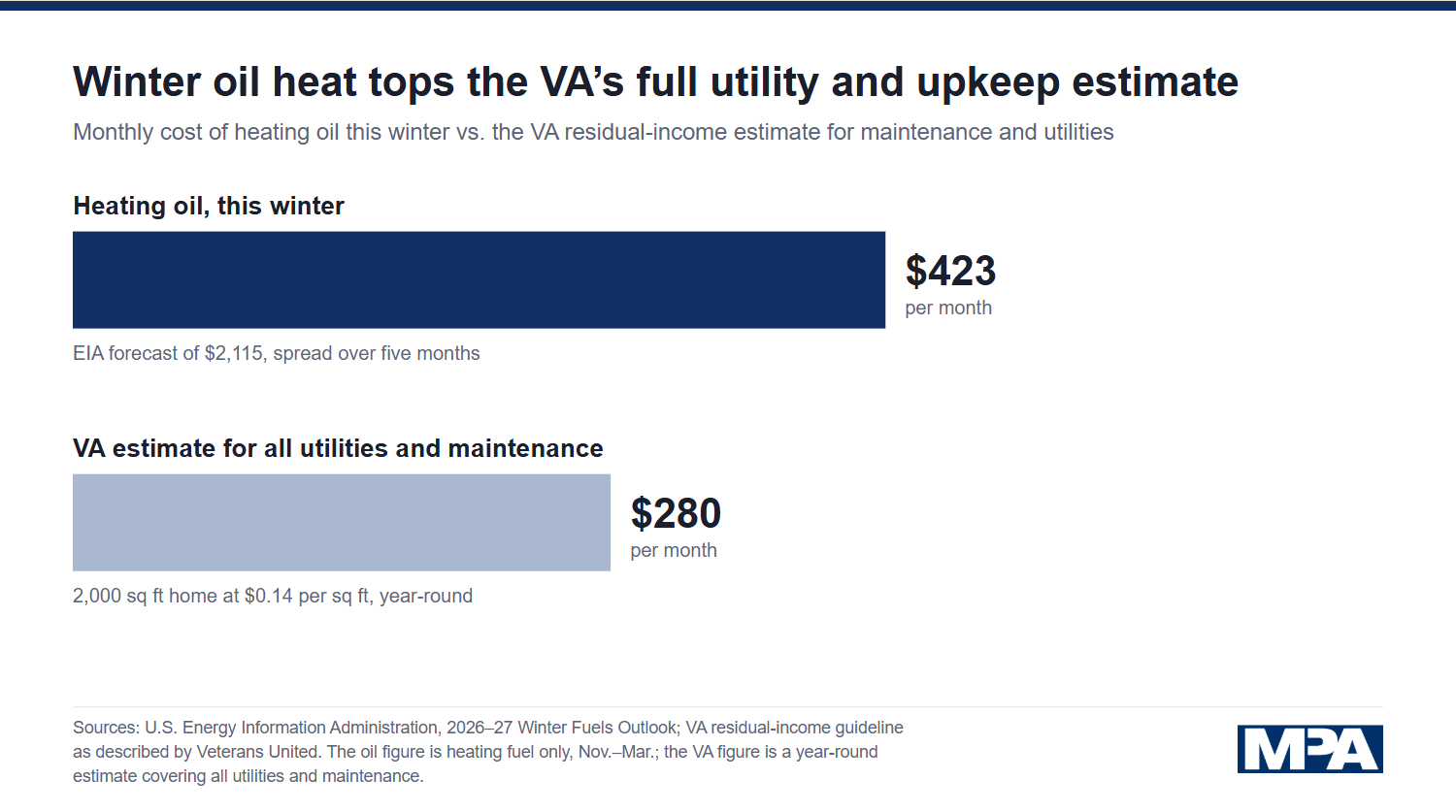
A heating bill never shows up on a loan estimate, and standard debt-to-income calculations leave utilities out entirely. But it comes out of the same paycheck as the mortgage. Spread across the five-month season, the EIA's $2,115 forecast works out to about $423 a month for heat alone.
One of the few underwriting tests that budgets for utilities at all is the VA's residual-income check, which uses a flat estimate of $0.14 per square foot for maintenance and utilities combined, according to Veterans United. On a 2,000-square-foot home, that's about $280 a month, year-round, regardless of fuel type. For an oil-heated house in January, the real number could be well above that.
Heating costs add to other ownership expenses that have climbed in recent years. An Insurify analysis put hidden homeownership costs at more than $21,000 a year, with utilities among the largest items, and the share of owners who are cost-burdened has reached a decade high. Homeowners have also absorbed steep insurance increases. For a household already near its limit, a 21% rise in fuel spending matters.
Read next: 71% of homeowners say insurance costs are up, and exec warns buyers are being squeezed out
Higher oil prices also feed into mortgage rates. Energy costs have added to inflation worries in the bond market, where the 10-year Treasury yield recently reached its highest level since 2002. With crude near $100 a barrel, a quick drop in mortgage rates looks unlikely, though some economists still see room for relief, as Cotality's Selma Hepp argued in a recent rate outlook.
Federal heating aid faces funding questions
Lower-income households may qualify for the federal Low Income Home Energy Assistance Program, though eligibility rules and benefit levels vary by state. Borrowers can find their local office through energyhelp.us or the National Energy Assistance Referral line at 1-866-674-6327.
Whether the program has enough money this year is an open question. NEADA asked Congress in July for an extra $3 billion to cover the oil price spike, and a group of 19 Senate Democrats and Sen. Bernie Sanders of Vermont recently urged Health and Human Services Secretary Robert F. Kennedy Jr. to seek at least $3 billion on top of the roughly $4 billion already allocated, Common Dreams reported. The administration's fiscal 2027 budget, by contrast, proposed eliminating LIHEAP funding for the sixth time, though lawmakers from both parties have signaled they'll reject the cut, as Congress has in past years.
Any household can cut its use. The Department of Energy's fall and winter energy-saving tips recommend turning the thermostat back for about eight hours a day while asleep or away, which it says can reduce heating and cooling bills by as much as 10% a year. The department also recommends sealing drafts around windows and doors and having heating equipment serviced.