Mortgage brokers discuss how to get deals done in an unpredictable market
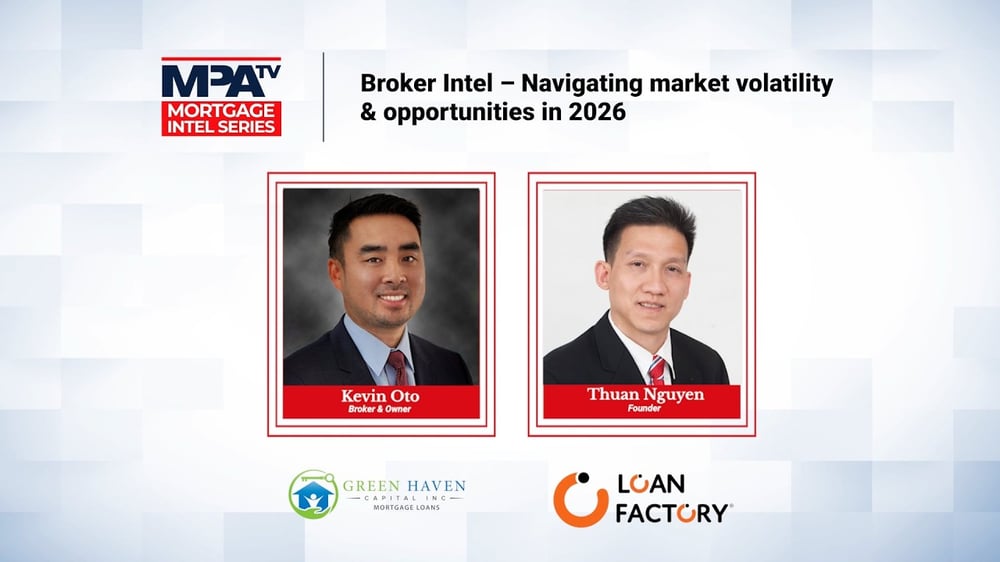
The mortgage market has been unpredictable over the first four months of 2026, with rate volatility, improving home prices, and external pressures from geopolitical conflict. How should brokers navigate these challenges? On this edition of MPA TV, we return to our Broker Intel series and discuss how to navigate a volatile market, build strong relationships with lenders, and keep mortgage costs in check while keeping up with the latest AI technology.
To view full transcript, please click here
Biggest opportunity for loan officers and brokers is just to educate and guide people. Clients, I don't really think they need more data.
Nobody know the future, but I always get ready for anything can happen.
I'm Matt Saxton, mortgage journalist here with Mortgage Professional America.
Today we continue our broker intel series featuring discussions with the top mortgage pros across the US on the most important mortgage topics of the day. I'm honored to be joined by two esteemed guests on today's episode. They are Kevin Oto, broker owner of Green Haven Capital, and Tuan Wyn, founder of Loan Factory. Thank you both for joining us today on MPA TV.
Thanks for having us.
Just always happy to chat with you and get a chance to catch up on what's going on out there. And since the last time we spoke, the mortgage market has been a bit turbulent with rates dropping first into the fives, then moving back into the sixes. We'll start with Kevin on this one. What do you make of the current state of the market as spring gets underway? And where do you see opportunities for success?
Well, I think what we're seeing right now is a good reminder that, you know, rates don't move in a straight line. They react to, you know, all the economic data that we're seeing, inflation expectations, and, you know, the the volatility in the bond market.
So the drop of the fives obviously created a quick surge in demand for refinances, but now we're back in the sixes. It just shows how sensitive the market really is. So from my perspective, I mean, this is natural.
This is what happens. This is a healthy environment. It just forces consumers to really reset expectations and focus on fundamentals rather than trying to time the market, which usually is impossible to do. So I think right now the biggest opportunity for loan officers and brokers is just to educate and guide people that you know there's a lot of information out there and a lot of it's conflicting. So clients I don't really think they need more data. They they really just need clarity. So you know if we could break things down, explain affordability, explain what's happening and and align their their loan with their goals, I think we're going to win in this market. So just focusing on purchase and not trying to focus on you know things that are out of our control.
Juan, what do you think?
Yeah, I would think similar like Kevin the the market uh there's a lot just like the internet just like uh social media there's a lot of misinformation fake news you know a lot of broker loan officer or even news media they spread the wrong information they say rate drop in rate drop in but actually rate going up they want to have more clients so they they say whatever they want to say so Uh but then for loan officer for and broker uh we we need to focus on ourself. We need to uh become better and better. So during this time uh we need to stay focused on become better more competitive. We need to stay ready for the market when it come back so that we can capture more business. So now I hate to tell loan officer I hate when I hear loan officer say oh rate so high time to take vacation you know that is not the right mindset we always have to be ready we have we always have to work hard um for the market to turn around we have to prepare for it this kind of ties into the first question we'll start with Tuan on this one has some of the headwinds that we've seen so far this year and there's been a little bit of volatility out there has it changed your optimism for the rest of the year or do you think that Maybe things will smooth out as the year goes on.
Yeah, actually it uh it changed my uh expectation. I was thinking that you know party on game on you know rate dropped so much uh time to time to capture more business cuz we've been waiting for it and but then the Iran war broke out and rate jump and you know with the experience that I have this is expect this is normal. I expect all of this. I do expect that rate might go all the way up to the seventh or rate might drop to the five again. You know, anything can happen. So, and I I always ready for it. I do be I really don't know the future. Nobody know the future, but I always get ready for anything can happen. Even rate go up to the seven or eight. We have to be ready for it. And I think that if we are prepared, if we stay ready, we can have higher success rate than others. And you know, I always build my company uh for any scenario.
Even when rate drop to let's say 4% 3% I'm always ready uh or if it go up to seven or 8%. That's we are going to be okay with that as well. So we all have to stay ready.
Evan, your thoughts? I'm always optimistic. I always stay optimistic no matter what the market is. So, um I think like I said previously, this is a market where loan officers who are focusing on purchase business and building relationships are the ones that are going to win. You know, refinance volume is never something you could rely on. So, it comes down to how well you're connected with, you know, other agents, how well you prepare your buyers and how consistent you are every day coming to the office, putting in the work, trying to focus on those relationships. But I also seen this you know previously when raid shot up the slower pace also creates a lot of opportunity you know it gave me and it gave others I see as well an opportunity to really step back evaluate your business see where your deals are coming from and when you're losing opportunities and see how we can actually capture more market share so you could improve your marketing you could you know get licensed in other states you could start building relationships you can actually you know focus on other things besides origination that will help build business. Maybe not today, but you can plant those seeds for tomorrow or when, you know, a month or two from now. So, and another big part of us when evaluating our business is, you know, leveraging AI and automation just to become more efficient and in the business in the process. So, there's things that you could do to generate business and also improve your processes. So, you know, you could be out there gaining and making those relationships. So, overall, I'm very optimistic, but I'm passively optimistic, I'd say. Um, but it's really just about being intentional, being disciplined, and you know, having that extra time if there is some to really build your system in your business.
You mentioned relationships ties us into our next question. We're doing monthly focuses on MPA on our website and this month or actually last month we focused on broker lender relationships. What do you think the most important thing is to foster a strong broker lender relationship? And Kevin, what would be your one piece of advice for mortgage brokers on something they can do to strengthen that bond?
Well, for me personally, I think the most thing in a strong relationship with the lenders we work with is transparency and then being proactive on both sides. From the lender side, for me that means being upfront about everything about their pricing, their turn time, their guidelines, and just setting realistic expectations from the beginning. Um it it means to me getting ahead of potential issues by you know doing things like uh you know TBD underwrites or having files re reviewed early so there's like no surprises in the process. And then from the LO side I think that LO has to also be very accountable when it comes to their files and their execution. So sending well structured complete files just makes a huge difference. you know, taking time upfront to fully understand the borrower's financials with whether it be their income, their assets, and any potential red flags and really just addressing those issues before submission just so you have a clean package going over to the lender. And I think when both sides operate that way, deals move faster, communication improves, and it builds trust over time, and you could rely on these lenders and and you know exactly what to expect. So, at the end of the day, I think the best relationships come down where the broker and a lender are aligned. They communicate well and they can deliver just clean, predictable closings and a great experience for our clients. Juan, your thoughts?
Yeah, I think in any relationship, especially business relationship, we require to help each other. We supposed to show uh the benefit so that our partner will love us and want to work with us. So I always try to help the lenders. Show them how they can improve. Show them that they will be beneficial for working with us. In this kind of relationship, the lender the lender need us more than we need them because we have so many lender who can choose from and they need our business. They need uh we to send them loans. So I feel that uh of course they need us but if we show them that beside we send them loans we can give them more benefits like we can help them improve their process their technology we can help them improve their operation they will appreciate us and in return they will give us more benefit. So for example, uh if we help them improve the process that it help us, right? We don't have to suffer. So I always push my lender to be better uh and then uh and give them a lot of advice and they love it. And that's why some of them even give me special treatments. So like special pricing and no EPO, you know, a lot of incentive that they give back to us because they see the relationship. They see the need that they they they make they have to make sure we are happy.
Yeah, it totally makes sense. Let's shift gears a little bit. We're going to talk kind of bigger picture things here. And obviously the Federal Reserve is always on everybody's minds even though rates are probably a more over reported story. So far this year, the Fed has held rates, their first two meetings. They've got another one coming up at the end of April. There have been mixed signals coming from Fed members regarding the near-term path for the central bank. Tuan, we'll start with you on this. What path do you think the Fed should take for the rest of 2026?
I do believe that they will drop the rates and they will drop a lot because that's what Trump want, right? What he want, he will make it happen. And with the Iran war he's under a lot of pressure to the constituent right he want to his party to dominate he want to make sure the consumer happy with him and the formula is simple lower the rate lower the rate and I think it's going to happen later this year after June I I I do believe that rate will drop and we all have should be get ready for it Kevin your thoughts It's hard for me to say, but if I had to pick a side, I'd say there's a more likelihood of a rate cut, but I still think the Fed is in a very complex position right now, and it's more than just inflation versus growth. There's obviously global factors, and there's leadership transition, but we do have a new Fed chair coming in, Kevin War, stepping in that, you know, brings some uncertainty. He's generally been viewed as more favorable to lower rates. But I mean he's walking into a tough situation now where inflation is still not fully under control and we get a lot of mixed data and at the same time we have these geopolitical factors you know like the war in Iran which has already you know driven oil prices up and created inflation concerns you know we've seen oil prices spike significantly over the past few weeks and you know that that's had an impact on our market especially so I think the Fed is in a very difficult spot because they're dealing with uh you know what's essentially a supply driven shock. Um and this is not something that I think a monetary pol policy can like easily easily to fix you know cuz if they cut too quickly they can risk reigniting inflation and if they stay too tight they can risk you know slowing down the economy. So in my opinion I think the right path is still like a datadriven approach. I think the Fed needs to stay patient and see how inflation trends. Although I would love lower rates. I just don't know. There's just too much going on right now.
So, I think the key takeaway for consumers is that even with the new Fed share, even if cuts happen later this year, mortgage rates are still going to be driven more by the bond market and inflation expectations.
Yeah, absolutely. And hopefully hopefully the bond market continues to go down because that's certainly good news for all of us. One final question today. Uh, and this final question is an open-ended one. Kevin, we'll start with you. What is one story in the mortgage space, either local to your market or a nationwide story, that you think the industry isn't talking about enough, but they should be? You know, this is something that I mentioned in one of the previous podcasts we had, but I think, you know, one of the biggest story I don't think the industry is talking about enough is is a combination of the rising origination costs and then the push towards automation and AI. Um, on one side, margins are really getting compressed. Um, credit reports are more expensive, compliance costs are up, VOE's are up, and it's just taking more resources to close a loan today than it did a few years ago. And on the other side, there's this rapid push towards AI to solve all these problems. But in mortgage, I don't think it's really that simple because we have to balance efficiency with compliance, data security, and at the same time, we can't use that personal touch in the process.
So I think um the real opportunity just isn't just adopting technology. It's being able to implement it in a way that reduces friction, improves accuracy, stays compliant, and is still keeping the, you know, client experience strong. So um I think the companies that figured out how to scale efficiently without sacrificing trust and that personal touch are the ones that are going to separate themselves.
Kanan, your thoughts? Yeah, there's a lot of beside AI. We we always talk about the costs, right? Uh and we talk about AI. I think the whole world talk about AI every day. We talk about AI. Uh what I see one thing is the consolidation or expansion of big players. You know, you can see that Rocket have you know purchased Ma Cooper. They purchase uh uh red pin. They have a complete vertical interration. They have become so big. Then they partner with compass which is also another humongous uh player. And uh with that those kind of changes and relationship it will be a disadvantage for small player like broker. We have nothing to fight against them. they they have better you know you can see that serviceer they have been getting more aggressive uh I even see a lot of uh a few cases when serviceer target my client directly for refinance that uh a lot of changes have happening but most loan officer don't even know where that business going to go down for sure because of the competition landscape but because of the a lot of disadvantage antage that uh small player like broker don't have against big player. Uh so I see the trend going to continue and small broker loan officer going to be continue to suffer and I think that the industry need to address it to discuss more about this and uh the trend will continue big player is continue to dominate and have uh power over small player. So, that is something that concerned me the most.
That's a great point. It's a story that I think we're going to be writing a lot more about as 2026 continues on. That's going to wrap things up for today's edition of MPA TV. A big thanks to our guests and a big thanks to you for watching this edition of MPA TV. For my guest, I'm Matt Saxon saying so long and we'll see you again next time.