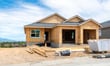
Sales of new single-family houses dropped 5.3% year over year, according to Census data

As mortgage rates began a sharp climb in the month of September, new home sales suffered as expected, according to the latest numbers released Tuesday.
Sales of new single-family homes ran at a seasonally adjusted annual rate of 676,000 in September, down 0.6% from August and 5.3% from a year earlier, according to the US Census Bureau and the US Department of Housing and Urban Development (HUD).
August's annual rate was revised to 680,000. A new home sold for a median $400,400 in September, up 3.9% from August but down 3.9% from a year earlier.
The report landed the same morning as the Case-Shiller and FHFA home price indexes, which showed overall home prices up 2.1% and 2.4% from a year ago.
Odeta Kushi, deputy chief economist at First American, noted that builders were leaning on price cuts and incentives to battle the higher rate environment.
“New-home sales were essentially unchanged in September, holding up better than expected even as mortgage rates rose," Kushi said. "Builders are meeting buyers’ budgets with price cuts, financing incentives and smaller, more affordable homes. That is helping sustain sales, but it also shows how hard builders are working to keep buyers engaged.”
Supply holds near eight months
New houses for sale numbered 476,000 at the end of September, down 1.0% from 481,000 in August and 2.3% from 487,000 a year earlier. That is a supply of 8.4 months at the current sales pace, compared with 8.5 months in August and 8.2 months a year ago.
Completed homes for sale fell to 111,000 from 122,000 a year earlier, while 250,000 were under construction and 115,000 had not started.
Those figures cover only new construction. Joel Kan, deputy chief economist at the Mortgage Bankers Association (MBA), looked at the broader supply picture at an MBA economists' session earlier this month.
"We are seeing some improvement in for-sale inventory," Kan said. "Running at around two million or so units, both new and existing. That's up from below one and a half a few years ago. That is certainly helping some of these transactions, but we're still, I think, relatively low."
Mike Fratantoni, chief economist at the MBA, said at a press briefing earlier this month that supply is looser than it was a couple of years ago.
"It really is at best a balanced market, more of a buyer's market nationally," Fratantoni said.
Regional swings and rate pressure
Sales rose from August in the Northeast (28.0%) and the West (21.4%) and fell in the Midwest (7.3%) and the South (6.6%). From a year earlier, the West was down 17.4%, the largest decline of the four regions, while the Northeast was up 10.3%.
The Census Bureau cautioned that seasonally adjusted figures often move irregularly. The agency said it takes four months to establish a trend for new home sales.
At $472,800, the average sales price of a new home was up 0.4% from August and down 6.7% from $506,800 a year earlier. The Census Bureau noted that price changes reflect the mix of homes sold by region and size as well as changes in the prices of identical homes.
Fratantoni said what homebuilders choose to build is shaping the new-home price numbers. The MBA also tracks the FHFA index, which holds quality constant.
"On the new side, you are clearly seeing builders over the past couple of years tilt production a bit towards smaller, lower-priced homes," Fratantoni said. "Some of that's an active choice; some of that is just changing mix of the folks that specialize more in entry-level are seeing more sales, and so the overall market is coming down. So that's more impacting the median."
Builders are also using rate incentives to move homes. Fratantoni said the terms have changed.
"Last I heard, buydowns are now being offered at 5.5%, not 3.99% or even lower than we've been seeing," Fratantoni said. "So it'll still be a huge benefit for someone buying a new home. My understanding is there’s much more of a move towards permanent buydowns than temporary."
Selma Hepp, chief economist at Cotality, which produces the Case-Shiller indexes, has been watching how the market has responded to higher rates. She said the combination of rates and home values is a mixed signal.
"In the last few months, mortgage rates have gone up, and we've had essentially flat home prices," Hepp told Mortgage Professional America earlier this month. "It's not like that's bad because it means improved affordability to some extent, at least if you ignore rising interest rates. But it's bad because it suggests that there are no buyers out there. There's nothing exciting going on in terms of home sales activity."
Freddie Mac's 30-year mortgage rate averaged 7.32% last Thursday, and the Fed meets this week. Sam Williamson, senior economist at First American, laid out his rate outlook for the rest of 2026.
"Treasury yields may have retreated from their recent highs, but the forces pushing them higher have not," Williamson said in October. "Stubborn inflation, resilient growth, and expectations for further Fed tightening will likely keep interest rates elevated through year-end."
The October report is due Nov. 25. Kushi noted that the overall picture remains challenging.
“Builder confidence fell to 29 in October, its lowest level since June 2012, while prospective-buyer traffic dropped to its lowest level since April 2012, excluding the pandemic shutdown," she said. "Mortgage rates have continued climbing above 7 percent, stretching buyers' budgets and increasing the cost of financing incentives. Builders have kept sales moving by adjusting prices, offering incentives and bringing more lower-priced homes to market.
"But with buyer traffic at a multi-year low and mortgage rates above 7 percent, those strategies may become harder to sustain without further concessions.”
Stay updated with the freshest mortgage news. Get exclusive interviews, breaking news, and industry events in your inbox, and always be the first to know by subscribing to our FREE daily newsletter.