Millions of Americans can afford a home — so why won't the system let them borrow for one?

Federal policymakers are being urged to revisit mortgage lending standards that a Pew Charitable Trusts study says have pushed millions of creditworthy Americans out of homeownership, a call arriving as home sales track toward their weakest annual pace since 1995.
The August 2026 issue brief, authored by Adam Staveski, a principal associate with Pew's housing policy initiative, contends that post-crisis underwriting rules now prioritize risk reduction over access.
The average credit score among new mortgage borrowers reached a record 742 in 2024 — 29 points above the national consumer average — even as the mortgage market carries less default risk than at any point in three decades, the study found.
The numbers tell a blunt story. In 2000, lenders originated roughly 1.08 million home purchase mortgages to applicants with credit scores between 601 and 660.
By 2024, that figure had plunged to 293,000, a 73% drop that Pew says cannot be explained by improvements in the broader population's credit profile.
From 2005 to 2024, the share of originations for borrowers in the 600-699 credit score range fell by 13.3 percentage points to 22.3%, while borrowers above 700 gained 24.9 percentage points of origination share.
Who gets left behind
The excluded borrowers skew young, lower-income, and non-white. Pew data shows 37.5% of Black mortgage borrowers and 26.9% of Hispanic borrowers held credit scores in the 600-699 range, as did 33.5% of buyers under 25 and 26.8% of first-time purchasers.
"While tighter standards have made the mortgage market safer, they have also made it harder for some qualified individuals to achieve homeownership," Staveski wrote in the brief.
For brokers, the warning signs are already measurable. Even as consumer credit scores have reached a 12-month high as delinquencies ease, the Mortgage Credit Availability Index has simultaneously dropped to a six-month low, narrowing the product landscape for the exact clients Pew is advocating for.
Why reform advocates say the risk case has shifted
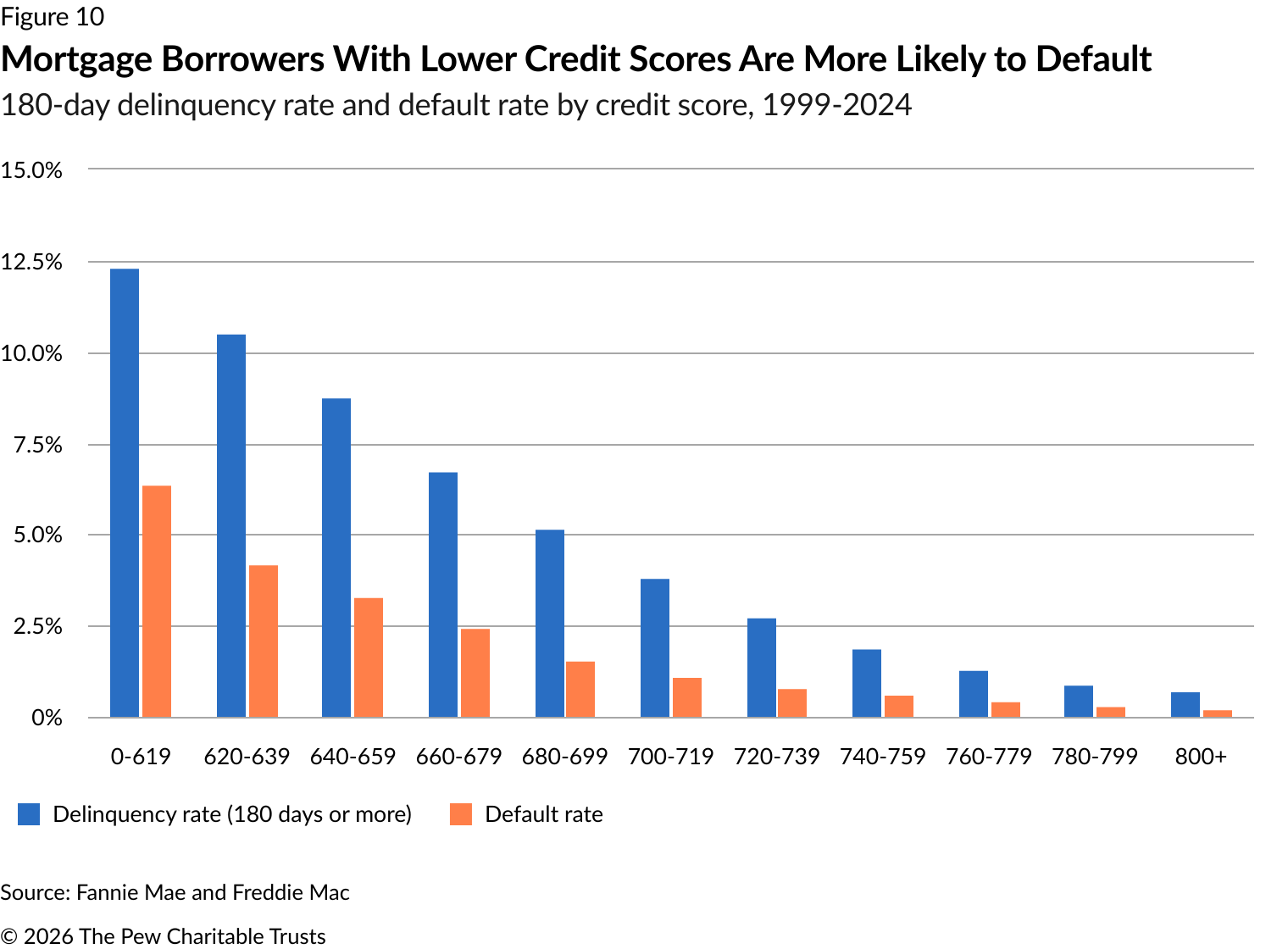
Pew's core argument rests on a dramatic change in default data. Among Fannie Mae and Freddie Mac borrowers with credit scores of 620 to 700, the share of seriously delinquent borrowers who ultimately defaulted fell from 55% in the 2000–2004 period to just 4% from 2020 to 2024. That's a decline the study attributes to federal loss mitigation tools including forbearance, loan modification, and payment deferral.
Josh Lewis, a certified mortgage consultant at BuyWise Mortgage, previously told Mortgage Professional America that scoring reforms hold particular promise for thin-file borrowers navigating today's environment.
"Some clients who have no FICO score at all due to inactivity may still show a valid VantageScore," Lewis said.
"That can absolutely shift the approval path, whether through AUS eligibility or loan pricing tiers."
The housing market offers little near-term relief. Existing home sales fell 2% last month to a seasonally adjusted annual rate of 3.98 million units, the third straight monthly decline and 1.2% below a year earlier, the National Association of Realtors (NAR) reported.
Thomas Ryan, senior North America economist at Capital Economics, projected in a research note that full-year transactions could average around 4 million, their weakest pace since 1995, as the 30-year fixed mortgage rate climbed to 6.76%.
Pew argues that targeted adjustments to pricing frameworks, underwriting thresholds, and legacy credit scoring models that are costing lenders the next generation of buyers could widen access for qualified borrowers without recreating the excesses of the early 2000s.
Stay updated with the freshest mortgage news. Get exclusive interviews, breaking news, and industry events in your inbox, and always be the first to know by subscribing to our FREE daily newsletter.