Dissenters pulled the Fed away from rate‑cut bias as energy shock deepened

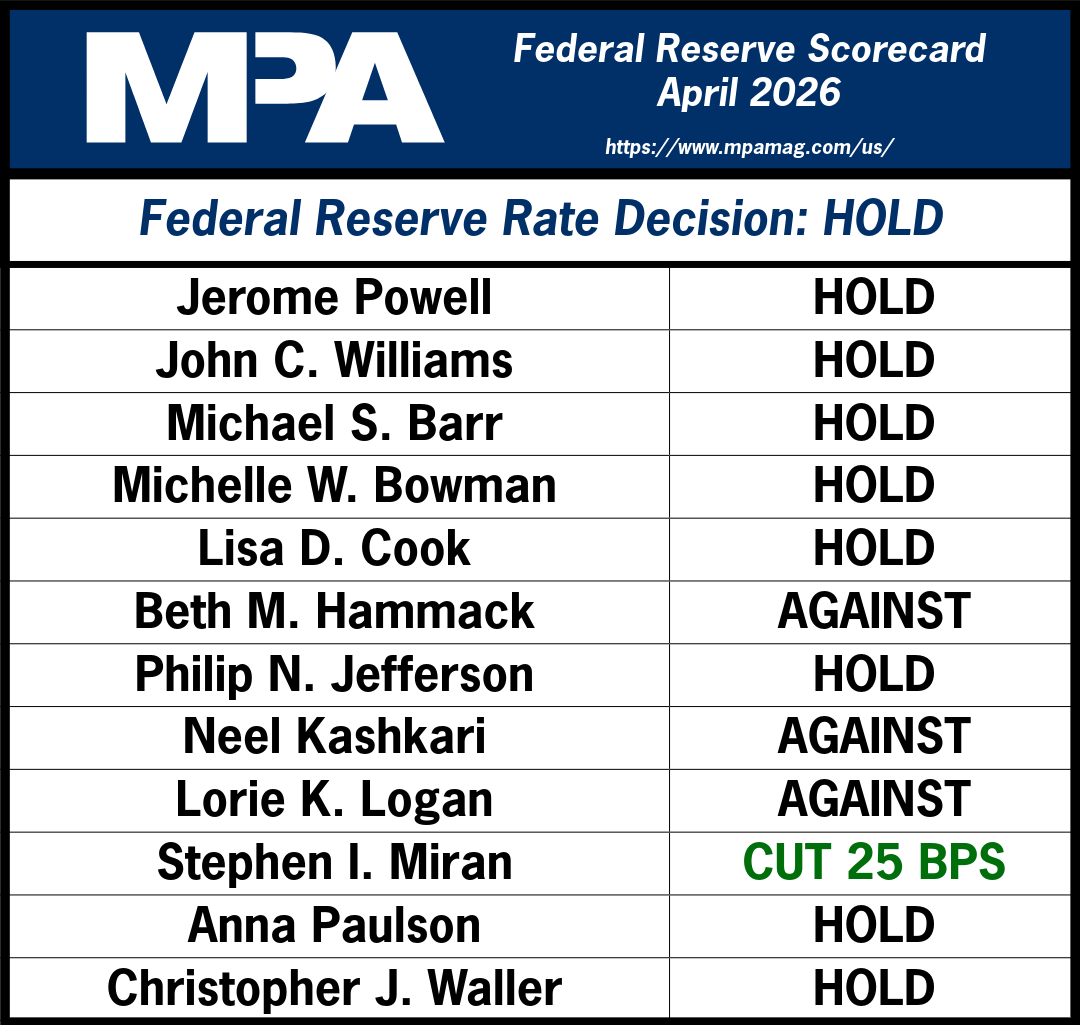
Federal Reserve officials who dissented at this week’s meeting warned that an escalating oil shock from the US-backed war with Iran made talk of future rate cuts premature and, in a worst case, could even force a fresh round of hikes.
The Federal Open Market Committee kept its benchmark rate unchanged in a 3.50%–3.75% range, its most divided decision since 1992.
The statement, however, still leaned toward further easing, reflecting a process that began about 18 months earlier to take policy from restrictive toward neutral.
Mike Fratantoni of the Mortgage Bankers Association highlights that the MBA expects the Federal Reserve to remain cautious as core inflation rises and labour market strength limits room for easing.https://t.co/YWPRgBr6XD
— Mortgage Professional America Magazine (@MPAMagazineUS) April 30, 2026
Dissenters push back on easing bias
Cleveland Fed president Beth Hammack said inflation pressures “continue to be broad-based, and rising oil prices present an additional source of inflationary pressure.”
She supported holding rates steady but opposed the “easing bias” in the statement.
Minneapolis Fed president Neel Kashkari focused on the potential fallout from a prolonged closure of the Strait of Hormuz and further damage to Middle East energy infrastructure.
The resulting price shock, he said, could be large enough that the Fed would need “potentially a series” of rate hikes to keep inflation expectations anchored.
“We would likely have to follow through with a strong policy response … Federal funds rate increases, potentially a series of them, could be warranted even at the risk of further weakness to the labor market,” he said.
Dallas Fed president Lorie Logan said she was “increasingly concerned” about inflation returning to the 2% target given the risk of “prolonged or repeated supply disruptions” from the conflict in the Middle East.
All three regional presidents backed holding rates but objected to language that markets interpreted as a signal that the next move would most likely be a cut.
What it means for mortgage lending
In a post‑meeting press conference, Fed chair Jerome Powell said the “center” of opinion on the committee was drifting away from a clear easing bias toward language that would leave the door open to a hike as soon as the June meeting, depending on how the conflict and inflation data evolve.
Kashkari, in a separate essay, argued that even under a relatively benign scenario in which the Strait reopened soon, underlying US inflation could remain near 3% for the year, well above target.
In that case, he said, policy would likely need to stay on hold “for what would likely be an extended period of time,” with no guarantee that cuts would resume.
Oil shock revives inflation and mortgage worries
Closure of the Strait of Hormuz, a key artery for global energy shipments, already pushed benchmark crude above $100 a barrel, with some trades near $126 versus around $70 at the start of the conflict.
The average price of US gasoline reportedly jumped to about $4.39 a gallon, compared with roughly $3 in late February.
Market-based inflation expectations also rose, with longer-term Treasury Inflation-Protected Securities pointing to higher implied inflation than earlier in the year, raising the risk that the latest energy shock could spill over into broader price setting.
Core inflation measures, excluding food and energy, moved back above 3%, echoing the post‑pandemic and 2022 energy spikes. While Fed officials still described long‑run expectations as “stable,” they acknowledged that near‑term household expectations jumped since the war began.
Stay updated with the freshest mortgage news. Get exclusive interviews, breaking news, and industry events in your inbox, and always be the first to know by subscribing to our FREE daily newsletter.