New survey data shows majority of homeowners welcome cooling prices as Budget, rate rises reshape market

Support for falling house prices has risen to 61%, according to new Resolve Political Monitor polling reported by Nine newspapers, up from 54% in June, as big banks continue to warn that prices will keep falling in the months ahead.
The poll found backing for lower prices was strongest among committed Labor voters, at 73%, but a majority of Coalition (58%), One Nation (55%) and Greens (63%) voters also supported a decline, as did 62% of uncommitted voters. Even property investors were largely on board, with 66% wanting prices to fall, the poll found.
Resolve pollster Jim Reed told Nine the finding "might be somewhat surprising," but said it reflects how many prospective buyers believe only a large price correction will make home ownership achievable for them.
What the market data shows
Auction clearance rates and house prices have softened in recent weeks, although Cotality's latest figures show clearances rebounded to nearly 55% last week following several weeks below the 50% mark.
Multiple major banks have forecast further price declines through to the end of 2027, with forecasts ranging from 6% to 10% depending on the city.
Westpac expects Sydney prices to fall 3% and Melbourne 4% across calendar 2026, although Brisbane, Perth and Adelaide are expected to keep growing, but at a slower pace. The bank attributed the divergence to higher interest rates and the Budget's tax reforms.
Westpac estimates the reforms will drive a 34% fall in new investor activity, with housing market turnover falling by around 20%.
HSBC has also flagged that busier markets, including Brisbane and Perth, are likely to be affected as the downturn broadens, while Commonwealth Bank expects flat national price growth for 2026. It cited slowing price growth, falling auction clearance rates, and homes taking longer to sell.
"Over the past couple of months, we have clearly seen momentum in the housing market slow down," said CBA senior economist Trent Saunders. "Price growth has slowed, auction clearance rates have declined and homes are taking longer to sell."
Saunders added that while supply, demand and interest rates shape long-term house price trends, sentiment is playing an outsized role in current conditions. "In the short term, sentiment can be a key driver of housing market activity," he said. "When there's uncertainty, buyers and investors often step back, and that can reinforce weaker conditions."
The Budget effect
The weakening market has been attributed to a multitude of factors, primarily successive interest rate increases from the Reserve Bank of Australia (RBA) and this year's federal Budget changes to negative gearing and capital gains tax (CGT).
Negative gearing will be limited to new-build residential properties from 1 July 2027. Investors will no longer be able to offset rental losses against wages or other personal income. Instead, losses can only be claimed against rental income or future capital gains from residential property. Properties already held before Budget night are grandfathered.
From 1 July 2027, the 50% CGT discount for individuals, trusts and partnerships will be replaced with cost base indexation and a 30% minimum tax rate on gains. This means the discount's value will erode fastest for investors sitting on the largest nominal gains. New-build investors can choose between the old and new methods, thus preserving an incentive to build rather than buy existing stock.
Prime minister Anthony Albanese and Treasurer Jim Chalmers framed the reforms as a means of giving first home buyers, particularly younger ones, a fairer chance of entering the market.
However, many economists and industry bodies remain unconvinced that the Budget changes will have the desired effect.
Outgoing Finance Brokers Association of Australia (FBAA) chief executive Peter White and Property Investment Professionals of Australia (PIPA) chair Cate Bakos warned of reduced rental supply and higher rents – a warning shared by many of their contemporaries.
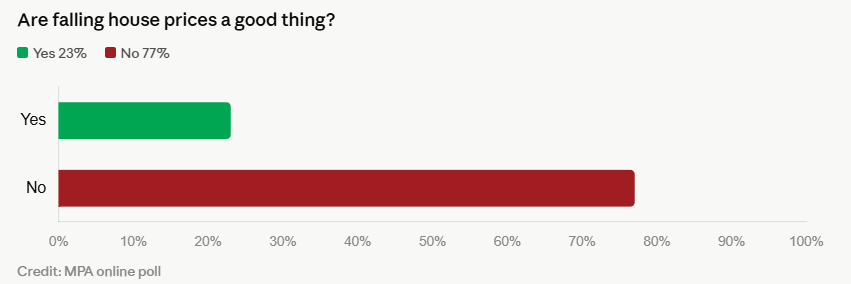
An online poll conducted by MPA found that 77% of broking industry professionals disagree and falling house prices are a good thing, compared to 23% who agree.