Analysis shows Sydney home owners pay more than double the monthly cost of renters

Renting is cheaper than buying a property in the majority of Australian capital cities, with Sydney recording the widest affordability gap between mortgage repayments and rental costs, new research from home loans comparison service Compare the Market has found.
The analysis examined global and domestic price-to-rent ratios by dividing house price indices by rent price indices. Of the countries examined, Finland was the only one where buying was cheaper than renting, with a price-to-rent difference of just 3.5%.
At the other end of the spectrum, Türkiye recorded the highest ratio at 100.63%, followed by Portugal at 73.25% and Hungary at 65.60%.
Australia's national ratio stood at 30.41%, placing it outside the most expensive countries for ownership relative to renting, though the gap remains material for prospective buyers.
Global house price-to-rent ratio 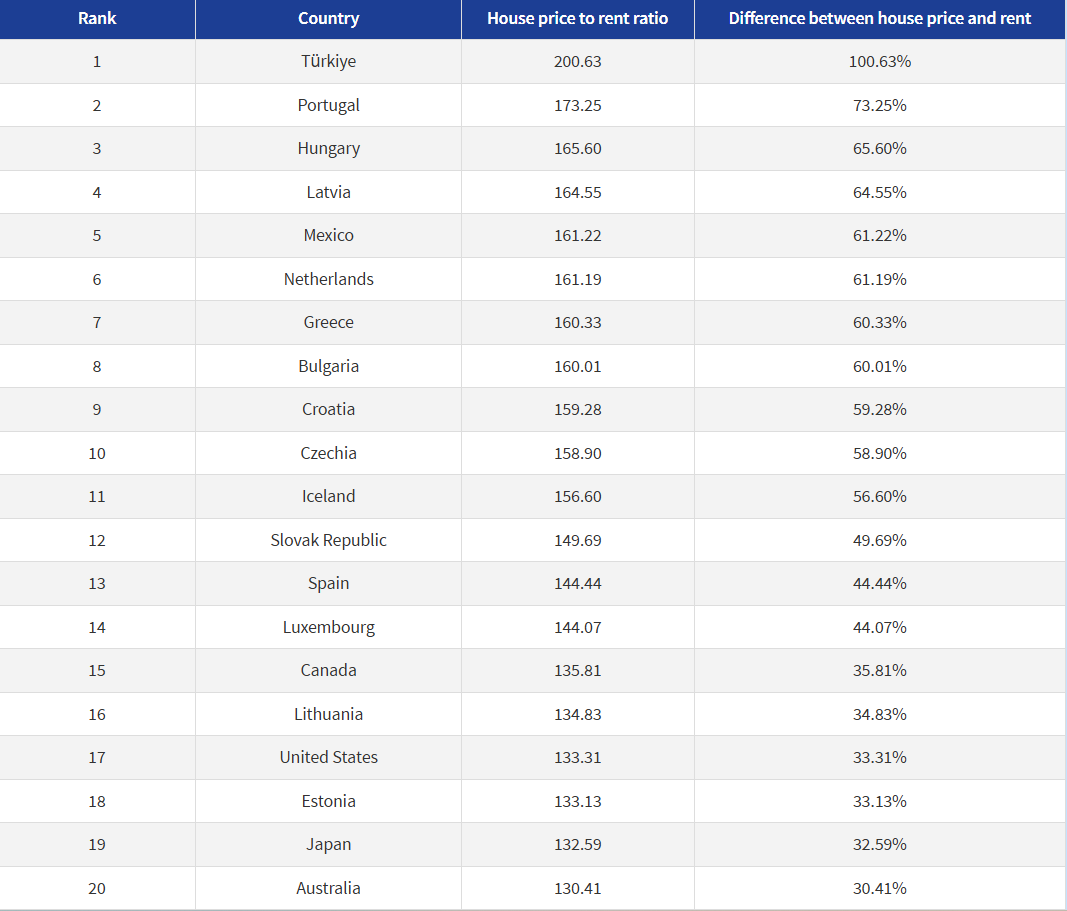 OECD data on price to rent ratio reported in 2024
To compare affordability across capital cities, the research used median house and unit values alongside median rental figures. Buyers were assumed to have a 20% deposit, with monthly repayments calculated at a 6% interest rate on the remaining loan. The analysis does not account for additional costs such as stamp duty, council rates, insurance, maintenance or body corporate fees, nor does it factor in changes to interest rates or property values over time.
Australian capital city house price-to-rent ratio ranking 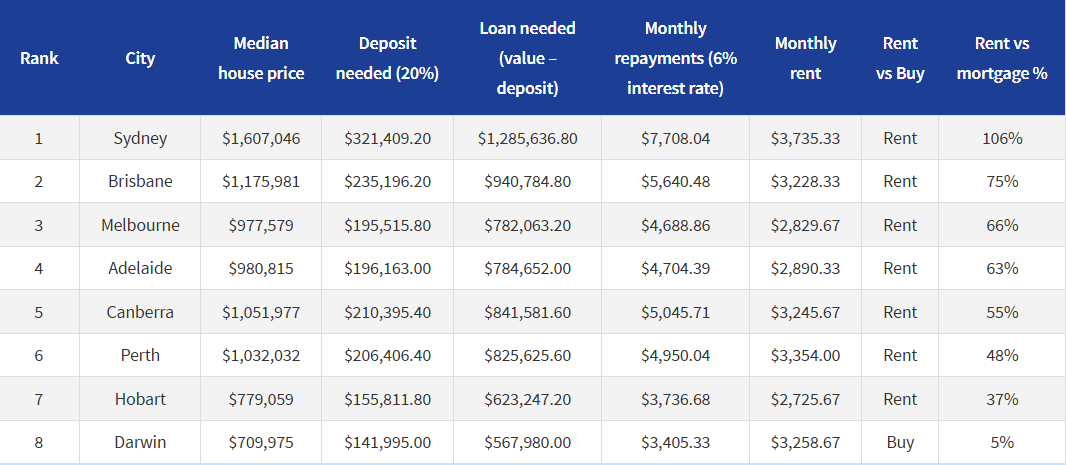 Median house price data: Cotality monthly Home Value Index, Q1 Feb 2026
Sydney recorded the highest median house price in the country at just over $1.6 million. Based on a 20% deposit and a 6% interest rate, monthly mortgage repayments average more than $7,700, compared with a median monthly rent of approximately $3,735 — a gap of around 106%. The data suggests renting offers a considerably lower short-term cost for those not committed to long-term residence in the city.
Brisbane's median house price sits at approximately $1.17 million, resulting in estimated monthly repayments of around $5,640 at a 6% interest rate. The median monthly rent is approximately $3,228, making renting roughly 75% cheaper than buying on a monthly basis.
Melbourne's median house price of around $978,000 produces monthly repayments of approximately $4,688, compared with a median monthly rent of $2,829. Renting is about 66% cheaper than buying in Victoria's capital.
Adelaide ranked fourth among capital cities for the price-to-rent gap. The median house price is approximately $980,000, with monthly mortgage repayments of $4,704 against a median monthly rent of $2,890 — making renting around 63% cheaper than buying.
The Australian Capital Territory recorded a median house price of approximately $1.05 million, with estimated monthly repayments of around $5,045. The median monthly rent is $3,246, making renting about 55% cheaper. The analysis notes that Canberra's relatively limited housing supply compared with larger capitals may contribute to its elevated rental costs.
Perth's median house price sits just above $1.03 million, with monthly repayments of approximately $4,950. The median monthly rent of $3,354 makes renting around 48% cheaper than buying, despite Perth offering a lower entry point than Sydney, Brisbane and Canberra.
Hobart's median house price of $779,000 results in estimated monthly repayments of approximately $3,736, compared with a median monthly rent of around $2,726 — a gap of about 37%. The relatively narrow difference between repayments and rent may be of interest to buyers considering entry into a capital city market at a lower price point than mainland counterparts.
Darwin is the only capital city where the cost gap between buying and renting is minimal. With a median house price of $709,000 and estimated monthly repayments of approximately $3,405, Darwin buyers pay just 5% more per month than renters, who pay a median of $3,259.
Australian capital cities’ unit price-to-rent ratio ranking 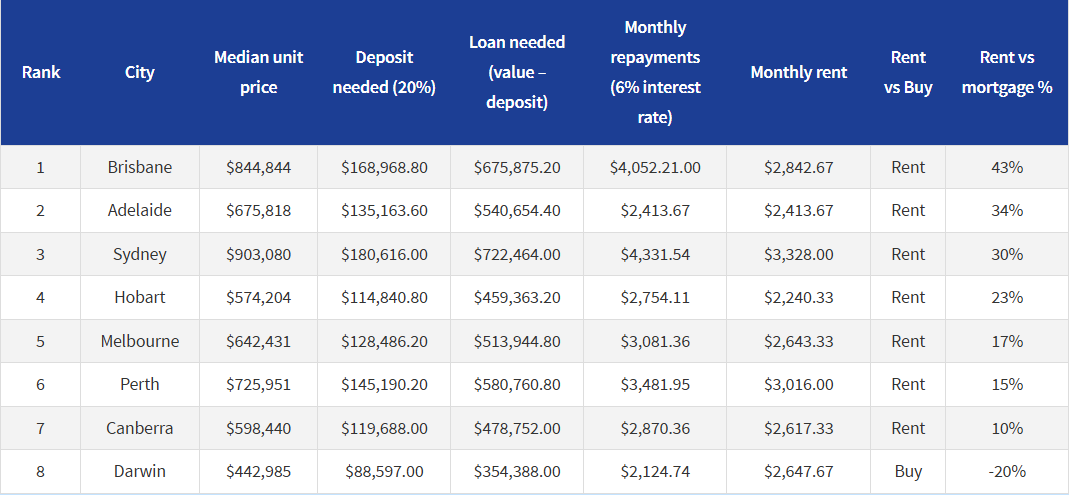 Median unit price data: Cotality quarterly rental review, April 2025
The unit market presents a different affordability picture. Brisbane ranks as the least affordable city for unit buyers, with mortgage repayments around 43% higher than rent. Based on a median unit price of $844,844, buyers would face monthly repayments of approximately $4,052, compared with an average unit rent of $2,843.
Adelaide and Sydney unit buyers also face higher repayments than renters, at around 34% and 30% respectively. Melbourne and Perth see smaller gaps of 17% and 15%, while Canberra's gap is approximately 10%, with monthly repayments of $2,870 against rent of $2,617. Darwin remains the standout for unit affordability, with mortgage repayments averaging $2,124 against a median monthly rent of $2,648 — a gap of roughly 20%.
 "While renting is currently the cheaper option in most Australian capital cities when comparing monthly costs alone, the decision isn't always straightforward," said Chris Ford (pictured right), communications manager at Compare the Market.
"Buying a home allows Australians to build equity over time, while renters may benefit from greater flexibility and lower upfront costs. Ultimately, the right choice will depend on an individual's financial position, lifestyle goals and how long they plan to stay in a particular location.
"Comparing home loans can help Australians find a mortgage that suits their needs and potentially save money in the process. By comparing different products, borrowers can assess interest rates, fees, loan features and repayment flexibility to find an option that aligns with financial circumstances and can support reducing borrowing costs to make home ownership more manageable, particularly in a market where every dollar counts."
Want to be regularly updated with mortgage news and features? Get exclusive interviews, breaking news, and industry events in your inbox – subscribe to our FREE daily newsletter. You can also follow us on Facebook, X (formerly Twitter), and LinkedIn.