Warehouse demand tied to AI infrastructure is adding jobs in key housing markets, but lenders question how long the boom lasts

Data center-related users accounted for a record 14% of new US industrial leasing in the third quarter of 2026, according to a Cushman & Wakefield analysis of data center logistics demand, widening the pool of warehouse and logistics deals that commercial mortgage brokers may be asked to finance.
Leasing tied to data center development and operations reached 50 million square feet through the third quarter, 113% above the full-year 2025 total. That far outpaced the 21% increase in total new industrial leasing nationally.
The US has more than 47 gigawatts of operational data center capacity and another 36 gigawatts under construction, and year-to-date imports of AI-related equipment, parts and components rose 62% to $659 billion, the analysis said.
Where data center industrial leasing is concentrated
Third-party logistics providers signed nearly 11 million square feet of data center-linked leases across 10 transactions of more than 500,000 square feet each, led by Columbus, Dallas-Fort Worth and Phoenix.
Hyperscalers, the largest cloud and AI operators, signed six leases of similar size, mainly in Dallas-Fort Worth, Atlanta, Kansas City and Charlotte.
Industrial construction pipelines have grown year over year in Columbus (190%), Atlanta (171%), Nashville (110%), Phoenix (92%) and Chicago (68%), though they remain well below 2023-2024 highs.
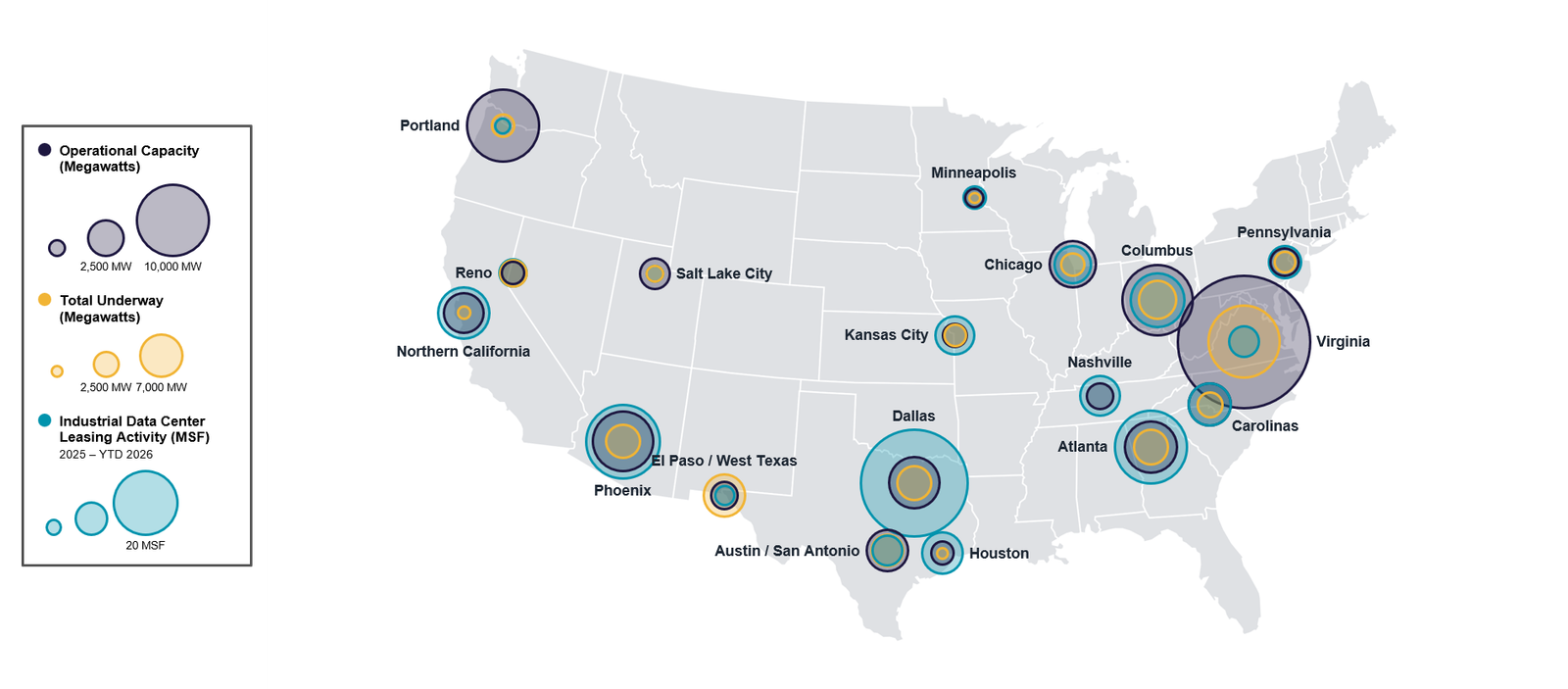
The activity is geographically narrow. In the National Association of Realtors' 2026 Data Center Impact Report, 92% of US counties had no mapped data centers, while Loudoun and Prince William counties in Northern Virginia held roughly 19% of all mapped facilities.
Among Realtors surveyed, 42% reported higher demand for industrial space and land in their markets, and 50% reported higher commercial property values nearby.
What does this mean for commercial brokers?
Jason Price, head of Americas logistics and industrial research at Cushman & Wakefield, said occupiers should move early.
"Occupiers with requirements in major data center hubs may want to evaluate their space needs and timelines earlier," he said.
"With new supply expected to remain modest in the near term, occupiers can secure well-located, Class A facilities."
Bar Mor, founder and chief executive of commercial real estate fundraising platform Agora, told Mortgage Professional America in April that the segment is gaining.
"Industrial is the one I'd keep an eye on," he said.
"It doesn't always get the same headline attention, but the momentum is clearly building, especially on the returns side."
Lenders, meanwhile, want an exit. Marc Tropp, senior managing director at Eastern Union, who works the Mid-Atlantic market, discussed the financing and zoning controversy around data centers in the same month.
"What's the secondary play if you have 200,000 square feet of data center, and five years from now, they only need 50,000?" Tropp said.
"One of the things that the banks look at is, 'What's that secondary conversion? Can it go to warehouse? Can it go to office? What's the cost of it?'"
Xander Snyder, senior commercial real estate economist at First American, urged similar diligence in a February interview on how brokers should approach distressed office deals.
"Also, look beyond headline vacancy rates to lease structure and expiration timelines," he said. "Near-term rollover risk and tenant credit can impact refinancing outcomes even if headline occupancy looks reasonable."
Cushman & Wakefield still expects data center and advanced manufacturing tenants to lift national absorption into 2027.
Stay updated with the freshest mortgage news. Get exclusive interviews, breaking news, and industry events in your inbox, and always be the first to know by subscribing to our FREE daily newsletter.