Realtor.com data reveals where new-home demand is coming from — and what it means for brokers on both ends of the move

Long-distance shoppers are reshaping new construction demand across the US, and mortgage brokers need to know where those buyers are starting from.
More than two-thirds of views to new-construction listings in the second quarter of 2026, or 67.2%, came from shoppers located outside the metro area where the home was listed, according to Realtor.com's New Construction Insights Report.
That figure outpaced the 65.4% out-of-metro share recorded for existing-home listings over the same period, underscoring how newly built homes are pulling buyers across geographic lines in a way that resale properties are not.
The pattern has direct implications for loan officers and brokers who serve relocating clients. New construction is increasingly functioning as an affordability valve for buyers priced out of their home markets and the data reveals exactly which metros those buyers are coming from.
National housing sales are down — but metros like Virginia Beach, San Antonio, and Cincinnati are thriving. Broker Jessica Eddy says affordability and relocation demand are driving resilience.https://t.co/FYHLghUwqr#housingmarket #realestate #mortgage #EdgeHomeFinance
— Mortgage Professional America Magazine (@MPAMagazineUS) August 21, 2026
Florida and Southern markets dominate cross-metro demand
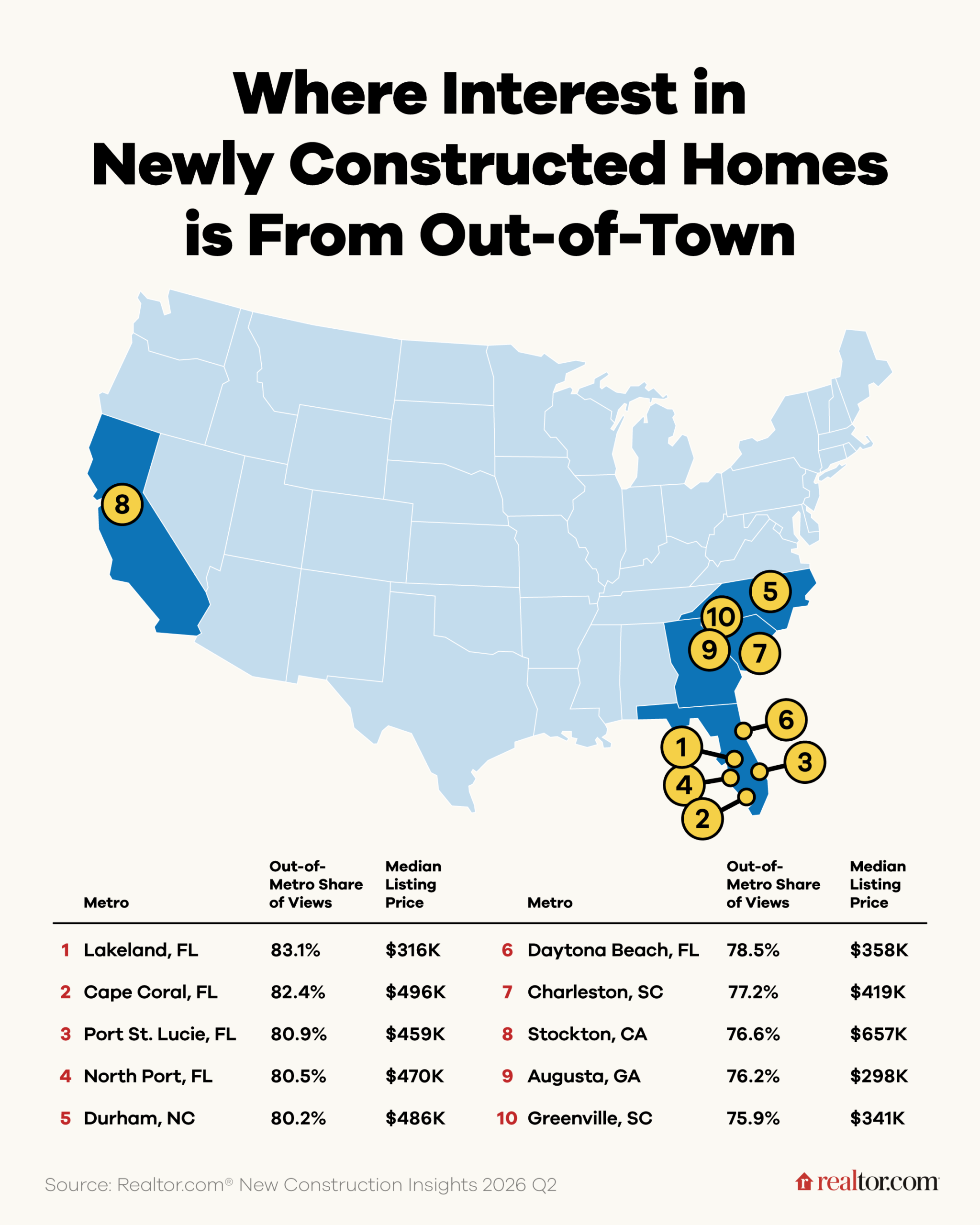
The markets attracting the greatest proportion of distant shoppers are concentrated in the South. Lakeland-Winter Haven, Fla., led the nation, with 83.1% of new-construction listing views originating outside the metro.
Cape Coral-Fort Myers, Fla. (82.4%), Port St. Lucie, Fla. (80.9%), North Port-Bradenton-Sarasota, Fla. (80.5%), and Durham-Chapel Hill, N.C. (80.2%) rounded out the top five.
"New construction is increasingly a destination for buyers who are willing to look beyond their current metro in search of more attainable options and a different lifestyle," said Joel Berner, senior economist at Realtor.com, Santa Clara, Calif.
"The markets drawing the most distant attention are largely in the South, where buyers can often find a newly built home at a price that compares favorably with more expensive nearby and coastal metros."
The origin data provides a useful lead-generation lens. Miami-Fort Lauderdale-West Palm Beach was the top viewer metro for each of the featured Florida markets.
New York, Chicago, and Washington, D.C. appeared among the top sending metros for multiple markets, reinforcing the familiar pattern of high-cost coastal buyers seeking affordability in Sun Belt new construction.
Brokers in origin markets may find that cross-metro new-construction demand is an underutilized source of referrals and pre-approval volume.
Builders cut prices as premium over existing homes widens
The national median listing price for a newly built home in Q2 2026 was $450,256, essentially flat year over year, down just 0.1%.
The median for existing homes fell more, dropping 2.0% to $408,317, which pushed the new-construction premium to 10.3% from 8.2% a year earlier.
To bridge that gap, builders continued to deploy price reductions more aggressively than sellers of existing homes. For the third consecutive quarter, a greater share of new-construction listings received a price cut, 20.0% versus 18.6% for existing homes.
"Builders are navigating a more price-sensitive market with an active, hands-on approach to pricing," Berner said.
"New-home listing prices have held broadly steady, but a growing share of builders are adjusting asking prices to meet buyers where they are. That dynamic could narrow the new-construction premium in the quarters ahead."
San Antonio-New Braunfels, Texas, led all individual markets in new-construction price reductions at 57.4%, followed by Fresno, Calif. (50.2%).
Charleston-North Charleston, S.C., combined a 36.9% price-reduction share with 77.2% of new-construction views coming from outside the metro, a dual pressure that brokers with clients eyeing that market should factor into client conversations.
New-construction inventory rose 2.8% year over year in the second quarter, closely tracking the 3.1% increase in existing-home supply.
New homes accounted for 17.1% of active listings nationally, nearly unchanged from 17.2% a year earlier. The median newly built home measured 2,050 square feet, up slightly from 2,045 square feet a year earlier. The median price per square foot edged down to $217 from $219.
Stay updated with the freshest mortgage news. Get exclusive interviews, breaking news, and industry events in your inbox, and always be the first to know by subscribing to our FREE daily newsletter.