Monthly rent slips in August, but annual gains hint at slow recovery

The national average apartment rent fell -0.03% in August to $1,751, ending eight consecutive months of positive gains and extending the seasonal pattern of late-summer softness, according to Apartments.com Multifamily Rent Growth Report.
The monthly decline was considerably milder than the -0.1% and -0.2% pullbacks recorded in the same month in 2024 and 2025, signaling gradual improvement in pricing conditions even as the summer leasing season closed.
Annual rent growth accelerated to +1.3% in August, up from the upwardly revised +1.1% in July, and ahead of the +1.1% pace recorded a year earlier.
The July national average was also revised higher, from an initial +0.03% month-over-month gain to +0.1%.
A sharp regional divide
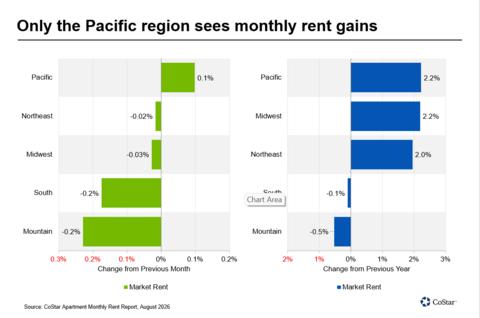
Regional results diverged in August. The Pacific region was the only one to post a monthly gain, at +0.1%, while the Northeast fell -0.02%, the Midwest -0.03%, and both the South and Mountain regions declined -0.2%.
Year-over-year, the Pacific and Midwest tied at the top with +2.2% growth, the Northeast posted +2.0%, while the South slipped -0.1% and the Mountain region dropped -0.5%.
Metro-level breadth tightened. Only 12 of the top 50 markets recorded monthly rent increases in August, down from a wider pool in July, with seven flat and 31 in decline.
Narrowing monthly breadth has been a recurring theme across this summer's leasing season. Orange County led monthly gains at +0.6%, followed by San Francisco at +0.4% and the East Bay at +0.3%. Orlando and Denver led declines at -0.7% each.
Coasts outpace overbuilt Sun Belt
On an annual basis, San Francisco posted +11.9% year-over-year rent growth, followed by San Jose at +7.7%, Norfolk at +5.8%, and the East Bay at +5.1%.
San Antonio led declines at -2.2%, with Denver at -1.9% and Phoenix, Houston, and Las Vegas each at -1.2% — markets where new supply has continued to outpace demand.
CoStar Group's August vacancy update also noted that the national apartment vacancy rate fell to 8.2% in Q2 2026, down 26 basis points quarter-over-quarter, evidence that absorption is improving as the construction pipeline shrinks.
For brokers advising multifamily investor clients, the data reinforces the need for market-by-market underwriting. As recent analysis of the CRE opportunity in 2026 outlined, tenant demand and consumer resilience are now doing more to shape deal outcomes than rate expectations alone.
Commercial real estate economist Xander Snyder of First American Financial Corporation in Santa Ana, California, told Mortgage Professional America in July that affordability pressures remain a key risk to leasing demand.
"If it gets to the point where renters need to find roommates, that could impact renter household formation, that can impact leasing demand for multifamily," Snyder said.
Stay updated with the freshest mortgage news. Get exclusive interviews, breaking news, and industry events in your inbox, and always be the first to know by subscribing to our FREE daily newsletter.