A new national survey reveals how far buyers will go to get into the market now

Renting until you can afford an entire home on your own is no longer the default position for most Americans.
A Neighbors Bank survey of 1,014 American adults conducted in September reveals that shared homeownership has moved from fringe strategy to mainstream aspiration, with 60% of respondents saying they would prefer to co-buy and own half a home now rather than continue renting while waiting to afford one on their own.
The findings arrive as housing costs remain well above pre-pandemic norms.
For the first time since the pandemic boom sidelined many borrowers, the forces behind US housing affordability are beginning to tilt toward buyers, though the adjustment is expected to be gradual rather than dramatic, according to First American's Real House Price Index.
Moreover, home prices in every one of the 50 largest US metro areas outpaced inflation.
Between January 2011 and January 2026, inflation rose 47.7% nationally. Home prices in every major metro surpassed that threshold, ranging from 65.5% in Baltimore, Maryland, to 343.9% in Miami, Florida, where the median climbed from $107,000 to $475,000.
In that context, co-buying is emerging less as a workaround and more as a deliberate choice.
A new report from Clever Real Estate found that home prices in all 50 of the largest US metro areas exceeded inflation between 2011 and 2026, with Miami leading the way at nearly 344% growth.https://t.co/NGEm4grL2E
— Mortgage Professional America Magazine (@MPAMagazineUS) September 30, 2026
Affordability, not aspiration, is driving the shift
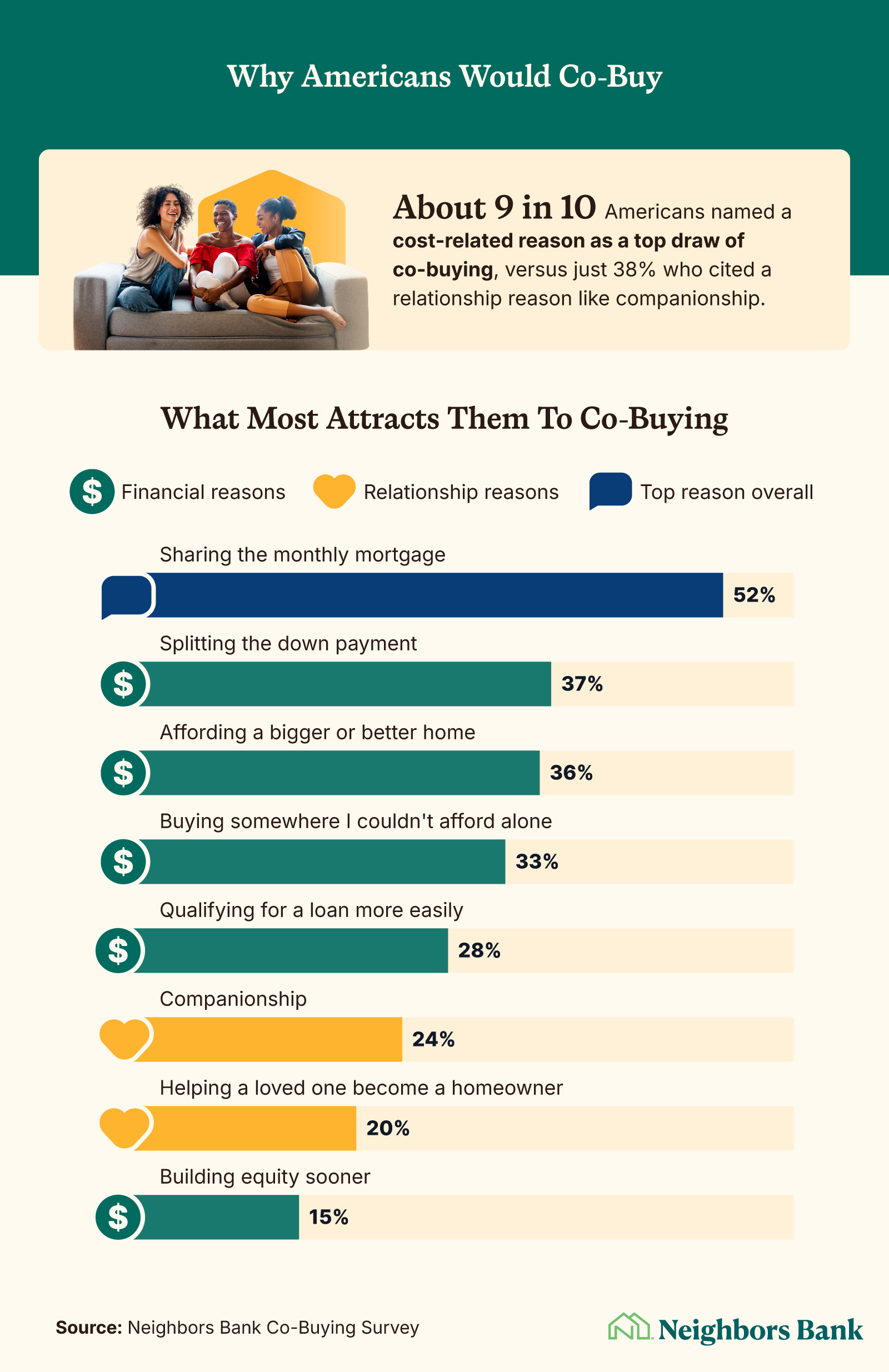
The Neighbors Bank data make clear that cost, not companionship, is the primary engine of co-buying interest.
Among the 94% of respondents who cited at least one cost-related motivation, sharing the monthly mortgage payment topped the list at 52%, followed by splitting the down payment at 37% and accessing a bigger or better home than they could afford alone at 36%.
Building equity sooner ranked last, chosen by just 15%, a finding that suggests buyers are focused on getting into the market now rather than optimising long-term wealth.
Family remains the most natural entry point for a shared purchase. Of those open to co-buying, 68% said they would consider purchasing with at least one family member.
Parents were the most commonly cited co-buyer at 44%, followed by siblings at 41% and adult children at 27%.
Another 40% would consider buying with an unmarried romantic partner.
Gen Z buyers claimed a record one-in-five share of all purchase mortgage rate locks in the second quarter of 2026, even as affordability pressures pushed more homebuyers toward non-traditional down payment sources, according to Intercontinental Exchange's JulyMortgage Monitor report.
The Neighbors Bank data reinforce that generational picture: 45% of Gen Z respondents said they would consider purchasing with a close friend, compared with 26% of millennials, 25% of Gen X, and 24% of baby boomers.
Income shapes the calculus as well. Americans earning under $50,000 were twice as likely to consider buying with a friend as those earning $100,000 or more — 38% compared with 19%.
What buyers want before signing a shared deed
The survey also examined how seriously Americans are approaching the legal and financial complexities of co-ownership. Nearly all respondents, or 94%, said they would likely put a co-buying agreement in writing before proceeding.
The most sought-after protection was a buyout or exit plan at 60%, followed by rules for splitting costs at 54%, defined ownership shares at 50%, and provisions covering what happens if one party cannot pay at 40%.
Even with a written agreement in place, anxieties persist. Among those who said they would use one, 37% still believed an agreement could not fully shield the relationship from the strain of co-ownership.
For brokers, that figure underscores the value of guiding clients through not just the mortgage qualification process but also the structural conversations around title, liability, and exit terms that co-purchases require.
Brokers who understand down payment assistance programs as a critical origination tool are gaining a competitive edge and co-buying opens another lane for that expertise.
Non-traditional down payment sources — family gifts, personal loans, and retirement funds — now account for 29% of all purchase down payments, a seven-year high according to ICE Mortgage Technology.
Clients drawing on those sources increasingly need originators who can structure complex multi-borrower files cleanly.
The Neighbors Bank survey also surfaced a striking attitudinal shift. Sixty-one percent of Americans said buying a home with a close friend or family member is a commitment as serious as marriage.
Half said they would consider co-buying with friends specifically to avoid living alone later in life, a signal that housing decisions are increasingly intertwined with social planning in ways that extend well beyond the transaction.
Stay updated with the freshest mortgage news. Get exclusive interviews, breaking news, and industry events in your inbox, and always be the first to know by subscribing to our FREE daily newsletter.