The building society’s 99% LTV loan could shrink years of saving to just over a year. But with prices slipping and the Bank of England tightening, advisers say suitability will come down to one question: how long does the client plan to stay put?

For a generation of renters told to just save harder, Nationwide’s new 1% deposit mortgage looks like a cheat code. For the brokers who will actually have to recommend it, it looks more like a stress test.
The Helping Hand 1% Deposit Mortgage, which went live on Wednesday, lets eligible first-time buyers borrow 99% of a home’s value at up to six times income. It is a five-year fix at 5.99% with no product fee, and Nationwide Building Society wants to push up to £1bn a year through it, helping what it estimates will be more than 5,000 extra buyers annually.
Looking at the market, though, the timing may not be ideal for a low equity product right now. The Lloyds house price index showed prices down 0.6% in October and 1.2% on the year, the sharpest annual drop since October 2023. Nationwide’s own index was flatter, roughly unchanged on the month and up 0.5% annually, according to Which?. Meanwhile Savills now expects values to drift lower through the rest of this year and fall 1.5% in 2027, a peak-to-trough slide of about 3%.
Borrowing costs are heading the wrong way too. The Bank of England lifted Bank Rate to 4% on 5 November, its first rise since August 2023, and expects inflation to hit about 5% by mid-2027. Mortgage approvals for house purchase fell for a third straight month in September, to 53,400.
Read next: ‘Two more hikes by mid-2027’ – industry reacts to Bank of England rate rise
A deposit in 15 months, not six years
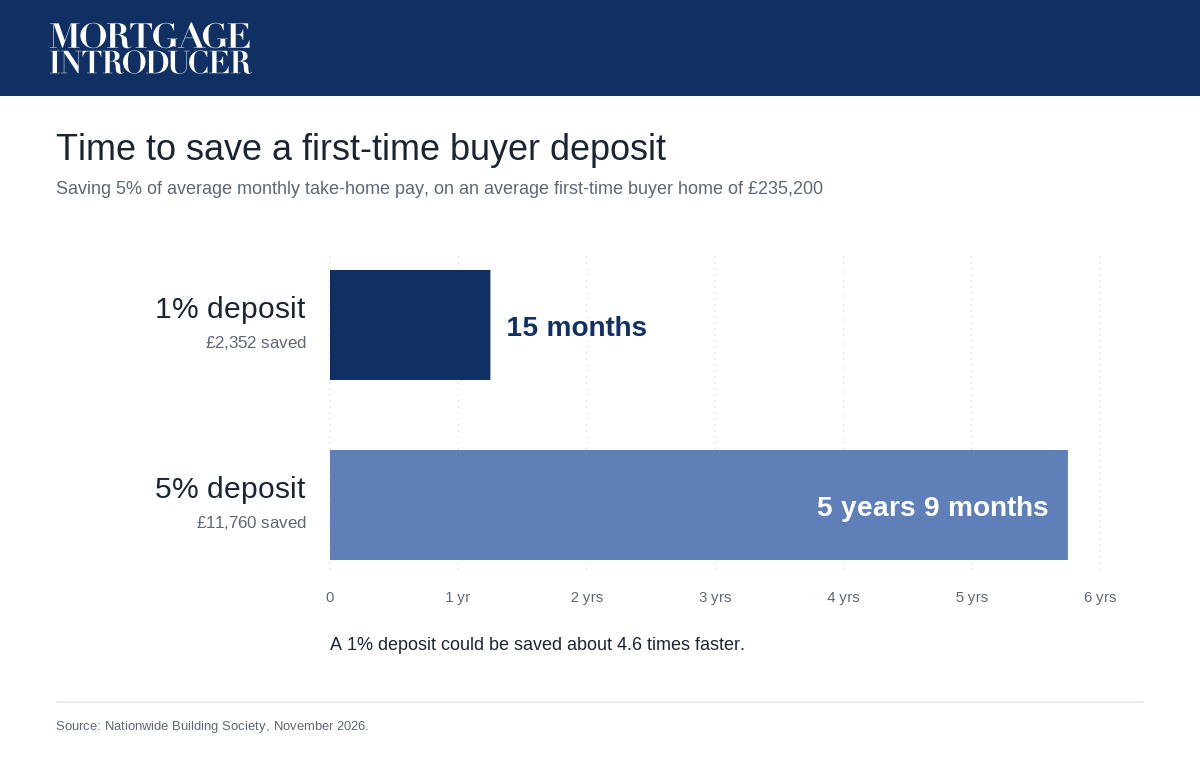
The pitch from the mortgage lender is pretty simple. On Nationwide’s average first-time buyer home of £235,200, a 1% stake is £2,352 against £11,760 for a 5% deposit. Nationwide says someone putting away 5% of average take-home pay could reach the smaller figure in 15 months, versus five years and nine months for the larger one.
Andrew Montlake, managing director at Coreco, told the Financial Times the deal would let some would-be buyers rerun their numbers and qualify. “For a lot of people the issue is not affordability, it’s the deposit,” he said.
Where the negative equity sums get uncomfortable
Not everyone is cheering. Riz Malik of R3 Wealth told the Guardian that “even a small slip in prices could leave borrowers in negative equity.” Darryl Dhoffer, founder of The Mortgage Geezer, warned the product leaves “almost zero equity buffer”.
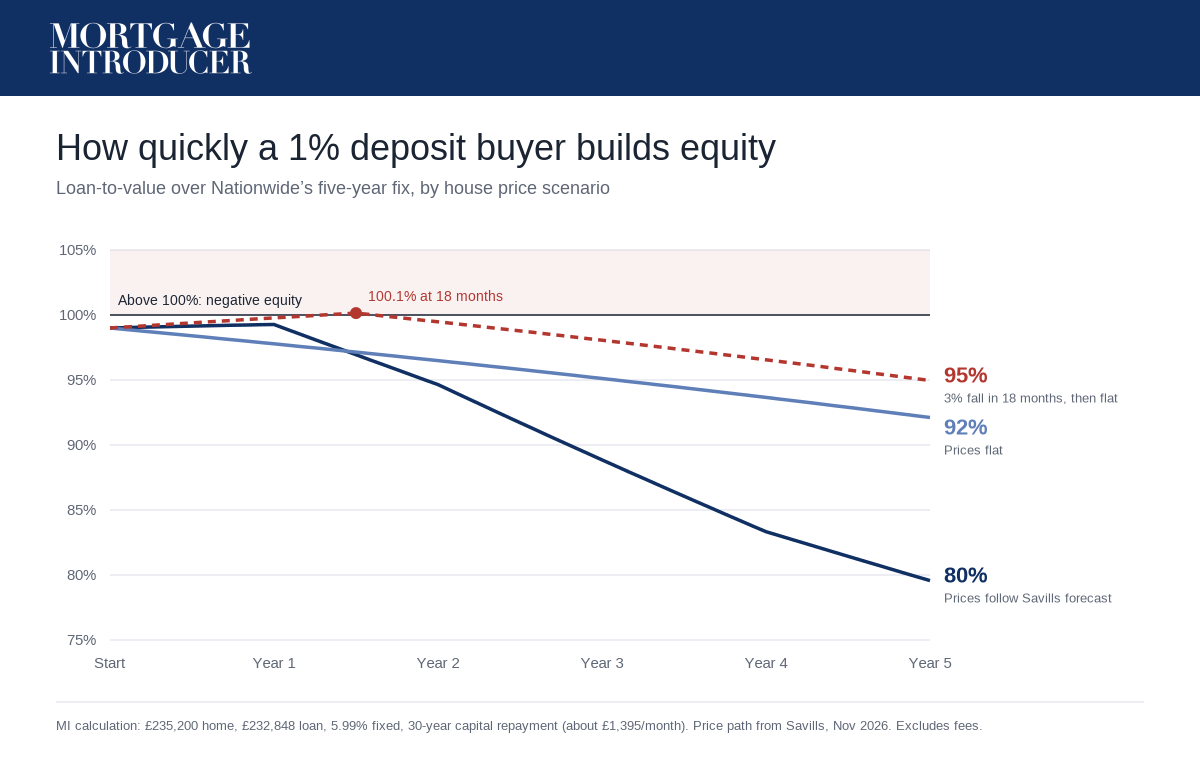
MI has run the numbers. On that average £235,200 home, the loan is £232,848. Over a 30-year term at 5.99%, repayments come to about £1,395 a month, and after 18 months the balance would still be around £228,500. If prices fell by Savills’ full 3% in that window, the borrower would be fractionally underwater. If prices instead tracked Savills’ five-year forecast of 15.8% growth to 2031, loan-to-value would be close to 80% when the fix ends.
Those two outcomes sit only a forecast apart, and forecasts move. In June, Savills was pencilling in 2.5% growth for 2027; it now expects a fall.
Henry Jordan, Nationwide’s group director of mortgages, defended the design to the Guardian: “I don’t think anyone is forecasting a fall in house prices over the next five years.” Over the full term that is broadly true. It is the next 18 months that worries the sceptics.
David Hollingworth, associate director at L&C Mortgages, argued the structure softens the blow: the fixed payments remove rate shock, and steady capital repayment over five years should build equity even if prices stall or dip.
Read next: Sales of zero-deposit mortgages hit five-year high
Houses only – and that’s no accident
Nationwide has fenced the product tightly. It is restricted to existing houses, so flats and new builds are out. The self-employed are excluded, sole applicants need at least £30,000 a year and joint applicants £50,000, and every case must be advised, either by a broker or a Nationwide adviser.
The houses-only rule lines up neatly with Savills’ outlook, which expects houses to keep outperforming flats and the North, Wales and Scotland to lead the recovery. London and the South East look tougher on both counts: Savills sees prices there falling 3.5% next year, and many first-time buyers in the capital start in flats the product won’t touch.
Nationwide points to a strong track record, saying fewer than 0.1% of Helping Hand loans are three or more months in arrears. That record, however, was built on deposits of 5% or more. The 99% cohort has none yet.
How it stacks up
Nationwide’s 5% deposit five-year fix sits at 5.69%, and Moneyfacts put the market average five-year fix at 95% LTV at 6.30% on launch day. Rivals include Lloyds Banking Group’s £5,000 deposit mortgage, Santander’s 98% My First Mortgage with a £10,000 minimum deposit, and Skipton’s 100% Track Record mortgage. Brokers can compare current deals in MI’s first-time buyer mortgage rates guide.
The state is muscling back in too. The government’s Your First Home equity loan, due in 2027, targets new-build buyers in England, exactly the segment Nationwide has left out.
The suitability conversation
For advisers, the product shifts the hard question from deposit to time horizon. Craig Fish, managing director of Lodestone Mortgages, told the Guardian it was best suited to buyers planning to stay well beyond five years, calling it “a genuine step forward” for renters who can afford repayments but not a deposit.
That means probing job security, likely life changes and what happens if the client needs to move or remortgage while the loan still sits near 100% of the property value. The alternative isn’t cost-free either: Hamptons expects new-let rents to rise 14.2% by the end of 2029, roughly double its 7.2% house price forecast. Every extra year spent saving is a year of rising rent.
Nationwide has bet £1bn a year that the long-term trend will bail out any short-term wobble. Brokers will be the ones explaining that bet to clients.