Latest APRA data shows an uneven pullback for the big five, with investor lending hit hardest

Australia's mortgage market is losing steam, and it isn't hard to see why.
Just as Labor's Budget reforms reshape what investors can claim on established property, the Reserve Bank of Australia (RBA) has spent 2026 tightening the screws on borrowing costs – and now the country's biggest banks are showing the strain in black and white.
The latest Authorised Deposit-taking Institution (ADI) statistics from the Australian Prudential Regulation Authority (APRA) show owner-occupier and investor lending both cooling across ANZ, Commonwealth Bank of Australia (CBA), Macquarie Bank, Westpac and NAB in the year to July, with combined owner-occupier growth holding at just over 6.5% and investor growth slipping below 9% for the first time in several months.
Owner-occupier and investor lending both lose pace
The slowdown wasn't spread evenly.
NAB recorded the sharpest pull-back of the five lenders, with both its owner-occupier and investor books losing momentum and its investor growth now the weakest among the majors.
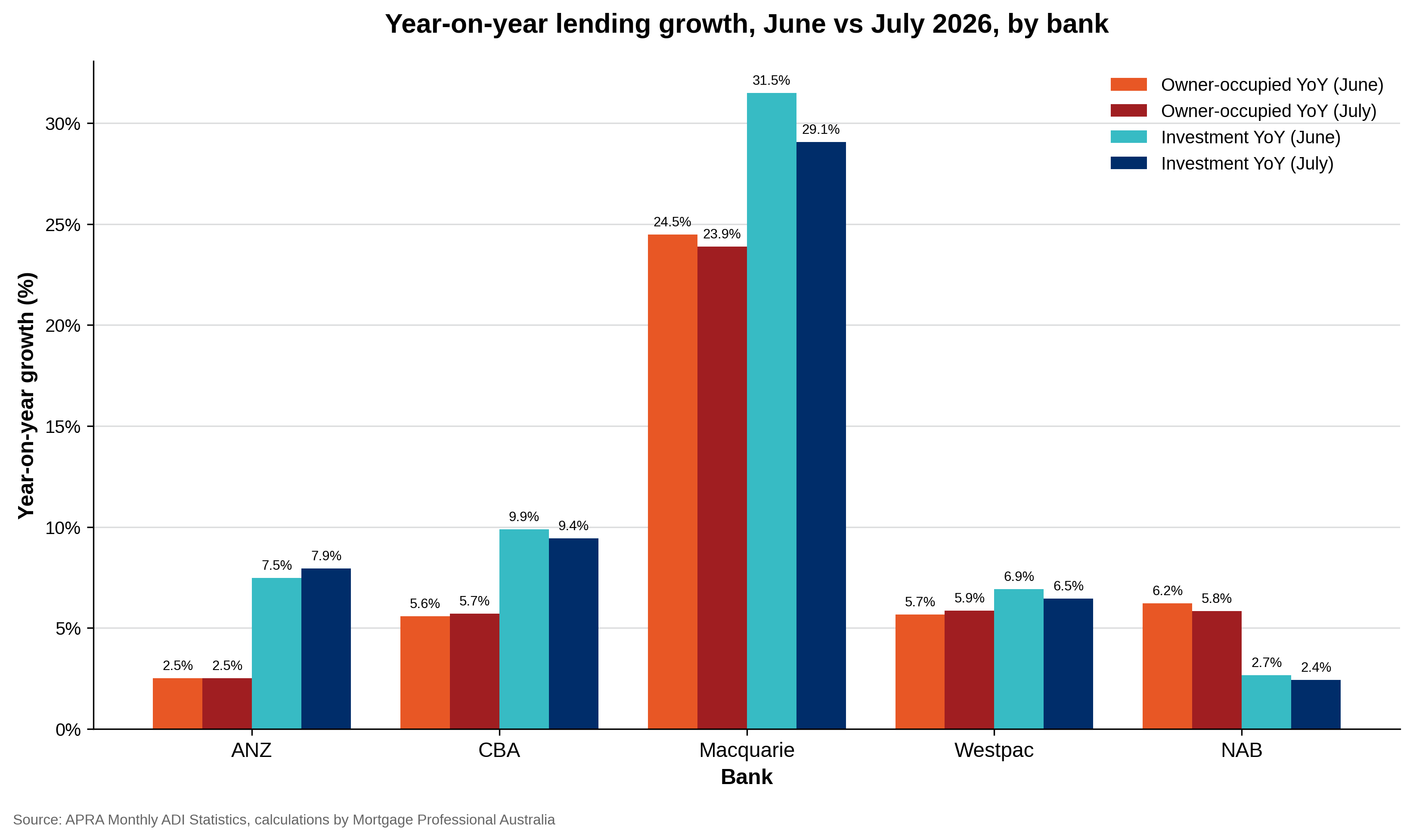
CBA and Westpac were more mixed – both banks' owner-occupier books actually picked up slightly even as their investor books cooled.
ANZ bucked the broader trend on the investor side, with growth there accelerating even as its owner-occupier lending remained the slowest-growing in the dataset.
Macquarie remains in a league of its own
Macquarie Bank continues to sit in an entirely different growth bracket to its major bank rivals, with both its owner-occupier and investor books expanding several times faster – even as that pace eased slightly month-on-month.
Growing off a smaller base makes rapid percentage growth easier to sustain, but the scale of the gap suggests Macquarie is still taking outsized share of new mortgage flow relative to its size in the market.
Budget reforms rewrite investor lending rules
Much of the investor-side cooling traces back to Labor's May Budget, which stripped negative gearing from established properties bought after Budget night and scrapped the capital gains tax discount on new investment purchases.
ANZ, CBA, Macquarie, Westpac and NAB all moved quickly to rewrite their serviceability rules, and the market reaction was immediate: investor mortgage applications plunged as the Budget's tax reforms started to bite, with lodgements sliding hard nationally.
Westpac reported a sharp drop in mortgage applications within weeks of the changes taking effect.
The uncertainty has had knock-on effects for brokers too, with negative gearing confusion blowing out settlement times and pushing more complex investor deals toward non-bank lenders as the majors tighten up.
Rate hikes compound the slowdown
The Budget changes haven't landed in isolation. Three RBA cash rate rises so far in 2026 have already left their mark on borrower demand, with a rate hike from the RBA shown to slow new mortgage demand according to Equifax figures tracking a sharp loss of momentum among new borrowers.
The pressure has flowed through to household budgets as well, with mortgage stress climbing to a two-year high after the RBA's rate rise and mortgage costs rising as CBA, NAB and ANZ passed through the RBA's rate hike to variable-rate borrowers.
With the RBA's next cash rate decision still to come, brokers are bracing for the possibility that a fourth hike could extend the slowdown further – layering rate-driven caution over the Budget's structural changes to investor lending appetite.
Taken together, the APRA figures offer one of the clearest signals yet that the twin pressures of tax reform and monetary tightening are starting to show up in the hard numbers – not just in survey sentiment or anecdotal broker feedback, but in the actual flow of new lending across Australia's biggest banks.