Record broker market share meets falling client sentiment in the Mortgage & Finance Association of Australia's annual report

The Mortgage and Finance Association of Australia (MFAA)’s 2025–26 Annual Report paints a picture of significant growth, yet growing market uncertainty, among Australia’s 24,000-plus mortgage brokers.
Numerous records were broken and the nation’s peak broker association had one of the busiest years on record on the advocacy front.
"More Australians are choosing brokers to help them understand their options and navigate important financial decisions," MFAA chief executive Anja Pannek (pictured) said. "That trust is earned through the work our members do every day. Our role is to support them with strong advocacy, practical education and resources that help them build sustainable businesses and deliver positive outcomes for their clients."
How big is the mortgage broker market?
Brokers now own nearly 82% of all new residential mortgage lending in Australia and settled 838,815 residential loans worth $495.55 billion in calendar 2025 – roughly one home loan every 38 seconds. Fewer than 44% of those settlements went to the principal brands of the major banks.
Leading aggregators settled $139.08 billion in residential home loans in the June 2026 quarter, the highest April-June volume on record. Commercial, business and asset finance settlements rose 27.4% in 2025 to $52.3 billion across the MFAA's matched aggregator sample, a sign more mortgage brokers are diversifying.
The workforce is growing to match. The broker population reached 24,116, up 2,011 or 9.1% in a year, with younger age groups lifting their share. Deloitte's The Value of Mortgage and Finance Broking 2025 report, cited by the MFAA, found the industry supports more than 37,000 jobs and $4.1 billion in economic activity.
Membership grows 4.1%
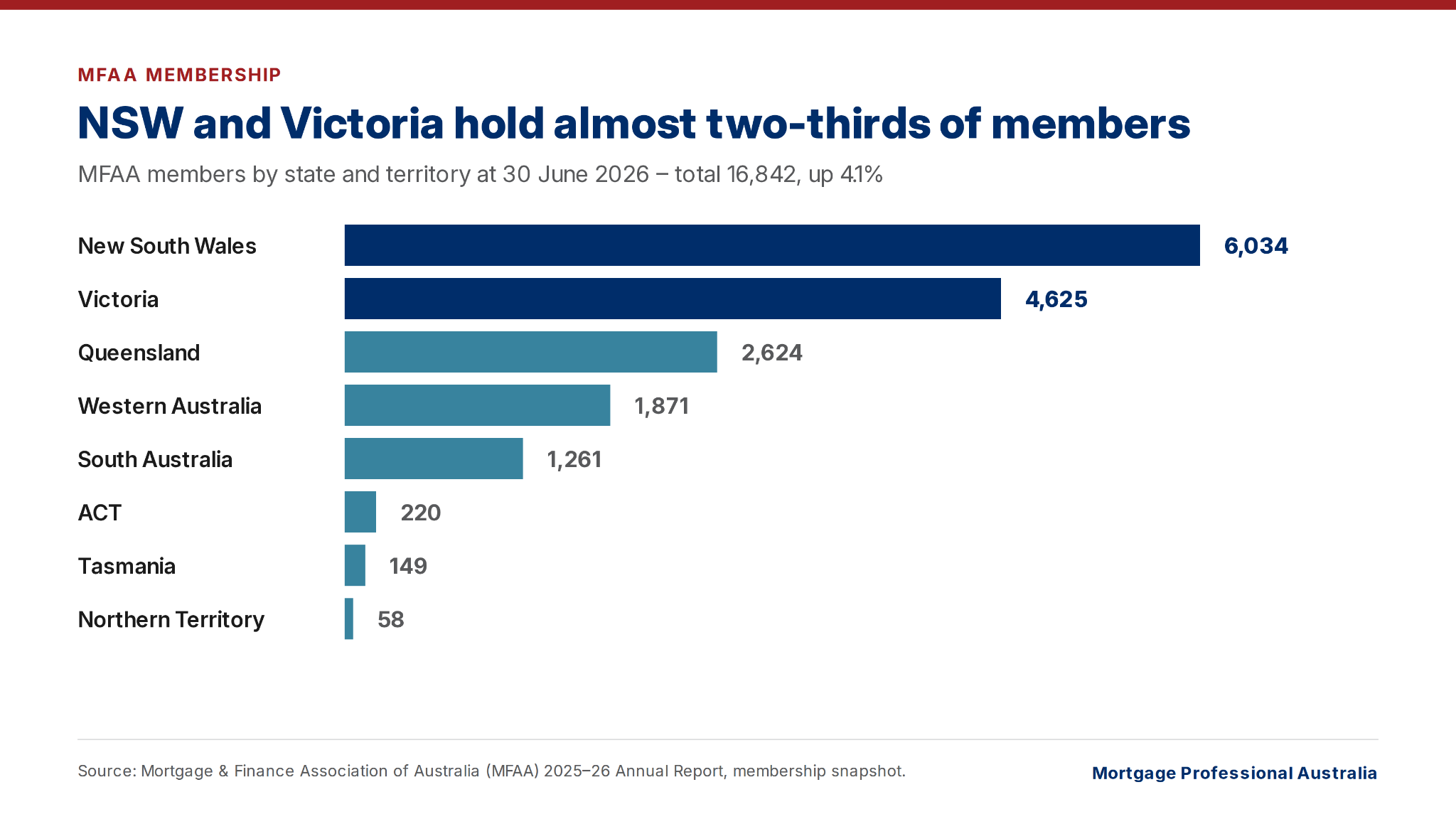
The MFAA had 16,842 members at 30 June 2026, up 4.1% from 16,172 a year earlier, with net growth in every month of FY26. Brokers make up 97% of members; 71% are male and 29% female. New South Wales (6,034) and Victoria (4,625) account for nearly two-thirds of the base.
The association ran 81 events drawing more than 21,000 registrations, while the 2026 Excellence Awards received a record 854 submissions. Its membership services team fielded 7,149 inbound calls, up about 11%, and made more than 6,170 outbound calls.
On the consumer side, the Find a Broker campaign generated 11.2 million advertising impressions, more than 232,000 broker profile views and 707 enquiry form submissions between March and May 2026.
A year of advocacy
The MFAA made more than 25 formal submissions in FY26 and engaged with Treasury, the Australian Securities and Investments Commission (ASIC), the Australian Prudential Regulation Authority (APRA) and the Australian Financial Complaints Authority (AFCA). Its priorities included the Compensation Scheme of Last Resort (CSLR), the Consumer Data Right, scams and cyber resilience, and the 2026-27 Federal Budget.
The report's advocacy timeline maps a crowded year. APRA's cap limiting lending above six times debt-to-income to 20% of new loans started on 1 February 2026. The May Budget's capital gains tax and negative gearing changes, and the ban on new residential SMSF borrowing, became law on 26 June 2026 – days after brokers scrambled when Labor announced the SMSF lending ban. The MFAA, the Australian Finance Industry Association (AFIA) and the Commercial & Asset Finance Brokers Association of Australia (CAFBA) jointly warned on 23 June that the ban risked reducing investment and credit availability.
The association appeared before the Senate inquiry into the tax bill, and its post-Budget member webinar drew almost 2,000 attendees.
"Mortgage and finance brokers see firsthand how policy decisions affect access to finance for households and businesses," Pannek said. "Bringing those experiences into policy discussions helps ensure the practical implications for our members and their clients are understood."
Pannek set out the association's agenda for the year in MPA's interview on trust and policy priorities.
Professional standards and broker education
By 15 June 2026, 35 brokers had graduated with the Mortgage Finance Professional Australia (MFPA) designation, developed with RMIT Online, from 111 applications. It is Australia's first professional mortgage broker designation, backed by the first university-level broker qualification.
Its 14 national webinars drew 13,370 registrations on topics including Best Interests Duty – the legal obligation for brokers to act in a client's best interests – and the compliance risks of artificial intelligence. The mentoring network grew to 137 endorsed mentors across 13 programs.
The MFAA also pushed ASIC to make the Diploma of Finance and Mortgage Broking Management the minimum education standard for new brokers, and fed member views into the Future Skills Organisation's review of entry qualifications.
Where the numbers soften
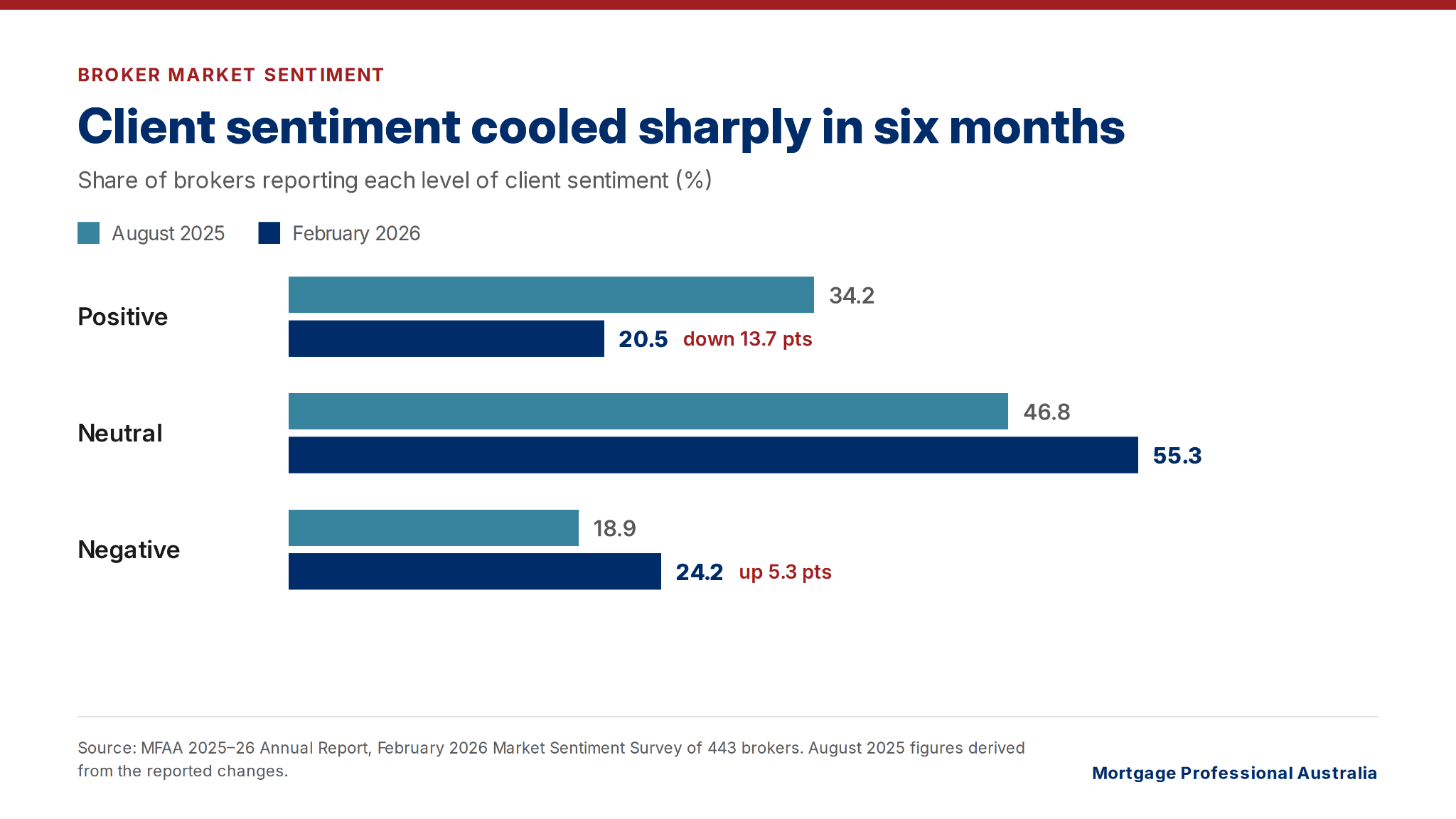
The MFAA's February 2026 Market Sentiment Survey of 443 brokers found just 20.5% reported positive client sentiment, down 13.7 percentage points from August 2025. Negative sentiment rose 5.3 points to 24.2%.
Refinancing remains a pressure point. Some 79% of brokers saw the same or more clients unable to refinance because they failed current lender serviceability tests, up from 71.8% six months earlier.
The association's own finances also tightened. Its operating surplus fell to $144,700 for the year to 30 June 2026, from $347,240, as revenue held at $11.51 million and expenses rose 2% to $11.36 million. Net assets rose 4% to $3.55 million.
The MFAA also commissioned its first international research across the United States, Canada, the United Kingdom, the Netherlands and Germany, examining regulation, remuneration and AI.
"The opportunity ahead is to build on our industry's strengths while preparing for change," Pannek said. "We will continue investing in professional standards, helping members embrace technology and ensuring the value of mortgage and finance brokers is understood by consumers and decision makers."