Australia’s largest home lender says correction is worse than anticipated – and it's coming for previously bulletproof cities

Commonwealth Bank has downgraded its housing forecast, now expecting national dwelling prices to fall around 9% from peak to trough this cycle, marking a bigger and broader correction than the bank had been pencilling in.
The revision lands as national dwelling prices fell 0.9% in August – a fifth consecutive monthly decline that leaves values 3.6% below their March peak.
Why CBA moved the goalposts
Trent Saunders, CBA’s senior economist, pointed to three drivers behind the downgrade:
-
Momentum has weakened faster than expected over the past three months
-
The downturn has spread into cities where tight supply was previously expected to cushion prices
-
The rate outlook has shifted higher following higher-than-expected inflation, with CBA now expecting the Reserve Bank of Australia (RBA) to lift the cash rate a further 0.25 percentage points to 4.6% in November
"The adjustment over the past three months has been larger and faster than we anticipated," Saunders said. A bank revising its housing forecast because prices are falling faster is one thing – revising it because it now expects another rate rise on top of an already-falling market is a materially more bearish signal.
No longer a two-city story
Sydney and Melbourne remain the weakest markets – Sydney fell 1.4% in August and sits 7.1% below its February peak, while Melbourne fell 1.1% and is 6.5% below its prior peak. CBA now expects peak-to-trough declines of around 13% in Sydney and 12% in Melbourne.
But the shift is happening across the country: Brisbane and Adelaide have each posted three straight monthly falls, and Perth has fallen for four months running – a sharp reversal from earlier in the year, when Perth prices were rising 2% to 2.5% every 28 days.
CBA now forecasts roughly 8% peak-to-trough falls across Brisbane, Perth and Adelaide.
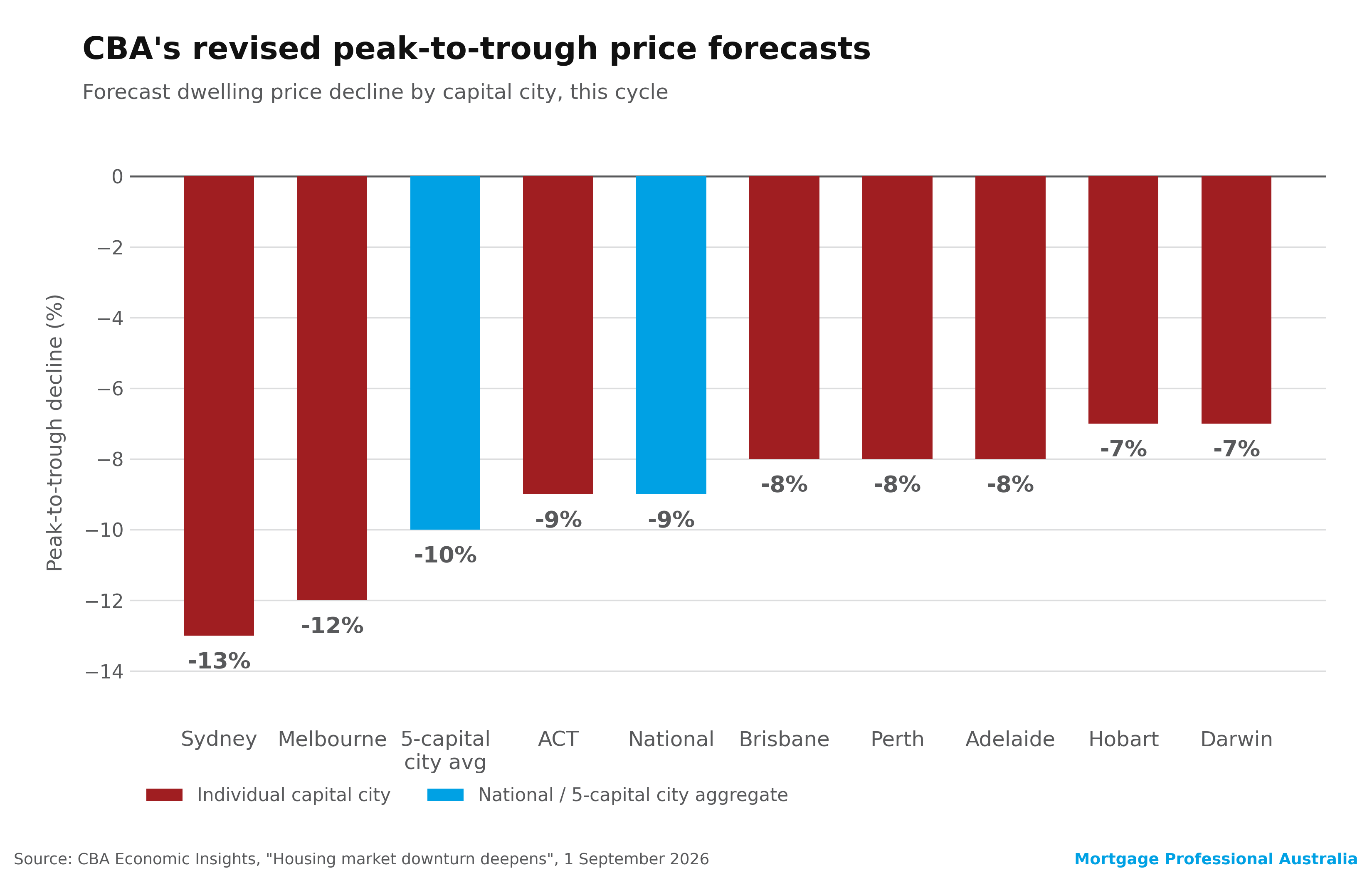
For years, the investment case for Perth, Brisbane and Adelaide rested partly on the idea that constrained supply would insulate them from the kind of correction Sydney and Melbourne were built to absorb. But Saunders conceded the downturn has spread precisely into the cities where it “wasn't supposed to”.
Read more: NAB warns housing downturn only a third done
The shift is showing up in how long stock is sitting on the market. In Brisbane, the median time a property spends listed has jumped from 15 days at the start of the year to 35 days over the three months to August. In Perth, it's risen from nine days to 22.
Auction clearance rates have softened too, giving buyers more choice and more time to decide than they had when competition was fiercer. It's a companion data point to MPA's recent reporting on the broader run of capital city price falls – the correction isn't just showing up in headline price indices, it's changing the actual mechanics of how properties sell.
What could turn it around – and what won't
CBA still expects the downturn to run its course, with prices stabilising and a modest recovery beginning in 2027 – forecast at around 2% national growth for the year. However, that number assumes that RBA rate cuts are coming in May and August 2027.
If the cash rate instead holds at 4.6% through 2027, CommBank estimates national prices would be roughly flat for the year. In other words: the recovery case is a rate-cut case, not a supply-and-demand case.
There are genuine tailwinds building in the background. As Saunders noted, "falling prices should improve affordability and increase the rental yield, drawing some buyers back into the market. The expected easing in monetary policy during 2027 should also provide some support. And housing supply is still very tight, with the vacancy rate a historically low level of 1.8% in August."
But he was careful not to overstate how much those factors can do in the near term: "These factors should eventually help the market stabilise, but they are unlikely to prevent a deeper cyclical adjustment through to the first half of next year."