House prices are falling in nearly every capital city, but a stalled approvals pipeline is presenting challenges

Australia's housing downturn is fast turning into the buyer's market many priced-out purchasers have been waiting for, with national home values falling for a fifth consecutive month in August.
Cotality's Home Value Index – the firm's monthly measure of dwelling value changes across the country – dropped 0.9% over the month, following a 1.2% fall in July, leaving values 3.6% below their recent peak even as they remain 2.7% higher than a year earlier.
Nearly every capital city recorded a fall, and the softening is spreading into regional markets too. But for brokers advising clients that now might be the moment to buy, one figure complicates the picture: approvals data show the supply side of the market is still barely moving.
House prices fall
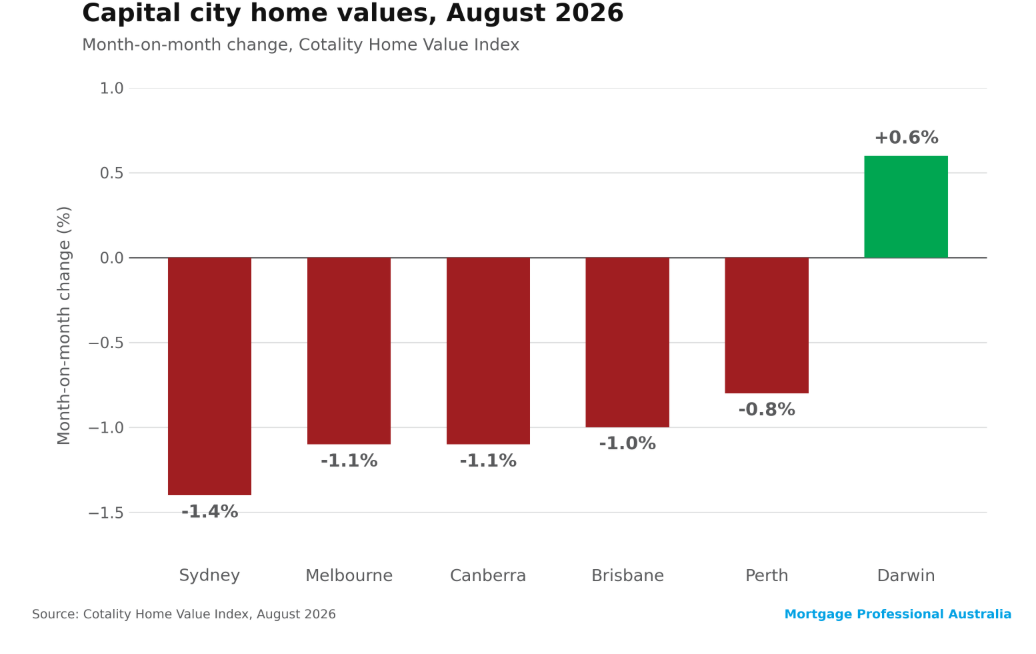
Roughly 93% of Australian suburbs recorded a price fall in August. Sydney led the declines among the capitals, falling 1.4%, followed by Melbourne and Canberra, both down 1.1%, and Brisbane and Perth, down 1% and 0.8% respectively. Darwin was the only capital to record a rise, up 0.6%, though it retains the country's cheapest median dwelling value at $647,000.
Gerard Berg, Cotality's head of research, said the pattern of decline typically starts in the most expensive suburbs before spreading outward. "We have seen a slower spread across the other parts of cities," Berg said. In Sydney, some of the more affordable outer areas – including Camden, Penrith and the Blue Mountains – have so far posted the city's strongest 12-month growth, a pattern Berg expects to shift as the downturn broadens into cheaper suburbs.
Sydney slide outpacing the last major correction
Sydney values are now 7.1% below their February peak – a pace of decline that has overtaken the 2022–23 correction, when the Reserve Bank of Australia (RBA) lifted the cash rate by 425 basis points and national home values fell 6.6% peak-to-trough.
This time, recent changes to housing taxation and investment settings are compounding the effect of conflict-driven rate rises on buyer demand, adding to the broader run of capital city price falls now recorded across the country.
For first home buyers with finance approved and a deposit ready, Berg said the softer market is creating an opening – but cautioned against trying to time it perfectly. "Being such a high value purchase, you need to be confident you are making the right decision," he said. "But if you are looking to hold the property for an extended period of time, you don't want to try and pick the bottom of the cycle. You almost certainly won't find that exact point."
The one roadblock: approvals still aren't moving
Falling prices are only half of what makes a genuine buyer's market – the other half is supply, and that's where the picture turns less favourable.
ABS building approvals data for July show total dwelling approvals fell 3.6% to 17,687 nationally, driven by a 4.2% drop in private sector house approvals to 10,199 – even as the series has trended gradually upward through 2026.
Non-residential approvals moved in the opposite direction entirely, surging 14.4% to $9.93 billion in value, the second-highest month on record, as data centre construction draws labour and materials away from home building.
That matters for how real this buyer's market actually is. A structural shortage in new supply was already stretching the country's 1.2 million-home Housing Accord target, and the warning that Australia will miss that target by 186,000 homes predates this month's price falls.
Tim Reardon, chief economist at the Housing Industry Association (HIA), has pointed to federal Budget measures – increased taxes on established housing and the government's ban on SMSF property lending – as active drags on new-home finance.
If falling prices discourage developers from starting new projects at the same time approvals are already soft, the shortage that has kept a floor under prices for years won't ease just because existing-stock prices are falling.
Buyers may get a cheaper established home, but the underlying supply problem doesn't go away.