Waiting lists are climbing again after six months of improvement and a third of mortgage holders have no protection in place whatsoever.

Start with the number that should worry every mortgage adviser more than it currently does: 36% of UK mortgage holders, that’s roughly 2.34 million people, have no life insurance, income protection or critical illness cover at all, according to research by LifeSearch and the HomeOwners Alliance covered by Mortgage Introducer.
Nearly half said they couldn't keep up mortgage payments within six months of losing their income to illness or injury. Most had talked to someone about protection during the buying process. Most never acted on it.
Read next: Millions of mortgage holders lack protection – study
That gap between conversation and action is exactly what the regulator has now put a spotlight on. The FCA's market study into pure protection, covering term assurance, critical illness and income protection published its interim findings in January 2026, and as Mortgage Introducer reported, it explicitly named mortgage completion as a natural trigger point for the protection conversation, without recommending caps or restrictions on how advisers are paid for it.
A final report is due in Q3 2026. Whatever it lands on its outcome is pretty certain: the regulator agrees the point of mortgage sale is where this should happen, and is asking why so much of it still doesn't.
Where health cover fits (and where it doesn't)
Life insurance, critical illness and income protection are "pure protection" products, and most mortgage advisers are already authorised to sell them, it's practically built into standard mortgage advice, since a lender wants the loan protected.
Private medical insurance sits in a different regulatory bucket entirely: it's a "non-investment insurance contract," the same category as buildings and contents cover, and it needs its own FCA permission that isn't automatically part of a mortgage or protection authorisation.
That's a big part of why PMI rarely comes up in a mortgage appointment even when everything else about the client's situation like a young family, a big loan, patchy sick pay from their employer can makes it relevant. It's not that advisers don't see the need. It's that most firms simply aren't set up, permission-wise or expertise-wise, to have that conversation themselves.
Why the NHS backdrop makes the case sharper
The reason this is worth keeping front of mind is the current state of the NHS itself. Waiting lists fell for six straight months to a three-year low of 7.11 million in March 2026, according to NHS England's own data then reversed, and have climbed every month since, back to 7.33 million by July.
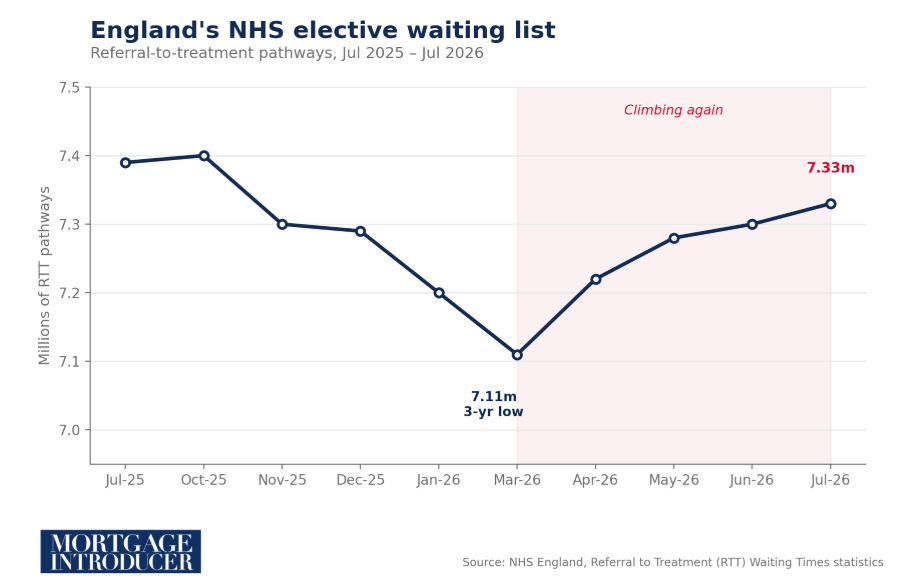
That reversal matters for a very specific reason in a mortgage context: the longer a client waits for NHS treatment, the longer they're potentially off work, and the more that stresses income protection claims and household affordability. The specialties carrying the heaviest backlogs are trauma and orthopaedics (830,000 people waiting), ophthalmology (621,000) and ENT (594,000) and are also, not coincidentally, common causes of extended time off work. A client with a hip or shoulder injury waiting the better part of a year for surgery on the NHS is a client whose income protection policy, if they have one, is about to earn its premium.