Investor retreat and shift to house-led development push off-plan share to lowest level since 2013

The share of new homes in England and Wales sold off-plan dropped from 36% in 2024 to 33% in 2025, according to Hamptons' annual off-plan sales index, which draws on Connells Group new homes data and Land Registry completions. The figure is the lowest recorded since 2013.
Off-plan sales peaked in 2016 at 49%, the same year the second home stamp duty surcharge was introduced. That policy change reduced buy-to-let investor demand, particularly in southern markets, where investors had traditionally accounted for a significant share of off-plan purchases. The surcharge was raised further, from 3% to 5%, at the end of 2024, adding further downward pressure.
Share of new homes sold off-plan (England and Wales)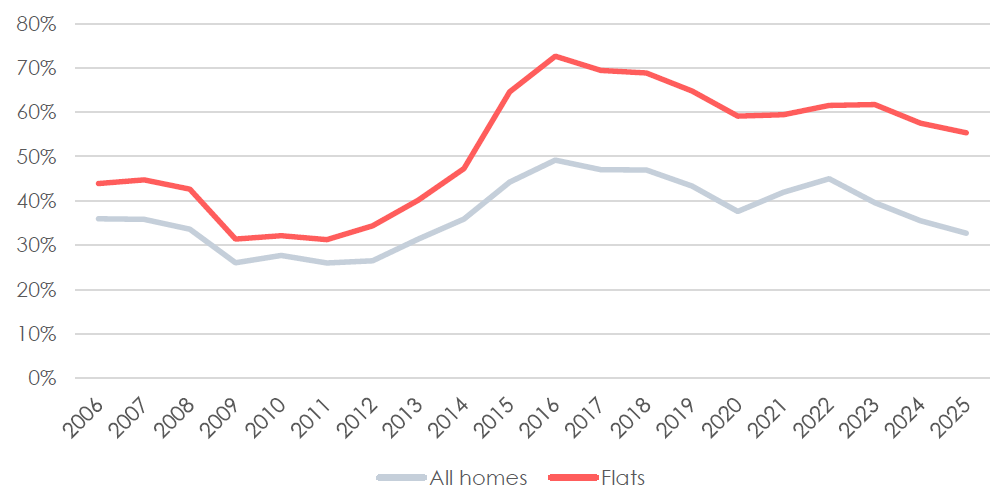 Source: Hamptons and Land Registry
Between 2016 and 2025, London, the South West and the South East each recorded falls of around 20 percentage points in off-plan sales — the sharpest regional declines in England and Wales.
Flats remain the property type most likely to be sold off-plan. In 2025, 55% of flats in England and Wales were sold before construction was complete. The North West recorded the highest regional share at 69%, ahead of London at 65%. At local authority level, Oldham led with 94% of new flats sold before completion, followed by Wolverhampton (86%) and Salford (81%).
Off-plan sales of houses were less prevalent. In 2025, 40% of terraced homes, 29% of semi-detached properties and 21% of detached houses were sold before completion. Yorkshire and the Humber recorded the highest share of off-plan house sales at 29%, while London was the only region where fewer than one in five houses were sold off-plan, at 15%.
Share of new homes sold off-plan (England & Wales) 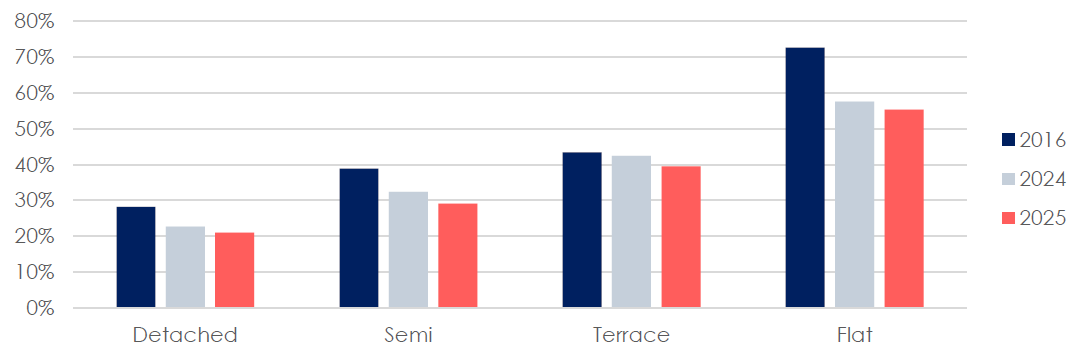 Source: Hamptons and Land Registry
Housebuilders have moved away from flat development in recent years, despite flats being more likely to sell off-plan. Flats accounted for 54% of new homes sold in 2007 but only 22% by 2025. As a result, flats made up just 38% of all off-plan sales in 2025, down from 55% in 2016.
The decline in off-plan sales has extended the period for which developers must carry development finance. Housebuilders in England and Wales incurred an estimated £264.5 million in additional financing costs in 2025 compared with 10 years earlier — equivalent to £3,125 per new home sold, up from £2,934 in 2024.
Approximately half of this increase is attributed to higher interest rates, adding around £1,800 per home in 2025. The end of the Help to Buy Equity Loan scheme in 2023 has also lengthened the time required to sell completed homes, adding further cost pressure.
 "The share of new homes sold off-plan continued to slide last year," said David Fell (pictured right), lead analyst at Hamptons. "Over the past decade, the share of new homes sold before construction is complete has fallen by around a third.
"This partly reflects the loss of buy-to-let investors from the market, who have traditionally been the largest buyers of off-plan homes. However, the shift away from building flats towards houses, which are more likely to be sold after they're finished and ready to move into, has increasingly contributed to the downward trend.
This shift towards lower-density, house-led development is likely to complicate the government's efforts to accelerate housing delivery, according to Fell.
"Housebuilders are increasingly focused on protecting margins, which has favoured faster-selling suburban schemes," he added. "By contrast, profits on slower-selling, high-density sites have been eroded, or in some cases, wiped out entirely by rising finance costs.
"In a higher inflation, higher interest rate world, off-plan sales have rarely been more valuable. The cash they generate allows housebuilders to pay down expensive development finance earlier and help offset the substantial upfront costs of materials and labour. Many of the materials needed to build new homes are highly energy-intensive, meaning their costs have risen far faster than wider inflation."
Want to be regularly updated with mortgage news and features? Get exclusive interviews, breaking news, and industry events in your inbox – subscribe to our FREE daily newsletter. You can also follow us on Facebook, X (formerly Twitter), and LinkedIn.