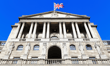
Major banks have raised mortgage rates twice in a week as swap rates climb and inflation hits 3.1%

UK inflation climbed to 3.1% in August, the Office for National Statistics (ONS) confirmed on Wednesday, heaping further pressure on the Bank of England's Monetary Policy Committee (MPC) ahead of its base rate decision tomorrow.
The Bank has held at 3.75% since December, but July's 6–3 vote – with three members already pushing for a rise to 4% – has left Thursday's outcome far from certain.
Major lenders have not waited for the verdict. Halifax, Nationwide, HSBC, and Santander have all raised mortgage rates in recent days – some twice in a week – as swap rates climb on the back of rising oil prices and stubborn inflation. For brokers, the repricing is itself a signal of where the market expects the MPC to land.
What lender pricing is telling the market
Paul Hampton (pictured top right), owner and mortgage consultant at Approved Mortgage Solutions, told Mortgage Introducer the repricing currently under way is rooted in swap rates, and what those rates imply about the direction of monetary policy.
"A swap rate is almost a prediction of what the base rate will be," he said. "So a two-year swap is more or less a prediction of what the base rate will be in two years' time, five years, and so on and so forth. Basically, inflation is a little bit more out of control than people would have hoped for. The unemployment is on the rise and there's lots of potential redundancies forecast, so those things alongside the market generally means lenders are a little bit cautious."
Hampton said markets have already converged on the expectation of a quarter-point rise on Thursday, and lenders have responded accordingly.
"Because the swaps are going up, the lenders are all repricing quickly, so before it happens. It's as simple as that. It's the economy, unemployment, the prediction of interest rate rises, and the uncertainty in the Middle East."
Hampton predicted a 5-4 vote split on the MPC, with a quarter-point rise the most likely outcome, but he acknowledged the housing market's fragility meant the decision was far from straightforward.
"I expect a quarter percent rise, but I expect it to be really close. Holding station and not doing anything isn't getting any results."
Inflation adding to base rate pressure
Rhys Edwards (pictured top left), mortgage consultant at Brooks Financial, told Mortgage Introducer the inflation data had hardened the case for a rate increase, with fuel prices and food inflation both feeding into the picture.
"We kind of knew it was coming into the marketplace with all the fuel prices still going up because of obviously all the issues still happening in the Middle East. That's definitely affecting the price for us at the pump, but obviously all the worries of inflation hitting the market. We've got food inflation, of course, with such a dry summer that's starting to roll through. So there is more increased pressure on the Bank of England to increase that base rate to make it a bit more expensive for us all, but ultimately to try and control this surge in inflation."
Edwards said the moves by major lenders over the past week reinforced that expectation.
"The fixed-rate pricing, certainly when it's around the Bank of England base decision, does indicate potentially that there may be an increase coming that way. The banks are ultimately also controlled by the wholesale market swap rates. So that is something I have been watching, and you can see the swap rates going up and up and up. That's the benchmark where the banks are kind of pricing from. With the two increases in a week, I think the banks are guessing that there will be an increase in the base rate this week. That would be my prediction."
What brokers should be telling clients now
With the decision imminent, both brokers were clear that clients – particularly those approaching the end of fixed deals – should act without delay. Hampton said the urgency for brokers to secure rates on behalf of clients had intensified sharply this week, as the window for locking in current pricing narrowed with each repricing cycle.
"From our point of view, it increases the urgency to get stuff done," he said. "It shortens the lead-in time and the consideration time for remortgages and product transfers."
He described a situation this week that illustrated the pace of change. A client had asked to rearrange her 4pm appointment until the following week. Hampton urged her not to wait. Between sending that email and the client joining the call, the lender notified brokers of an imminent rate increase.
"We need to do something today," he told her.
On the question of first-time buyers, Hampton said the calculus remained more nuanced than headlines might suggest. Those renting faced the prospect of rent increases well in excess of any mortgage rate movement.
"If you're renting, then it's not going to be significantly different to your rent, and your rents are going to go up next year anyway."
Edwards said that in periods of uncertainty like this, clients tended to lean toward longer-term fixed rate products for additional security, but that advice still had to be tailored carefully to individual circumstances.
"Clients do become more risk wary when there's news like this, inflation going up and rates. Certainly, you generally see clients asking more about five-year fixes for a bit more security, because people kind of want to lock in, worrying that it might get worse, so you've really just got to listen to your clients' needs and advise them."
Want to be regularly updated with mortgage news and features? Get exclusive interviews, breaking news, and industry events in your inbox – subscribe to our FREE daily newsletter. You can also follow us on Facebook, X (formerly Twitter), and LinkedIn.