Britain's biggest listed broker network handled more mortgage business than ever in the first half of 2026, yet profits barely moved

If you've spent 2026 working through a queue of borrowers whose fixes are ending while purchase clients hold off, Mortgage Advice Bureau's latest numbers will look very familiar.
The Derby-based group's interim results which came out just a few days ago, showed total mortgage completions up 16% to £16.5bn in the six months to 30 June. Revenue rose 8.6% to £161m. Adjusted pre-tax profit rose only 2.1% to £14.8m, statutory pre-tax profit fell 35.7% to £6.2m, and the adjusted margin slipped from 9.8% to 9.2%.
The reason is simple. The growth came from refinancing, especially product transfers. Founder and chief executive Peter Brodnicki acknowledged that these deals "carry a lower revenue contribution than purchase lending". More work, thinner fees.
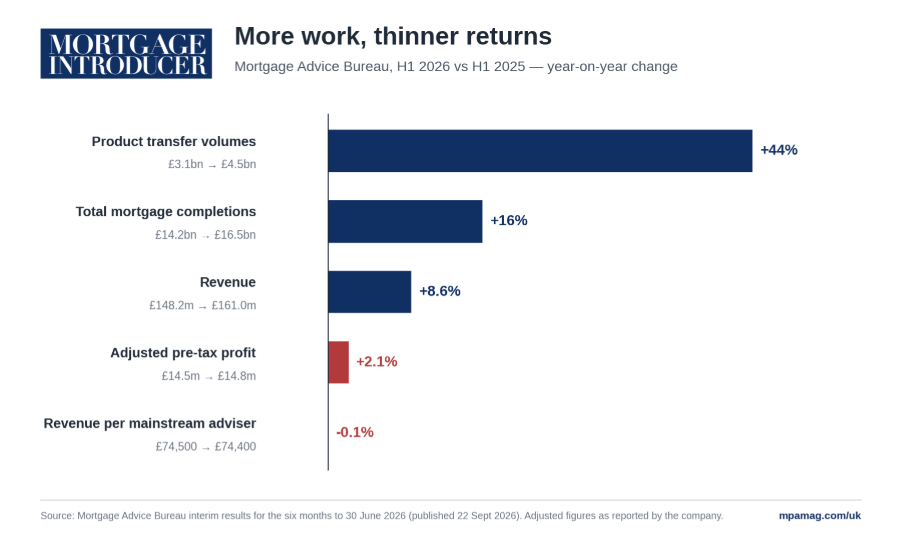
MAB's product transfer volumes rose 44% to £4.5bn, slightly ahead of a market that grew 40% to £143.2bn. Across the market, purchase lending slipped 2% while remortgage lending rose 30%. MAB said it expects the mix to stay weighted towards product transfers while affordability remains tight.
What the City thinks
Investors have been harsh, though not everyone thinks they're right. Writing in Investors' Chronicle's Stockpickers column this week, Christopher Akers noted that MAB's shares have lost more than 40% of their value this year. At around 385p they trade on roughly seven times forward earnings, with a projected 2027 dividend yield close to 7%. The column rates the stock a buy.
MAB is also pushing ahead with its plans. It moved from AIM to the LSE's Main Market on 1 May with an eye on the FTSE 250. A rebrand to "MAB", with a new franchise option for firms, is due in November.
A warning before the results
The market already knew trouble was coming. On 9 September, MAB cut its full-year guidance to adjusted pre-tax profit of about £38m, against a consensus of £43.4m. The shares dropped 19% to 399p that morning.
MAB gave two reasons. First, the purchase recovery hoped for in January hasn't come. The group cited HMRC datashowing transactions 3% lower in the first seven months, and approvals for house purchase down 15% year-on-year in July. The Bank of England's figure of 56,053 July approvals was the lowest monthly total since January 2024.
Second, new lead flows at Fluent, the lead-generation business MAB bought in 2022, have been slow to start. That takes about £5m off Fluent's 2026 contribution and pushes the uplift into 2027.
Even so, £38m would still be growth of roughly 5% on 2025's £36.3m. That's disappointing, but it's not a collapse.
Read next: Stuck in place: Why UK homeowners are not moving house
Rates are heading the wrong way
The wider picture doesn't help. The Bank of England held base rate at 3.75% on 17 September, its sixth hold in a row, with CPI inflation rising to 3.1% in August. Energy costs and Middle East tensions have pushed swap rates up. A poll of mortgage professionals before the meeting found more than a third expected a rise, up from 11% in July.
Talk of cuts has largely given way to talk of a possible hike. Lenders had already been nudging fixed rates upwards.
Read next: Mortgage adviser numbers rise in H1
What it means for brokers
The adviser figures are the most useful part for anyone running a firm. MAB's average number of mainstream advisers rose 8.7% to 2,163, reaching 2,194 by the end of June. Revenue per adviser was flat at about £74,400 for the half. The network is growing its headcount but not getting more out of each adviser.
The detail that should worry firms most is buried in the results: protection attachment rates fell, reducing the contribution from protection income, which carries higher margins. That's what happens when a quick PT becomes a rate-switch conversation and nothing else. It also suggests where margin can be recovered: putting protection at the centre of the advice rather than adding it at the end.
Read next: Unemployment cover is the protection gap brokers are missing
The pipeline is the bright spot. UK Finance estimates around 1.8 million fixed-rate deals mature this year, and MAB says 2027 maturities will be around 30% higher again. The refinancing volume is coming either way. The firms that make it pay, and keep those clients close for the moves they've put off, will be best placed when purchase activity finally returns.
Want to be regularly updated with mortgage news and features? Get exclusive interviews, breaking news, and industry events in your inbox – subscribe to our FREE daily newsletter. You can also follow us on Facebook, X (formerly Twitter), and LinkedIn.