Asking prices nudged up for the first time since May, but a stack of fresh data shows a seller in Scotland has more than double the chance of a sale than one in London — just as fixed mortgage rates start climbing again

There's a temptation, every time Rightmove drops its monthly House Price Index, to reach for the nearest one-line verdict: up good, down bad. September's report, published Monday, doesn't really allow for that. Yes, average asking prices rose 0.7% between August 9 and September 12 — the first monthly increase since May and, according to Rightmove, a slightly bigger jump than usual for the time of year. But scratch below that headline and the picture brokers are actually working with is far messier.
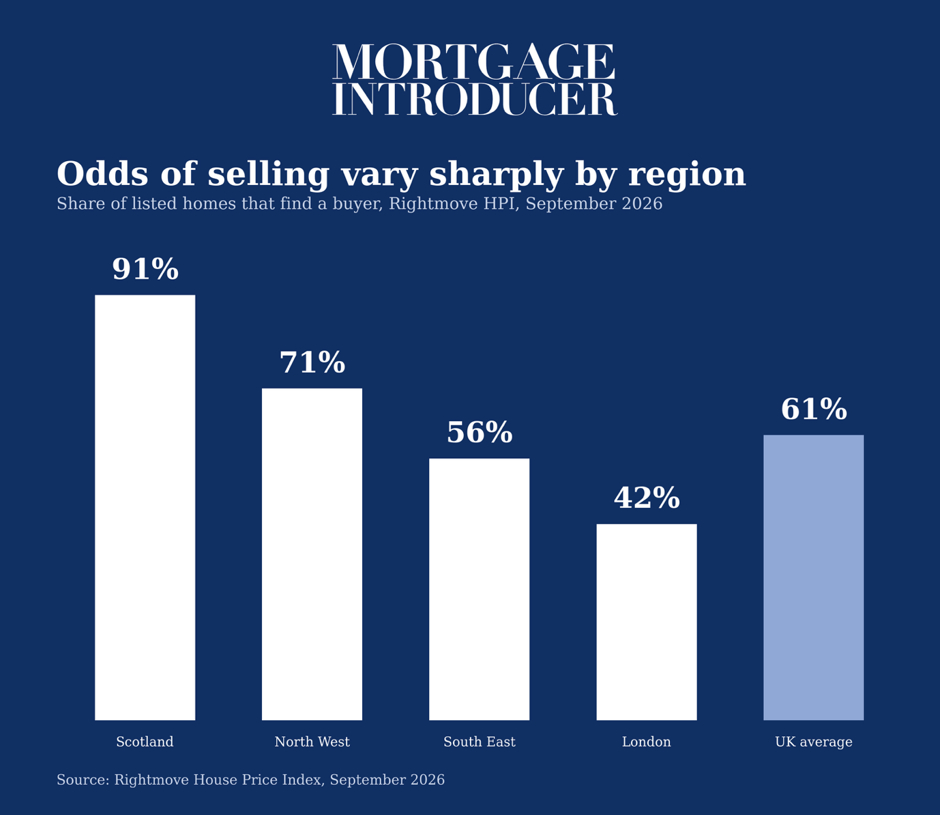
Buyer enquiries are still running 9% below where they were this time last year. Sales agreed are down 9% too, and the number of homes for sale has hit a 12-year high for the season — a genuinely unusual combination of more stock and less appetite to buy it. Rightmove now puts the average chance of a listed home actually finding a buyer at 61% nationally. That's down from 74% in 2021, when the market was, in Rightmove's own words, "frenetic."
A country, not a market
What the 61% figure disguises is how wildly that probability swings by postcode. In Scotland, nine in ten homes for sale are finding a buyer. In the North West of England it's 71%. Fall south and east, though, and the numbers thin out fast: 56% in the South East, and just 42% in London — meaning a majority of London listings are currently not converting into a sale.
Read next: Buyer demand surges in back-to-school bounce, Rightmove data shows
Price data tells a similar regional story. The average UK asking price now sits at £367,440, but that spans a gap of nearly £460,000 between the cheapest and priciest regions. They vary from £199,973 in the north-east of England up to £657,775 in London. London also posted the biggest monthly price rise anywhere in Britain (up 1.8%), while Wales saw the steepest fall, down 0.4% to £268,610. For advisers working across regional patches, it's the difference between two entirely different conversations with clients.
Colleen Babcock, Rightmove's ‘property expert’ said that with a "large crowd of sellers chasing a smaller number of buyers," realistic pricing is now doing most of the work that used to be done by demand alone.
Marc von Grundherr, director of estate agency Benham and Reeves, agreed that getting the price right on day one is "absolutely vital" in London specifically where buyers face so much choice that an over-ambitious asking price can sit unsold long enough to start looking stale, forcing a seller into the very price cut they were trying to avoid.
Rates are the other half of this story
Rightmove's tracker shows the average two-year fixed rate climbing to 5.29%, up from 5.09% the previous month and that's a milder move than some lenders have made. Major names including Halifax, Nationwide, HSBC and Santander have repriced upward twice in a fortnight as swap rates climbed past 4.70%, pushed higher by renewed volatility in the Middle East and stickier-than-hoped inflation. The Bank of England held Bank Rate at 3.75% at its September 17 meeting, but only just the Monetary Policy Committee split 6–3, with three members pushing for an immediate rise to 4%. UK CPI inflation hit 3.1% in August, still well above target, and the Bank itself has flagged that further increases can't be ruled out if energy-driven price pressure persists. For a market already nervy about affordability, that's an uncomfortable backdrop to an "autumn bounce."
Rightmove's Matt Smith, framed it as two forces pulling in opposite directions: renewed buyer appetite this month, set against mortgage-rate volatility that's still holding some would-be movers back from committing.
An activist investor — and a correction worth making
Running alongside the HPI report is a story that matters for anyone with a stake in Rightmove's future: activist fund Sachem Head Capital Management, led by Scott Ferguson (a protégé of Bill Ackman, not, as some coverage has wrongly suggested Ackman's Pershing Square itself), has built a 6% position and is reportedly pushing Rightmove to take on debt for share buybacks.
Some City observers read that as a prelude to a takeover approach; Rightmove's shares, which fell from £8.18 in summer 2025 to around £4.10 in May amid AI-driven sell-off fears, have since recovered to roughly £5.
For brokers, the relevance isn't the share-price drama it's what a change of strategy or ownership could mean for the tools many use daily, including the joint mortgage-eligibility tool Rightmove built with Nationwide.
The 40-day pitch
Rightmove's chief executive, Johan Svanstrom, has meanwhile been setting out a more ambitious fix for the market's structural problem: speed. The average UK seller currently waits 64 days to find a buyer, and then another 150 days to complete, a process Svanstrom wants to compress to 40 days, partly by giving buyers earlier access to data such as planning history, EPCs and title deeds, so fewer chains collapse deep into the process over information that should have surfaced on day one. It's a bold target, and one that would matter enormously to conveyancers and brokers alike if it ever landed. Fewer fall-throughs generally mean fewer wasted applications and less client frustration all round.
Whether that vision survives contact with an activist shareholder pushing for buybacks rather than big platform investment is, for now, an open question.
What this means for advisers this week
A client selling in London or the South East is operating in a genuinely tougher market than the national headline suggests and it’s worth factoring into conversations about bridging finance, the timing of a rate lock, or porting an existing deal rather than starting a fresh application from scratch.
A client in Scotland or the North West, by contrast, is more likely to be in a seller's market, where speed of mortgage approval rather than price negotiation becomes the real bottleneck.
The autumn bounce is real. It just isn't evenly distributed, and neither should the advice that follows it be.