The Resolution Foundation wants council tax and stamp duty replaced with a flat 0.7% annual levy

Households in the capital pay billions of pounds less in property tax every year than the value of their homes would justify according to at least one body. Families in the North East are among those making up the difference, according to the report published five weeks before John Healey's first Budget as chancellor.
The Resolution Foundation's Home Economics briefing calculates that in 2024-25 London households paid £3.1bn less in council tax and stamp duty combined than they would have under a system reflecting what their homes are actually worth. Hannah Aldridge, senior research and policy analyst at the think tank, called the shortfall "a huge £3.1 billion subsidy for those living in London". She argues it is effectively bankrolled by homeowners elsewhere in England.
The problem is that the system hasn't kept up with house prices. Council tax bands in England still rest on 1991 valuations. Since 1995, prices in inner London have climbed more than sevenfold, against a little over fourfold in the North East. By 2030-31, the foundation reckons, someone in a £100,000 home will face an effective property tax rate almost three times that paid on a £1m home.
Around 80% of London households come out ahead under the current arrangements. Meanwhile, 85% of North East households are on course to overpay relative to their home's value, by an average of £710 a year by the end of the decade. Outside the capital, just over two-thirds of English households are overpaying, according to the foundation.
Read next: Burnham's tax plans threaten biggest property shake-up in years
Burnley versus Westminster: the gap in pounds
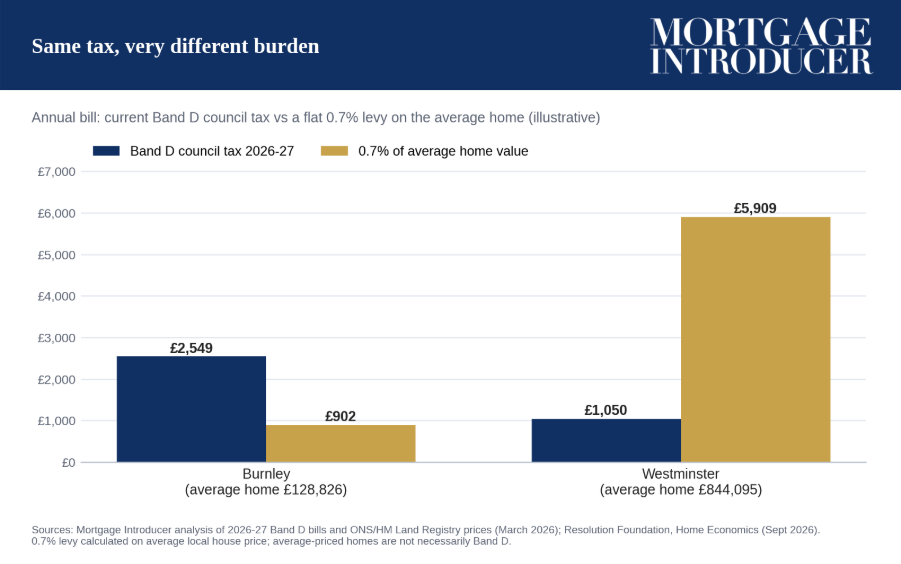
The imbalance is easiest to see at the extremes. An analysis of every English council's 2026-27 bill against local house prices found Burnley households pay the equivalent of 1.98% of their home's value in council tax each year, the highest ratio in the country. Westminster came bottom at 0.12%.
In cash terms, the Band D bill in Burnley, where the average home is worth about £129,000, is £2,549. In Westminster, where the average is about £844,000, it is £1,050.
Apply the Resolution Foundation's flat 0.7% rate to those average prices, and the picture flips. The Burnley bill would fall to roughly £900 a year, while the Westminster bill would jump to roughly £5,900. That comparison is illustrative, since not every average-priced home sits in Band D. Even so, it shows why reform is popular in the Red Wall and resisted in prime London.
A 0.7% levy, and a warning against scrapping stamp duty overnight
The foundation's plan is to abolish stamp duty on main residences and replace both it and council tax with a single, revenue-neutral annual charge of 0.7% of a property's value. Occupiers would pay it. There would be a rebate for low-income households and a deferral option for those who are asset-rich but cash-poor. A £350,000 home would attract £2,450 a year and a £1m property £7,000.
For brokers, the stamp duty argument have all been heard before. The foundation estimates the tax stops around 100,000 house purchases a year, deterring downsizers and people who would move for work.
But it warns that simply announcing abolition would backfire. It says this would stall the market as buyers wait, hand existing owners an unearned windfall and leave a £15bn hole in the public finances. Instead, it wants the chancellor to use the Budget to set out a roadmap. That would begin with a fresh national database of property valuations and an independent commission, and include a pledge not to touch stamp duty rates or thresholds for the rest of the parliament to keep the market steady.
Don't expect a big bang in October
Burnham shut down the prospect of stamp duty reform this autumn back in July. Asked whether he would change or scrap the tax at the next Budget, he said: "That won't be happening."
The pressure for change hasn't gone away, though. A parliamentary petition calling for an independent review of council tax and stamp duty passed the 100,000 signatures needed to be considered for debate. More than 100 Labour MPs are said to be pushing for reform, amid reports that the government has weighed a proportional property tax or land value tax as replacements.
Read next: Council tax by town: full 2026 rankings vs house value
The mansion tax is the live risk
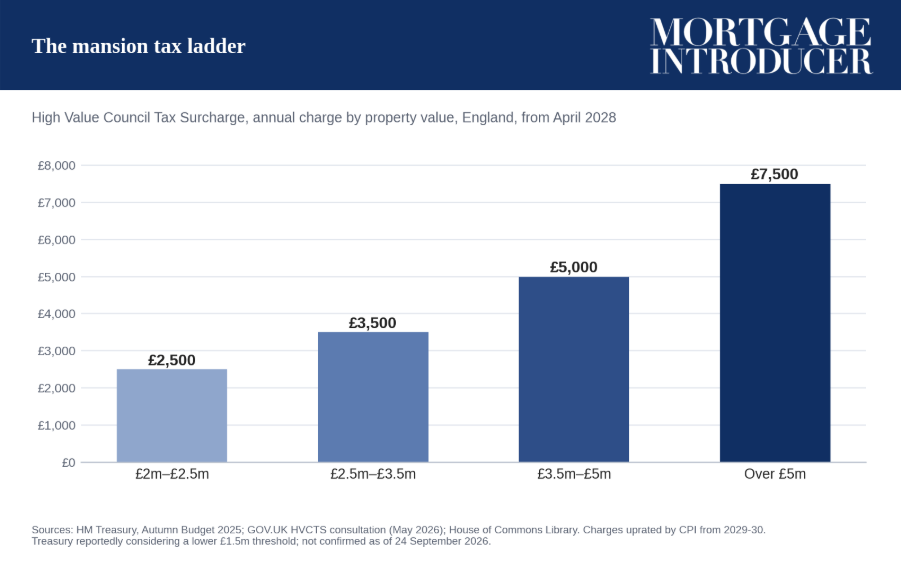
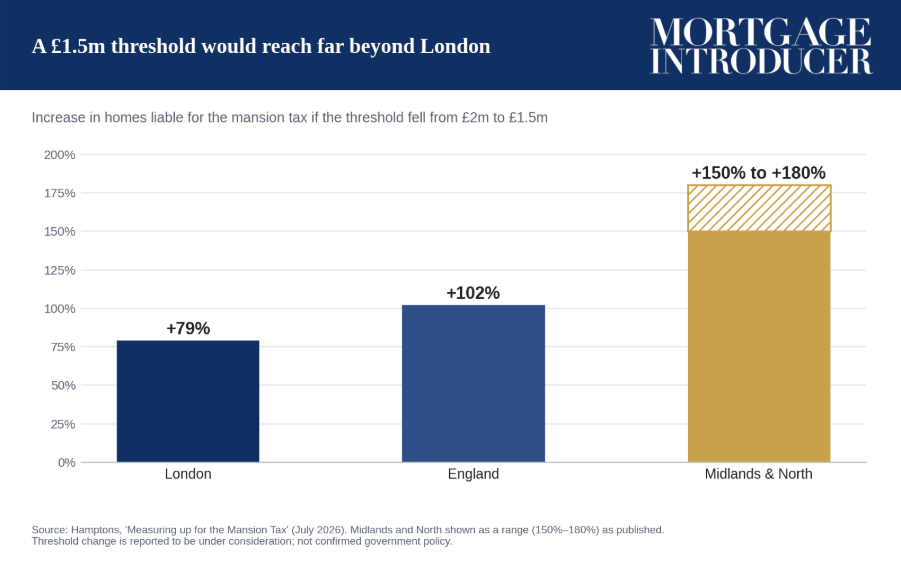
The more pressing issue for higher-value clients is the High Value Council Tax Surcharge. The Treasury is reported to be considering cutting its threshold from £2m to £1.5m, roughly doubling the number of homes caught to about 271,000. Nothing has been confirmed. As it stands, the surcharge starts in April 2028 at £2,500 a year for homes worth £2m to £2.5m, rising to £7,500 above £5m.
Analysis by Hamptons suggests a lower threshold would hit regional wealth hardest. It would increase the number of liable homes by 79% in London but by 150% to 180% across the Midlands and the North. The existing £2m line is already distorting deals, with buyers and sellers negotiating prices down to stay under the mansion tax threshold.
'A big political call'
Not everyone buys the foundation's framing. Dan Neidle of Tax Policy Associates told The Times that a London buyer who stretched to a 90% mortgage on an expensive home, now worth less in real terms, can hardly be called undertaxed. He argued that compared with a northern counterpart on similar income and with similar equity, the Londoner has neither a bigger home nor more wealth.
Lucian Cook, director of residential research at Savills, warned that merging a local annual tax with a national transaction tax would be complex, costly and disruptive to both the housing market and council funding. It would be, he told the paper, "a big political call to make".
The Treasury said it had already acted on the imbalance whereby band D homes in towns such as Darlington or Blackpool pay more council tax than £10m Mayfair mansions. It added that tax decisions are for the chancellor at fiscal events.
Read next: Why the mansion tax could freeze the prime market
What it means for brokers
-
Stamp duty: Plan for no change on 28 October, and say so to nervous movers who might otherwise delay.
-
Mansion tax: Clients buying or remortgaging between £1.5m and £2m should know the surcharge could reach them. That matters for affordability conversations and for negotiations around the threshold.
-
Longer term: A value-based annual tax would redraw affordability calculations nationally. Monthly outgoings would rise for many Londoners and fall for most households elsewhere, and deferral schemes could interact with later-life lending. Reform on that scale is years away, but a new valuations database would be the signal that it's coming.
Read next: Tories' stamp duty vow 'could be transformative'
Want to be regularly updated with mortgage news and features? Get exclusive interviews, breaking news, and industry events in your inbox – subscribe to our FREE daily newsletter. You can also follow us on Facebook, X (formerly Twitter), and LinkedIn.