YouGov’s 2026 survey of 30,000 UK adults shows shifting brand intent across generations

Nationwide Building Society has extended its lead as the UK’s most considered financial brand, with a third of UK adults saying they would choose it the next time they are in the market for a financial product — a margin no other bank or building society comes close to matching.
YouGov’s BrandIndex 2026 survey, which tracks 36 banks and building societies across more than 30,000 UK adults, reveals Nationwide’s consideration score at 33.5%, up from 31.2% the previous year. Its nearest rival sits 11.7 percentage points behind — a gap that has grown from 10.6 points in 2025.
Behind Nationwide, the high-street names cluster tightly. Lloyds Bank (21.8%), NatWest (20.8%), Santander (20.6%), Barclays (20.3%), HSBC UK (19.6%) and Halifax (18.2%) are separated by just 3.6 percentage points across six brands.
Behind the rankings: the favorite and the newcomer
Nationwide maintains its top ranking as its mutual structure, returning around £440 million to approximately 4.4 million members through its latest Fairer Share payments in May 2026, gives it a consumer proposition that high-street banks cannot directly replicate.
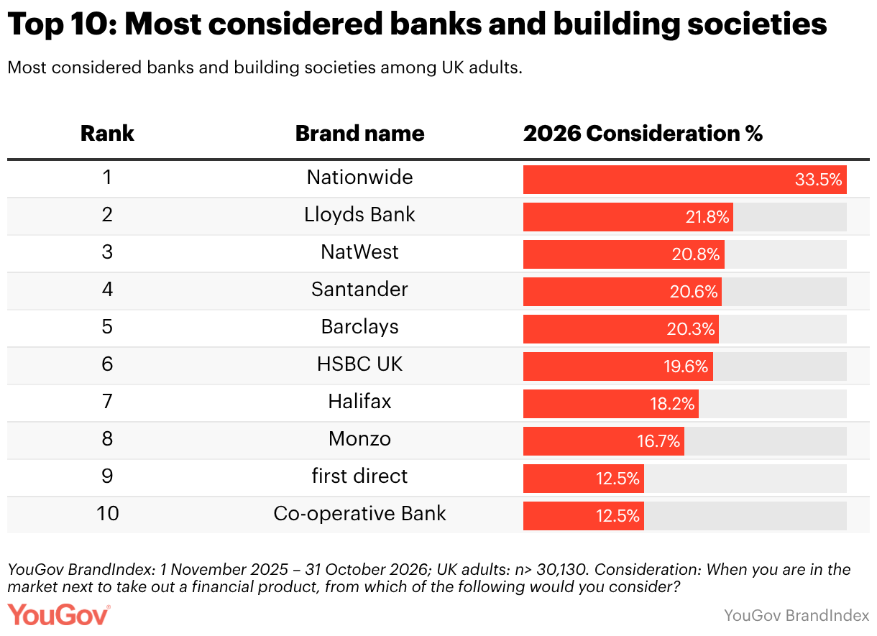
The more significant movement sits further down the table. Monzo recorded the largest year-on-year gain of any brand, rising 2.7 percentage points to 16.7% — placing it eighth overall, ahead of first direct and the Co-operative Bank.
The generational split behind that number is where brokers should pay attention. Monzo is considered by 22% of Gen Z adults but only 5.4% of Baby Boomers+, a gap of 16.6 percentage points. Revolut follows the same pattern, at 15.5% among Gen Z versus 4.3% among Baby Boomers+.
Gen Z is now entering the first-time buyer market. These borrowers have grown up with app-based banking and are more likely to begin their financial product search through a digital-first lens, including lenders they already bank with day to day.
Not every established brand held its position. Halifax dropped 1.5 percentage points to 18.2% — the largest decline in the top ten. That fall coincides with Lloyds Banking Group’s plans to phase out the Halifax brand during 2026 and 2027, a strategic decision that appears to be registering with consumers before the rebrand is complete. Lloyds Bank itself rose 1.2 points to 21.8% over the same period.
What the data means for the broker channel
Consideration scores are a leading indicator of product intent, not satisfaction with an existing provider, but it shapes the conversation from the moment a first-time buyer walks through the door. When a brand’s score rises, it signals that more consumers are actively willing to include it in a shortlist.
For lenders, a strong consideration score can generate inbound consumer enquiries directly, which affects how reliant those lenders are on the broker channel. Conversely, a lender whose brand is under pressure — whether from a rebrand, rate changes, or shifting consumer perceptions — may lean more heavily on intermediaries to maintain volume. Halifax’s position is worth watching in that context.
This dynamic is worth watching from a broker perspective. For brokers advising younger clients, the growing influence of digital brands on Gen Z borrowers is a prompt to revisit how they communicate and which lenders they position first. This creates opportunity but also requires brokers to understand the product and service offer independent of the brand’s consumer profile.
Want to be regularly updated with mortgage news and features? Get exclusive interviews, breaking news, and industry events in your inbox – subscribe to our FREE daily newsletter. You can also follow us on Facebook, X (formerly Twitter), and LinkedIn.