Small business owners go on the defensive amid cashflow pressures, making broker guidance more important than ever

Australian SMEs are borrowing less, cancelling more loan applications, and prioritising cashflow certainty over growth capital, according to lenders and brokers across the sector.
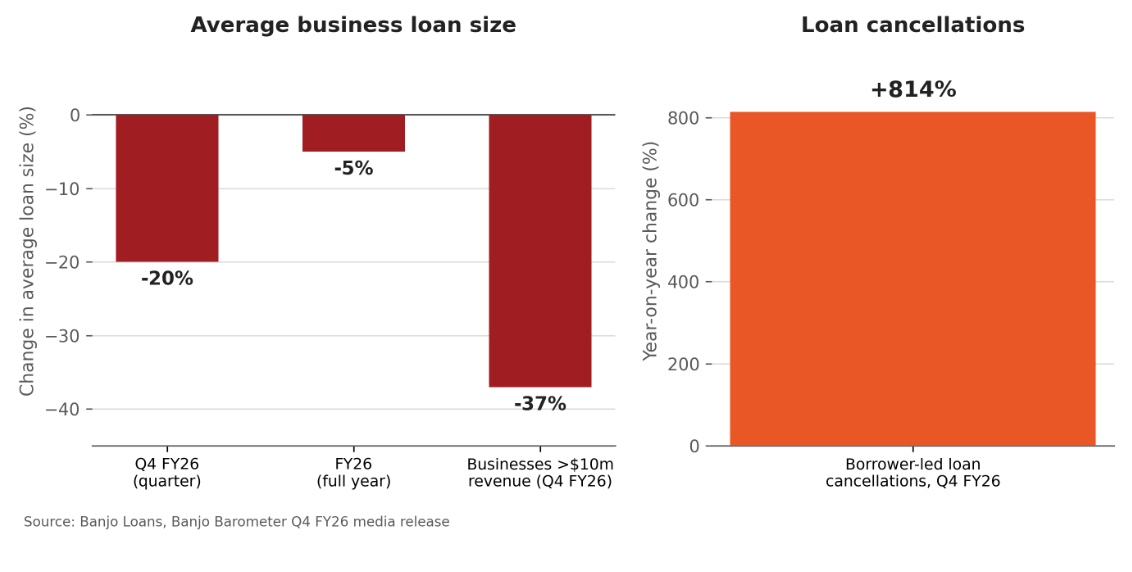
Data supplied by Banjo Loans shows average SME loan size fell 20% in the June quarter, contributing to a 5% decline across the 2026 financial year, as businesses go on the defensive.
"SMEs are doing it tough right now,” said Banjo Loans chief executive Guy Callaghan. “We're seeing more businesses come to us not to fund growth, but simply to keep the lights on – covering wages, paying suppliers and managing day-to-day cashflow.”
Kaz Carter (pictured, left), head of third party at BOQ, is seeing similar trends play out at the second-tier lender, where many SMEs are looking to build working capital buffers through revolving facilities or cash reserves to manage supply chain costs, wage pressure, energy, insurance, stock delays and slower customer payments.
"The biggest issue for most businesses is cost inflation, and smaller firms have less ability than larger firms to absorb or pass on higher input costs," Carter told MPA. "Cashflow flexibility matters more than headline rate. Consumer confidence and discretionary spending remain fragile, so many businesses are dealing with revenue volatility as well as higher costs."
Businesses, Carter explained, want lending that matches their trading cycle, not products that assume steady monthly cashflow.
Certainty over capital
That same appetite for certainty over raw pricing is showing up at Pepper Money, where Siobhan Williams (pictured, centre), head of mortgages, retail broker, described SMEs as operating in a compressed margin environment.
She cited rising input and labour costs, ongoing supply chain pressure and higher rates affecting serviceability.
"Regulatory changes like Payday Super are tightening cashflow and reducing flexibility," Williams said, pointing to the shift from quarterly to payday-aligned superannuation payments as a further squeeze on SME cash management. The regime took effect nationally on 1 July 2026 under the Australian Taxation Office's rules.
"The key shift is that SMEs are prioritising certainty and flexibility, not just access to capital, and that's where non-bank lenders like Pepper can play a really important role, particularly when deal structuring or timing is more complex," Williams added.
These shifting priorities are translating into stronger refinance demand as businesses look to release equity, stabilise cashflow and simplify their lending structures.
And given the cautious environment facing SMEs right now, it stands to reason that they’re being pickier with their refinancing partners – the data certainly backs that up. Banjo loans revealed that borrower-led loan application cancellations increased by 814% in the June quarter amid “heightened market testing and lender comparison”.
Fuel costs and cashflow relief
The heightened caution is shaping how Resimac approaches fuel-reliant clients. Michael Stavroulakis (pictured, right), head of product for auto and equipment finance and secured business loans at the non-bank lender, noted that businesses reliant on fuel-intensive assets are facing particular cashflow pressure as operating costs rise.
As such, Resimac has adjusted its lending approach for fuel-intensive businesses "to help avoid placing further pressure on their cashflow”, Stavroulakis said.
Loan structures can be tailored to free up cashflow, including support for upcoming Payday Super obligations, Stavroulakis explained, and Resimac's collections team has been equipped to offer tailored variations to existing contracts, helping customers manage short-term challenges and continue trading.
For businesses facing liquidity crunches and cashflow timing issues using Resimac's secured business loan, Stavroulakis said the lender is continuing to offer more flexible pre-paid interest options.
"With this, we won't require those regular repayments to be made for some time while they manage cashflow in the shorter term," he said.
Resilience
Despite the mounting headwinds, the resilience of the Australian SME sector shows up in Equifax's payment data: 79% of commercial debt was paid on time in May 2026, up from 71% in January, even as the 31-to-60-day late payment share climbed to 10% over the same period.
But unfortunately, the strain is following business owners home. Equifax data shows SME owners carry mortgage debt around 50% higher than non-SME owners nationally, averaging $585,000 versus $379,000 in May 2026, with personal mortgage delinquency rates for SME owners running four basis points above the general public.
Remember: brokers are small businesses too
Carter noted the pressures reshaping SME clients are hitting brokers just as hard. "Brokers are facing the same cost considerations as their clients," she said, pointing to payroll, compliance, technology, staff retention, professional indemnity, aggregator costs and now payday super as factors squeezing broker business cashflow.
Consolidation of broker businesses is already occurring to create scale and reduce overall cost to serve, Carter explained, and the shift from quarterly to payday-based super payments means broker businesses need enhanced payroll discipline and better cashflow planning.
Trust and capital gains tax changes may also affect succession planning, since many brokers operate through company or trust structures.
Carter continued: "Exit strategy conversations are likely to start earlier. Higher rates, cost pressure and softer confidence mean buyers will look harder at the quality and durability of brokerage earnings.
"Clean financials, strong trail management, documented processes, diversified referral sources and clear succession plans will matter more in a market where buyers and lenders are more selective."
In the meantime, Carter pointed to the instant asset write-off as a planning tool for SMEs under pressure. With the $20,000 threshold becoming a permanent fixture since 1 July, Carter said more SMEs may look to finance equipment, vehicles, technology or fit-outs while preserving cash. "The key is productive investment, funding assets that help reduce costs, improve efficiency or support revenue, rather than adding debt without a clear business benefit," she said.
It's advice that, taken together with Williams' and Stavroulakis' comments, points to the same conclusion: in a market where cashflow now counts for more than headline pricing, brokers who understand the need for flexibility, structure and certainty will be the ones who come out ahead.