Rivals say lighter capital settings helped fuel Macquarie's rise up the lending ranks, but Australia's fifth-largest bank says otherwise

Macquarie Bank’s storied rise up the Australian mortgage finance ranks needs no introduction.
It has spent the past decade building itself into the country's fifth-largest home lender, now holding more than 7% of the national mortgage market and growing faster than any of the major banks, year after year.
Its savings and transaction accounts have developed a reputation among brokers and borrowers alike as some of the most competitive – and least complicated – on the market, built on a "no hoops, no catches" pitch the major banks have struggled to match.
But has that rise happened on an even playing field? That's the question Commonwealth Bank is now asking regulators directly.
Per recent AFR reporting, Commonwealth Bank (CBA) has commissioned economic analysis from consultancy Mandala arguing that the corporate structure underpinning Macquarie's banking arm allows it to operate with a lighter capital base than the major banks – and that this, rather than efficiency or customer value alone, is helping fuel its rapid growth in mortgages and deposits.
Is it all posturing from two high-profile competitors in the Australian mortgage finance scene, or is there validity to the claims?
Minding the gap
Line the two banks' headline owner-occupier rates up, and it’s true that Macquarie edges out CBA.
Macquarie's cheapest advertised variable rate for principal and interest repayments sits at 6.04% at the moment, available with no ongoing account fees. You can get a rate as low as 6.09% for a digital-only loan at CBA, although a full-fat standard variable starts off at 6.34%, plus annual fees.
It’s a gap that can be closed with offers, cashbacks (or rewards points) and the like, but here the picture really changes is on the other side of the ledger.
Macquarie currently pays 5% on its savings account up to $2 million, unconditionally, and 2.75% on every dollar sitting in its everyday transaction account. CBA's GoalSaver only reaches that same 5% if the customer grows their balance every calendar month – miss that, and the rate falls to 0.10% – while its everyday Smart Access account, like most major-bank transaction accounts, pays no interest at all.
Macquarie's physical differences go a long way in explaining the gap: it runs no branch network and none of the brick-and-mortar footprint the majors carry across regional Australia, freeing up funding to pass through to depositors. CBA, by contrast, is still funding thousands of branches and a legacy technology stack alongside its digital build-out.
Whether that's the whole explanation for the pricing gap is precisely what's now in dispute – CBA's commissioned analysis argues Macquarie's lighter capital settings are also doing some of the work, letting it price more aggressively than a bank facing stricter regulatory oversight. Macquarie rejects that framing entirely, maintaining its capital treatment is no easier than the majors' and that the rate gap is simply the dividend of a leaner cost base.
A Macquarie spokeswoman, responding directly to the Mandala analysis, told the AFR: "There is a level playing field with regards to the capital that Macquarie Bank is allocated and measured against with respect to major banks." She added that the report "seems to confuse estimated measurements for the entire Macquarie Group with the actual measurements applied for Macquarie Bank's standalone operations, and fails to acknowledge the fact that Macquarie Bank's activities cannot be subsidised by the group's predominantly international non-bank activities."
Macquarie plays "in the jurisdictions that we are in by the rules they have," outgoing chief executive Shemara Wikramanayake said at a recent AFR Business Summit.
Speaking to MPA, a Macquarie spokesperson refuted aspects of the research that have been made public. They said: “Our decision to offer strong and competitive mortgage and deposit rates to all Australians is a deliberate business choice and is not driven by our capital cost base, which operates on a level playing field with our competitors. Without access to the report, it is not possible to fully rebut its contents, but there are factual errors in the parts that have been put to us.
MPA has approached both CBA and Mandala for access to the research.
NOHC, NOHC
Central to the unfair advantage thesis is Macquarie's non-operating holding company (NOHC) structure. Strip away the jargon, and a NOHC is just another corporate structure.
In the case at hand, Macquarie Group Limited is the NOHC. It owns Macquarie Bank Limited (the Australia Prudential Regulation Authority (APRA)-regulated, deposit-taking entity) and a separate non-bank group housing its asset management, investment banking and commodities trading arms.
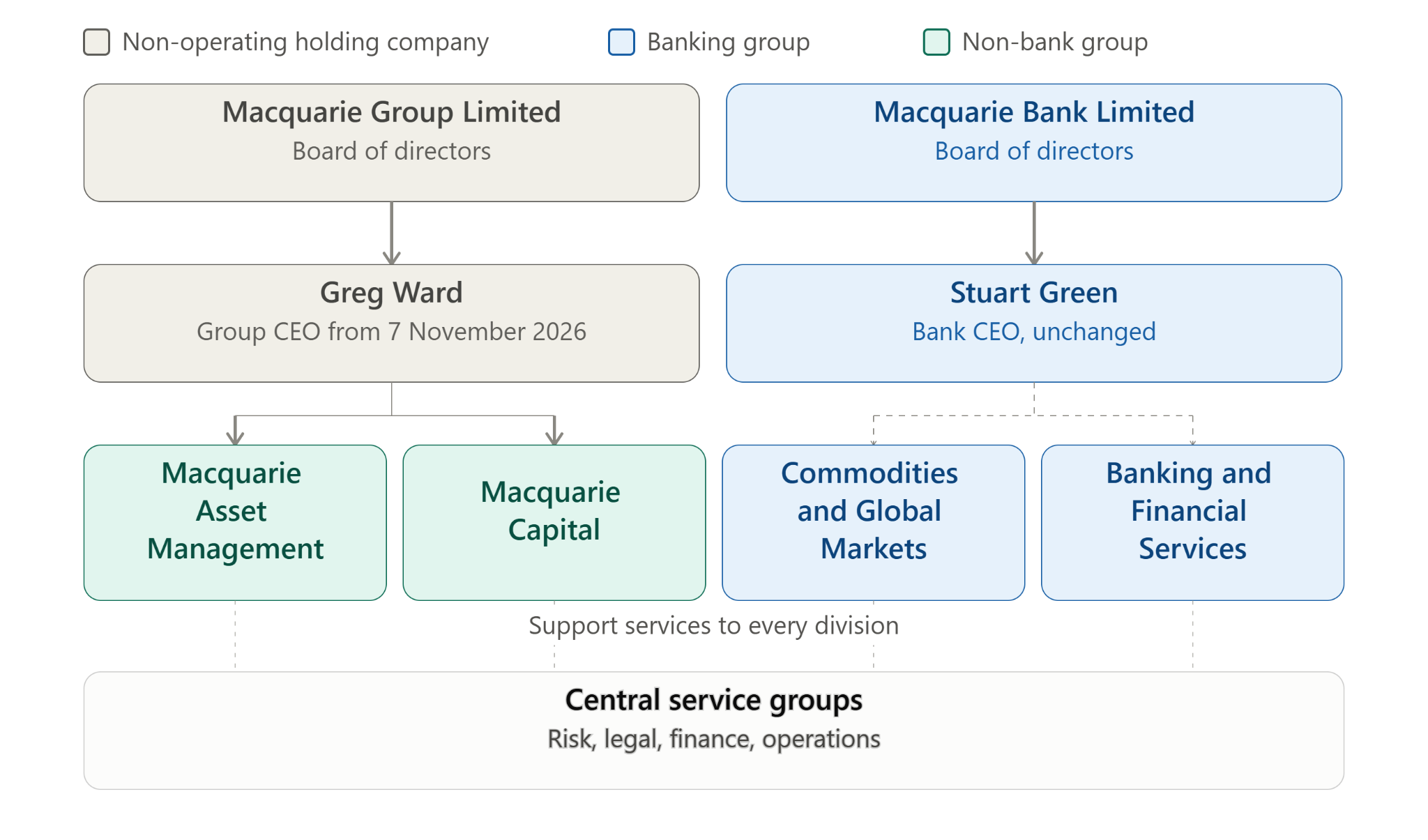
Source: Macquarie executive committee
Macquarie set this up in 2007 with APRA approval, specifically to let its faster-growing international and markets-facing businesses operate with more flexibility than a bank charter allows. These non-bank divisions don't take deposits, so the regulatory logic is that they shouldn't need to carry the same capital buffers a bank does.
The practical effect is that Macquarie's riskier activity – commodities trading, sub-investment-grade lending, market-making – largely sits in the non-bank group, outside the perimeter used to calculate Macquarie Bank's common equity tier 1 (CET1) ratio, the core measure of a bank's loss-absorbing capital relative to its risk-weighted assets.
Mandala's purported argument, on CBA's behalf, is that this makes Macquarie Bank's headline CET1 ratio look stronger than the group's true underlying risk – even though Macquarie disputes this, saying its bank-level ratio consistently runs higher than the major-bank average and that the non-bank arm cannot subsidise the bank.
Macquarie isn't the only bank using a NOHC structure. ANZ set up its own NOHC in January 2023, though under considerably tighter conditions – notably, all of ANZ's lending must sit inside the regulated bank, which isn't the case for Macquarie. AMP, Judo Capital, MyState and Revolut also operate APRA-authorised NOHCs.
To be fair, CBA and Mandala's purported argument is narrower – that Macquarie's specific authorisation, granted in 2007 and largely unchanged since, hasn't kept pace with how much its bank has grown, while ANZ's more recent and more tightly conditioned NOHC reflects what a modern approval looks like.
Perhaps you're asking: why doesn't CBA just create a NOHC structure of its own, if it's so advantageous? It's a good question without a clean answer, although Jarden analyst Matthew Wilson surmises that "[CBA] could, but it's a costly distraction process”.
Speaking to MPA, Wilson contended that Macquarie’s non-banking and banking segments are appropriately separated, noting they are separately “by a legal organisational structure and fragility rules”.
Should Macquarie be classified as a D-SIB?
APRA designated the big four – ANZ, CBA, NAB and Westpac – as domestic systemically important banks (D-SIBs) in December 2013, based on four criteria: size, interconnectedness, substitutability and complexity.
The designation carries a real cost: each D-SIB must hold an extra one percentage point of CET1 capital on top of standard requirements, a "higher loss absorbency" buffer intended to reduce the odds of failure at an institution whose collapse would do outsized damage to the financial system, along with closer, more intensive APRA supervision.
Macquarie is not a D-SIB, yet its mortgage book has grown faster than any major bank's for several years running, and it now holds over 7% of the home loan market – up a full percentage point in the past 12 months, per APRA data. It is the country's fifth-largest home lender by a substantial margin.
Its deposit growth has also been sharp: Between December 2020 and December 2025, Macquarie's deposit market-share gain surged from 2% to 7%. Over the same period, the Big Four’s market share dropped in equal measure: from 80% to 76%.
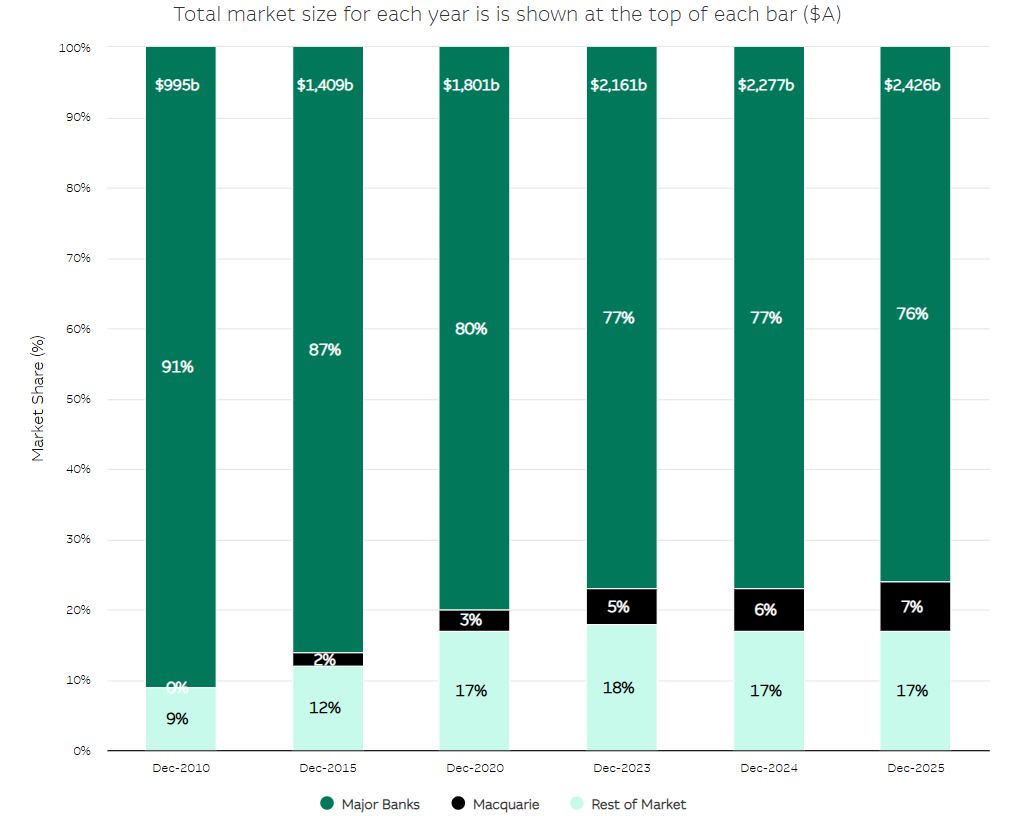
Source: Macquarie, APRA Monthly Authorised Deposit-taking Institution Statistics, December 2025
On a pure growth-and-scale trajectory, that's the kind of trend that eventually invites the "how big is too big" question APRA asks of the majors.
Yet even with that growth, there is an ocean between Macquarie's mortgage book and ANZ's (i.e. the smallest of the big four).
As of July 2026, Macquarie held $185.9 billion worth of home loans (7.4% market share) against ANZ's $331.9 billion (13.2% market share). CBA's, for the record, was $637.5 billion (over 25% market share).
In terms of deposits, the gap is narrower but still vast. Macquarie held $115.9 billion in deposits, representing 7% market share, against ANZ's $198.4 billion (11% market share) and CBA's $467.7 billion (26% market share).
The question, then, must be: how much market share would constitute a systemic risk should the bank in question collapse?
Wilson argues there is "no case" to designate Macquarie as a D-SIB "given size and interconnectedness at only 7% of the home loan and deposit market," but perhaps others might disagree.
A Comyn case
CBA chief executive Matt Comyn has built a public case that certain competitors enjoy a structural advantage.
During CBA's interim results in February, Comyn described an unnamed rival as one that was "optimising around capital, regulatory structure, regulatory architecture”. Three weeks later, CBA chairman Paul O'Malley took the same argument to an audience of company directors, framing it as a broader competition issue rather than a complaint about one rival: "across multiple sectors, we are seeing uneven regulatory treatment for functionally similar services," he said.
Neither executive has publicly put a name to the "competitor" or the "uneven regulatory treatment" they're describing, but the timing is hard to ignore: those comments arrived in the same period CBA was purportedly commissioning the Mandala analysis of non-operating holding company settings, and shortly before APRA confirmed in its 2026–27 corporate plan that it would review existing banking governance structures.
So, posturing or a point worth taking seriously? Probably a bit of both.