Big deals dominate as offshore buyers now account for a third of Australian commercial property trading

Foreign investment is quickly becoming the engine of Australia's commercial property market, with offshore buyers accounting for 34% of all trading so far in 2026.
Australian commercial property sales reached $48.4 billion in the year to 31 August 2026 per Commonwealth Bank data, up 6% on the same period in 2025.
Offshore capital contributed $16.3 billion of that total, a sharp jump from 23% of trading in calendar year 2025.
The figures cover individual sales above $1 million and include preliminary data for August.
Singapore and Canada lead the charge
Singapore and Canada together account for 70% of offshore acquisitions this year, (39% and and 31% respectively), while the US contributed 21% and Hong Kong 6%.
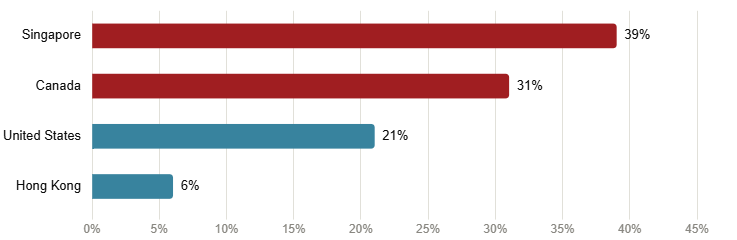
Share of offshore acquisitions, year to 31 August 2026. Source: CommBank Business and Industry Insights, 23 September 2026 (RCA, CBA, Macrobond)
One single deal did much of the heavy lifting. The $6.2 billion joint acquisition of the National Self Storage real estate investment trust (REIT) by GIC of Singapore and Brookfield of Canada pushed investment from both countries in Australian commercial property to record levels.
That transaction also explains why self storage has dominated offshore activity, making up 39% of foreign purchases in 2026. Office ranked second place in offshore buying, led by US investment manager Barings' $657.3 million purchase of 480 Queen Street in the Brisbane central business district (CBD) from Dexus.
Foreign appetite for industrial property, by contrast, has cooled, which CBA analysts chalked up to offshore buyers targeting diversifying growth assets and prime-grade properties held for the long term.
Industrial margins shrinking
Across the whole market, industrial property remains the most traded asset class for a seventh consecutive year, with $13.4 billion in sales. Its share of trading, however, has fallen from 35% in 2025 to 29%, with retail close behind at 27%.
CBA said strong demand for shopping centres, particularly neighbourhood centres and freestanding supermarkets with a high share of non-discretionary retailers, is likely to keep downward pressure on yields in the short term, despite the expectation of higher interest rates.
Brokers should note a private capital shift
For mortgage brokers with investor clients, the report points to a possible shift in where private capital goes next.
CBA said the share of lower price-point "other" assets could keep growing as investors previously active in established residential property gradually move into commercial property following the 2026–27 Federal Budget tax changes.
Under those reforms, negative gearing for residential property will be limited to new builds from 1 July 2027, and the 50% capital gains tax (CGT) discount for individuals, trusts and partnerships will be replaced with cost base indexation and a 30% minimum tax rate.
The negative gearing changes apply only to residential property, with commercial property keeping the existing arrangements, which is likely to increase the attractiveness of commercial investments.
"One of the biggest possibilities is that formerly residential investors will start to look increasingly at commercial property," Kevin Stanley, director of commercial property research at CommBank, recently stated. "It means really a time for investors to stop, reflect, do some research and figure out which part of the investment landscape they want to focus on."
NSW dominates, Queensland overtakes Victoria
New South Wales remains the country's commercial property powerhouse. Sales reached $18.6 billion in 2026 to date, the largest share nationally at 42% , and volumes are up 18% on the same period in 2025. CBA described investor sentiment towards the state and Sydney as very strong.
Queensland is the standout mover. Investment there has climbed 39% to $10.8 billion, lifting the state ahead of Victoria into second place nationally. Victoria recorded a 15% rise to $9.2 billion.
South Australia continued its strong run, with trading up 24% to $2.69 billion. That puts it narrowly ahead of Western Australia, at $2.65 billion. Private buyers accounted for over half of South Australian trading and offshore sources 35%.