From mortgage fraud to AI, the major banks' broker leaders get frank about a volatile year in lending

Talk about a volatile time for the Australian mortgage finance industry.
Amid a Budget that's split the sector down the middle, a housing market that's finally showing cracks after years of relentless growth, lending volumes retreating across owner-occupiers and investors, and a fraud crisis to reckon with, there was no shortage of material for Australia's five largest banks and two leading brokers to dive into at this year's major banks roundtable.
May's Federal Budget remains the biggest single spectre hanging over the industry. Pitched by the government as a correction between young buyers and investors, the removal of negative gearing and capital gains tax concessions – alongside sweeping changes to discretionary trust taxation – has at least sparked deep contemplation among brokers and lenders as they work out how the reforms will shift who buys what, and when.
House prices, meanwhile, have started to move in a direction few predicted this time last year. According to the Real Estate Institute of Australia, the national median house price fell 1.2% in the June quarter – its first quarterly decline since September 2024 – while the median for other dwellings dropped 0.9% to $751,839, its first fall since March 2023.
Annual growth remains positive, at 7.9% for houses and 6.1% for other dwellings, but the softening is real in the New South Wales and Victoria powerhouses, driven by four cash rate increases (at the time of writing, with a strong likelihood of more to come) through 2026 and the lingering uncertainty created by the Budget's tax reforms.
Lending volumes have also been pared back, albeit unevenly. Australian Bureau of Statistics (ABS) data shows first-home buyer loan commitments fell 2.9% in the June quarter compared with the previous quarter – a genuine pullback, but a modest one next to the 8.6% quarterly drop recorded for investor loan commitments, nearly three times the size.
Then there's the pressing issue of home loan fraud in the mortgage finance industry, which has brought to the fore questions over integrity and due diligence at all stages of the application process.
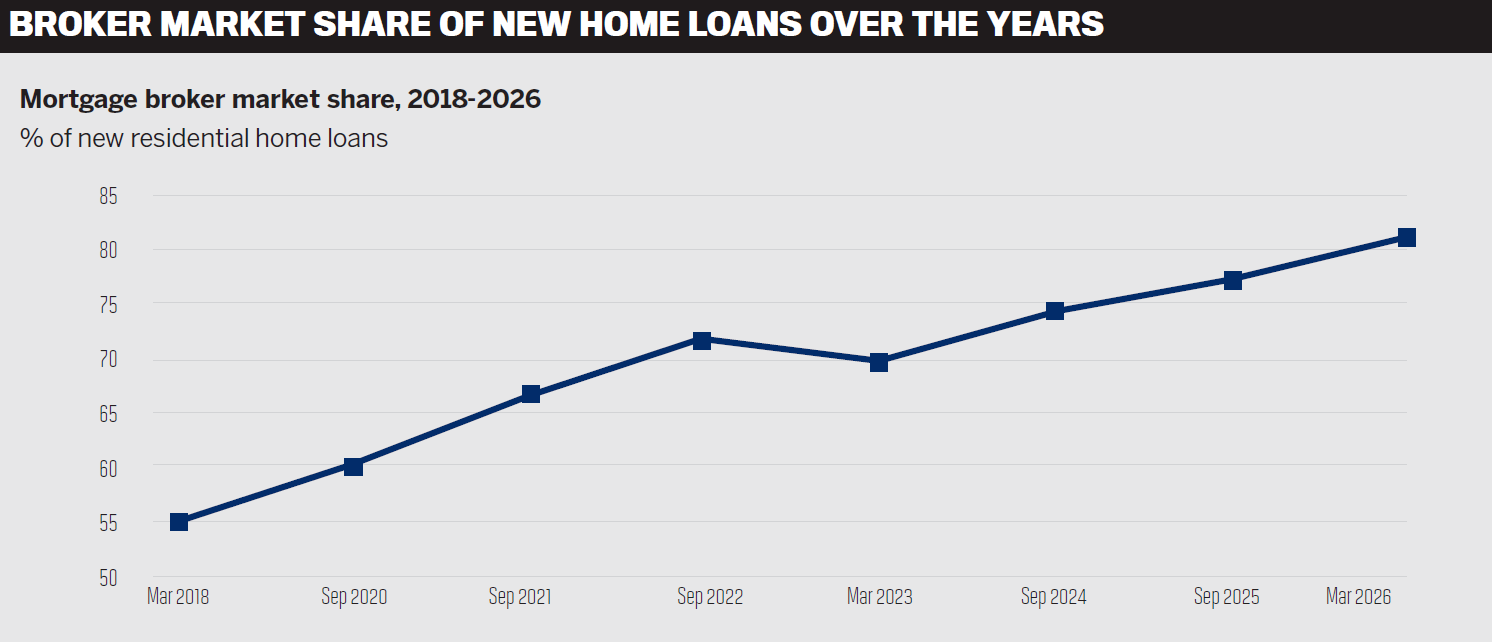
Source: Mortgage and Finance Association of Australia (MFAA)
It is against this dizzying backdrop that MPA gathered leaders from the five major banks, alongside two brokers, to talk through what it all means for the year ahead.
Around the table this year were Natalie Smith, general manager, retail broker at ANZ; Sarah Willsallen, head of broker distribution at Westpac; Wendy Brown, head of broker sales at Macquarie Bank; Adam Brown, executive, broker distribution at NAB; and Baber Zaka, general manager of third-party banking at Commonwealth Bank (CBA).
Joining them from the broker side were Lucy Blain, director at Blain Financial, and Melissa Procajlo, senior broker and director at Pro Good Finance.
There is no ignoring the fact that home loan fraud is a rising concern that requires a whole-of-industry approach. What do you see as the majors' role in stamping it out?
Natalie Smith, general manager retail broker at ANZ, taking the first word, stressed that the majors have a really important role in terms of mortgage fraud. "Many brokers must be accredited with major lenders through their aggregator, indicating the important role major lenders play in setting industry standards."
She pushed back on the idea that fraud is a new challenge for the industry: "It might feel like a growing issue, but it is an issue lenders and brokers have long managed as part of their day-to-day operations." What has changed, she said, is the method: "We're seeing repeat offenders find new ways to re-enter the industry, or access outcomes they'd been shut off from in previous years." Conduct standards, clear controls and solid onboarding and offboarding processes are paramount.
Sarah Willsallen, head of broker distribution at Westpac, argued fraud requires a coordinated, holistic industry approach. "It's an industry problem that requires an industry response," she said, especially as fraudsters become more sophisticated at using AI technology. She pointed to Westpac's investment in detection technology: "We've embraced AI as a supporting tool in the home loan assessment process, which not only helps us identify potential fraud but also helps enable faster decisions for our brokers and customers." Willsallen also flagged the bank's work to educate and raise awareness of scams, a new aggregator hub launching in October that "captures additional data points for broker accreditation," and the rollout of two-factor authentication and delegate access across broker platforms.
"All banks have a role to play, but larger banks can play an important leadership and convening role. We all need to be working closely together to mitigate fraud, address systemic issues and help brokers and customers protect themselves," said Wendy Brown, Macquarie Bank's head of broker sales.
She argued for a heavier focus on data feeds instead of documents, saying, "If we could get a data feed from the ATO (Australian Taxation Office), it would not only make things easier for customers, but we have mitigated fraud on valuations because it's an API straight into our system, a live feed no one can edit." However, she acknowledged the practical hurdle: "I totally understand it's a legislative challenge at the moment for the ATO to give us that data, but it would be great for customers and would go a long way towards protecting the integrity of the financial system as a whole."

(l-r) Sarah Willsallen, Westpac; Baber Zaka, CBA
It's undoubtedly "a serious issue," continued Adam Brown, executive broker distribution at NAB. He drew a distinction between opportunistic misconduct and organised crime, although both require an equal amount of serious attention. "NAB has a zero tolerance for criminal behaviour and you've got to stamp it out quickly and definitively. That's where I think industry as a whole – lenders, aggregators and industry associations – really play a role, and we need to work together to fight this crime effectively," he said.
Turning to the brokers, ACT-based Lucy Blain, director at Blain Financial, has a client base that skews towards government-linked pay, which limits her exposure: "We're not seeing the outliers – it's more straight down the line." She praised the shift toward direct data feeds for valuations: "We're using a lot of systems now where we're not only gathering bank statements from third-party systems – not relying on the clients to give them to us – but they now hook into the ATO portal. So, we get direct from the data feed all of their bank statements, a full sweep of their ATO portal: notices of assessment, income tax returns, HECS statements, whether the tax has been paid. It completely puts you one step ahead."
Melissa Procajlo, senior broker and director at Pro Good Finance, working with a diverse, often self-employed client base with very different income structures, raised a recurring frustration: brokers rarely learn why a deal was flagged. "You submit it, it gets a red flag, and the bank comes back and says it's a red flag – and you're like, cool, what is the red flag?"
W. Brown jumped in, explaining that the red flags brokers encounter are often driven by data rather than assessor judgement. With a dataset as large as Macquarie's, a flag might come from something as seemingly minor as a pattern of arrears on a particular street. "That quickly becomes thematic because our dataset is so big. With a much smaller dataset, trends like that could easily go unnoticed." She noted that teaching brokers the minutiae of how fraud is conducted and detected can be a double-edged sword – it can make public the very procedures bad actors use to commit illegal activity in the first place. Nonetheless, W. Brown advocates for more education, not less. "If the industry had known what to identify, [syndicated fraud] could have been identified a lot earlier."
Adam Brown brought it back to the fundamentals of knowing your customer: "The fundamentals of good broking and good banking is understanding who you're working with. Who is the person, what do they do, what's their background? Is it too good to be true?" Or, as Blain said, "Does it pass the pub test?"
Now that the Budget dust has settled, how do you generally believe it will impact the mortgage finance industry in terms of deal flows, investor demand, house prices and the broker-borrower relationship?
Zaka framed the Budget as just one piece of a much bigger puzzle of factors "that are going to be influencing borrowing power at the moment. Ultimately, it comes down to borrower confidence." With interest rates, inflation and housing supply all still unresolved, he argued that confidence wouldn't fully return, at least for now. Yet Zaka framed this complexity as playing to brokers' strengths, stressing that "this type of environment really lends itself to personalised, relationship-led advice."
His overall view? "The Budget provides some positive signals for the market, but sustainable growth won't come from a single policy announcement. It will come from improving housing supply, maintaining customer confidence, and continuing the strong collaboration between lenders, brokers and government."
A. Brown agreed that uncertainty drives customers back to trusted advisers – brokers, accountants, financial planners – all fielding the same question: "Is now still a good time?" He pointed out the weight this puts on brokers already deep into a client relationship: "You might have been talking with a customer for three months, six months, 12 months, two years on potential investment, property purchases or upgrades or renovations." Layered on top of the Budget is a run of interest rate increases and their squeeze on household budgets, a situation A. Brown describes as follows: "There's pressure on household budgets and living standards... and broader global geopolitical uncertainty adding to that."
Willsallen pointed to research from Westpac's economics team on the affordability gap driving the market. "Housing affordability ultimately comes back to supply – but supply at the right price point that matches the median incomes of Australia," she said. "Median income in Australia is about $70,000, and capital city house prices are at more than a million dollars – they just don't align." For her, the fix isn't simply more homes: "It's building more affordable and well-located homes near jobs, near education, near healthcare, at a price point that regular Australians can afford." Echoing previous comments, she sees this complexity as an opportunity for brokers: "As customers navigate those affordability challenges... trusted guidance becomes ever more valuable."

(l-r) Lucy Blain, Blain Financial; Natalie Smith, ANZ
Smith reminded the room that affordability – housing, groceries or otherwise – is at the crux of the issues facing Australians. That certainly predates the Budget, with rate hikes and geopolitical strife exacerbating the problem at the tail end of 2025. The Budget "is going to help change the composition of where the housing market is going," Smith said, pointing to an observable shift from investors to owner-occupiers. She continued: "We don't expect house price declines to be felt evenly – not by location, and not across property types. There will be some segments more greatly impacted than others, and that's one point for the average broker to consider: what are the customer's circumstances and where is the housing stock located." Looking forward, Smith is predicting a more refinance-led market, with investor activity unlikely to come back as strongly as owner-occupied lending. "That shift is going to be predicated less on the Budget and more on the interest rate cycle. Supply remains a challenge, but the mix will matter just as much."
The general feeling is that the market is taking a bit of a pause. W. Brown noted that market activity eased around the Federal Budget period before beginning to recover, although she cautioned that seasonal factors, including school holidays, may have contributed to some of that movement. "We are seeing owner-occupiers off a little, but investors are off a bit more," said W. Brown. Regardless of the mix, "I think brokers have the best opportunity to demonstrate the value they add. They're the interpreter, the guide for customers. They can help them navigate the new landscape, as long as they've got the right foundations and are educating their customers." Zaka also pointed to a broader opportunity for differentiation: "Changes like these can create an opportunity for brokers to differentiate through proactive customer engagement, helping customers understand what developments mean for their individual circumstances."
That confidence in the broker channel was echoed from the other side of the table. Blain described continuously repricing her existing loan book rather than pushing refinances to another lender. "Can we get a better rate at this bank? Sure, there might be cheaper rates, but that doesn't make it a good move for you," she said of a typical conversation, framing this value-add as client education: "It's about educating them so they become an absolute expert on their next purchase."
Procajlo drew a comparison to past downturns in real estate, where the weaker operators fell away. In blunter terms: "Crap real estate agents used to leave the industry when there was a downturn, and it's the same for brokers. If your business is not thriving now, then you need to have a good hard look at yourself as to why that is, because there is a lot of opportunity… there are always people transacting, there's deaths, there's divorces, there's people growing families, there are transactions everywhere."
Broker question from Lucy Blain: If we're all lending under the Australian Prudential Regulation Authority's (APRA) framework, why can one bank decline a deal that another approves without issue? Is policy becoming a competitive advantage, or should the industry be moving towards greater consistency?
Blain stepped up as the first broker guest to grill the roundtable on an issue close to her heart: policy inconsistency across the panel. As a broker working across dozens of lenders operating under the same APRA framework, she's the one left explaining to a client why a deal that sailed through at one bank was declined outright at another – often with little insight into what actually drove the difference.
Willsallen argued that risk appetite is inseparable from a lender's total book, factoring in loan-to-value ratios among other metrics. "Lenders operate within the same regulatory framework, but each applies its own credit policies and risk appetite based on a range of factors, including portfolio mix." A declined deal doesn't necessarily mean a bad customer, she added: "What might not meet one lender's criteria might meet another's." Variety, added Willsallen, ultimately benefits borrowers: "Competition is great. If we were all the same, I actually think the loser in that would be the customer." It's up to the broker to be the "navigator and translator" to guide clients through this range of options.
Smith agreed, framing policy as one of several levers alongside price and proposition. "It's very hard for an average customer coming off the street to understand the ANZ policy landscape, but brokers help navigate and guide customers," she said. When it comes to disparate policy settings, everything beyond the APRA minimum "goes to your own bank appetite in terms of the customer segments policies support," Smith continued. "We don't all attract the same type of customers, and our policies also reflect and support our customer base."
Smith added a variable to the original question – why the same deal can get different answers at different banks isn't always down to policy. "It's partly policy, but policy isn't the only answer there," she said. "It could be some data that is unique to that lender, or an insight that lender has, and therefore, that loan may not be supported by a particular lender."
A. Brown pushed back on the idea of standardising risk appetite across the industry. "If you look at aggregator panels, you might have 30 or 40 lenders – some have up to 70. That breadth creates more options for Australians," he noted. "One bank won't necessarily be the right choice for every customer or situation. Having that choice, and brokers being able to help a customer identify that option for them, is so critical."
Zaka continued: "Policy is a differentiating factor and is core to the strategy of each of the major banks. You either go broad, like CBA, to target a bigger customer base, or you can go very, very narrow, like some of the second-tier lenders." Banks can't be one-size-fits-all, he said, because "our customer base is not one size fits all. They're very unique customers in very unique situations, and each bank makes decisions about who they can best support, and where they're going to put their risk appetite."
As for Macquarie, "We're quite diverse across all of Australia. And policy really does lean into where you want to play," said W. Brown. She pointed out that all banks have their own risk appetite and specialisations, which naturally creates different sets of outcomes for some borrowers. "If we went all exactly the same, brokers actually lose out from that," she said. "Aggregators often have 70 lenders on their panel so they can look after every Australian at every stage of their loan. Some Australians need something very different at the beginning to what they need at the end."
Procajlo knows the frustration of inconsistent outcomes all too well – she just wishes there was more transparency from the banks on how data influences lending decisions. That gap, she said, is exactly what keeps her up at night, describing deals that clear at one bank and stall at another with no explanation given.
Almost every broker I speak to says that rate is no longer the top priority for clients. It's flexible credit policy, strong BDM support and consistent turnaround times. How are you meeting these demands?
W. Brown described policy as the real gatekeeper before service quality even comes into play. "Policy is a critical starting point, and we're continually looking at ways to support a broader range of customer scenarios where appropriate," she said.
On BDMs, she was blunt about what doesn't count as support: "There's no point in having a BDM if all they say is, 'Go to the credit hotline, go to the chat and resolve it'."
Macquarie targets consistency over speed: "Confidently consistent is what we've always worked towards, for turnaround times. We are confidently consistent no matter whether it's a self-employed deal or a more straightforward PAYG deal. Brokers know we'll pick up their application in hours if not minutes, regardless of the customer or complexity of the application."
Zaka revealed that CBA prioritises superior outcomes, and confidence in the application proceeding smoothly, over assessment times, when it comes to complex files. When brokers come in with complex scenarios, "they want us to actually opine on these more complicated situations, to be able to provide the support that they need," he said.
On BDMs specifically, he described a shift away from relationship visits towards problem-solving: "It needs to be much more around credit knowledge, credit policy, being able to support the brokers in difficult questions, difficult times." He hears the same thing directly from brokers all the time: "'If I'm calling my BDM, it's because something's gone wrong. I'm not just calling for a chat'."
Willsallen agreed rate alone won't win the business. "A competitive rate gets you onto the shortlist, but it's great service and certainty that helps you win broker and customer trust," she said. Westpac's broker feedback consistently comes back to four things: "Strong BDM relationships and support, competitive pricing, sensible policy, and reliable turnaround times. And we've invested heavily across all four of those areas, because the experience – for brokers and customers – matters just as much as the rate."
"Trust and consistency are two really core components," continued A. Brown. "It's also ensuring that we can bring the best of NAB to the customer's situation." And as Australia's largest business bank, NAB is uniquely positioned to handle one substantial cohort of the Australian public: "If I think about a typical NAB customer, they might be self-employed, they might be looking to grow their business at some stage in the future. How can we utilise our business banking capabilities to support that customer over the longer term, beyond just the home loan? Yes, there's policy; yes, there's price; yes, there's relationship – that's important for a broker to recommend you as an option – but it's also really understanding the customer's lifetime journey and what they're going to need out of a large bank."
Smith explained how broker feedback shapes all of ANZ's investment decisions, pointing to a boost in BDM support made a few years ago that has been well received by both brokers and frontline staff. "We have a really strong policy setting that has been foundational to us for a long period of time, and that continues to underpin the offering we have in market," she explained.
"We're known for, and continue to invest in, our BDM support. A couple of years ago, we increased the level of support to our brokers, and that's held us in good stead… It's always a watch point for us, making sure we've got the right level of support depending on what's happening in the market at the time. We've also invested in consistency in our assessment process, and that's improved throughout the course of this year. It remains a key area of focus, supported by technology investment."
As for the brokers, Procajlo has "definitely" seen a step change in how the majors have approached BDM support over the past 12 months.
"As the broker role evolves, the BDM role also needs to evolve with it," she said. "I think it's important that the lenders identify that and help us with our education, and equip us with the tools to be able to deliver service to market. A lot of it does come from the BDM support and making sure that they're available." Blain agreed, describing what she wants from a BDM in blunt terms. "I don't see that person as someone who's an admin supporter. They're someone who is allowing me to accelerate the business and get back to the client even faster."

(l-r) Wendy Brown, Macquarie; Adam Brown, NAB
Broker question from Melissa Procajlo: Clawbacks were designed to protect against broker misconduct, but in practice they're now triggered whenever a borrower refinances or pays out early, even when the broker did nothing wrong and the client's decision is about market conditions, not conduct. Is there any consideration of restructuring clawback triggers so they reflect broker behaviour, rather than penalising brokers for decisions entirely outside their control?
Procajlo used her turn at the table to make the case for brokers as small-business owners absorbing a cost few outside the industry ever see. She traced how the job itself has changed over her decade in broking – from simply matching a product, to something that now involves ongoing education, post-loan service, rising compliance obligations, and at times, feeling "like a counsellor". Against that backdrop, and after five years of geopolitical and COVID-era upheaval, she pointed to a pattern she's seeing more of: brokers being hit with a clawback even in instances outside of their control. It is not a new grievance, but a pressing one, nonetheless.
Procajlo said that line doesn't always sit comfortably with the reality on the ground. "I don't think it's openly discussed, and I don't think it's encouraged by the bank. To be honest, I don't usually challenge it, because half the time it's not worth the time pushing it," she said. But she described the cumulative toll on small brokerages when circumstances stack up: "I've got a broker in my business that has had multiple clawbacks in succession... a lot of people that bought with very low deposits in the last couple of years are now in negative equity on their asset, and they're liquidating the asset and they don't have any other option." She called it one of the hardest parts of the job: "It's a really hard cost to the business."
Smith defended clawback as a mechanism for aligning interests rather than punishing brokers. "The effort that the broker puts in, the lender also puts in – that loan is not there for either of us," she said. "Clawback has a really important purpose in making sure that the incentives are aligned for all of the industry."
Zaka framed clawback as one piece of a wider profitability equation rather than something to consider in isolation. "For the broker channel to continue delivering good outcomes for customers, it needs to remain sustainable for all participants," he said. "Clawback is one part of a profit equation alongside commissions up front and trail. You can't look at one without looking at the others."

Melissa Procajlo, Pro Good Finance
Willsallen confirmed Westpac had already adjusted its policy following a review. "We conducted a review of our clawback policy a number of years ago, when we reduced our clawback period from two years to 18 months," she said, adding there are no further reviews currently planned.
A. Brown confirmed NAB's own shift. "We changed ours to a sliding scale two years ago," he said, referencing a move away from a flat two-year clawback period. Procajlo pressed further, asking whether clawback exemptions are assessed case by case or applied as a blanket rule.
Zaka confirmed CBA does make exceptions. "We're definitely open to exemptions if there's been a divorce, if there's been a death, or any other major life change," he said. "There is a negotiation that can happen if there is a specific circumstance." But he drew a clear line for elective sales: "If it's a customer who's just decided to sell because they wanted to, well, no one wins in that scenario."
What is the latest word on how AI and technology are reshaping the mortgage finance industry?
To round the discussion off, participants had their say on how the most disruptive piece of technology of the modern era is impacting their chosen profession.
AI is "having a big impact on lenders," began W. Brown, who described the technology as an extension of a long-running effort to combine human judgement with automation. "We've always, whether we were using AI or other digital tools, talked about how we can best support our teams to be more productive and use technology to facilitate that," she said. But she raised a sharp warning on cost: "We've already heard of some brokers who spent $10,500 in one month on tokens... if you extrapolate that out, that could be paying a salary of over $120,000. So, it's important to understand the value being generated alongside that investment." Her second concern was data handling: "It's really important brokers truly understand how their data, and customer data by extension, is being handled."
A. Brown agreed AI's real value is freeing up time for relationships, not replacing them. "It doesn't replace the relationships and the advisory that a human can provide," he said. "What we're using it for is to take away the administration tasks, with the intent of spending more time with the customer."
Smith raised a dimension she felt was missing from the conversation: how AI is shaping the customer before they even reach a broker. "What we don't talk about a lot, though, is the consumer in this, and how AI is permeating consumer decision-making. They're becoming the companion that they turn to first."
She was quick to note the regulated environment still requires a human in the loop: "We have responsible lending guidelines... that means that they're always going to come to a person," while acknowledging that person increasingly comes "with a perspective that's shaped by AI".
Willsallen agreed on the upside of AI, but was equally clear on the risk side, particularly around fraud, identity verification, data security and trust. "Responsible AI governance is just as important as innovation," she said.
Zaka closed with a caution aimed squarely at brokers over-automating client contact. "I've spent a lot of time with some brokers just saying, 'I'm trying to minimise my process so I can just meet my customer for five minutes and everything else is automated'," he revealed. "You're kind of selling yourself out of a role, because this is a relationship-based industry."
He also flagged a longer-term threat to broker value: "Some of the tools out there do lower the barriers of entry for what you need a broker for... you have to have a value add, and that is knowing the market, understand what customers want, knowing the policies and knowing how you're differentiating what you're doing versus what could be automated."
If the roundtable delivered a single verdict, it was that a turbulent market rewards those who are prepared for it. Four cash rate increases, a Budget that has redrawn the investor playbook and a housing market softening across the biggest states have left borrowers asking serious questions about their homeownership strategy, and most borrowers are taking those questions to a broker.
Around the table, the majors were united on the fundamentals: know your customer and their increasingly complex needs, be ahead of the tech curve and work with your BDMs to solve any problems before they take root.

The MPA Major Banks Roundtable 2026 panel