Investor lending growth hits two-year low as tax changes, higher rates make themselves felt

Australian housing credit growth eased to its slowest monthly pace since March 2025 in July 2026, as tax changes for investment properties and higher interest rates began to filter through into new lending data, according to Westpac Economics' latest private credit bulletin.
Total private sector credit grew 0.6% month-on-month in July, down from 0.8% in June and below the market consensus forecast of 0.7%. On an annual basis, total credit growth eased to 8.4%, down from 8.6% in June.
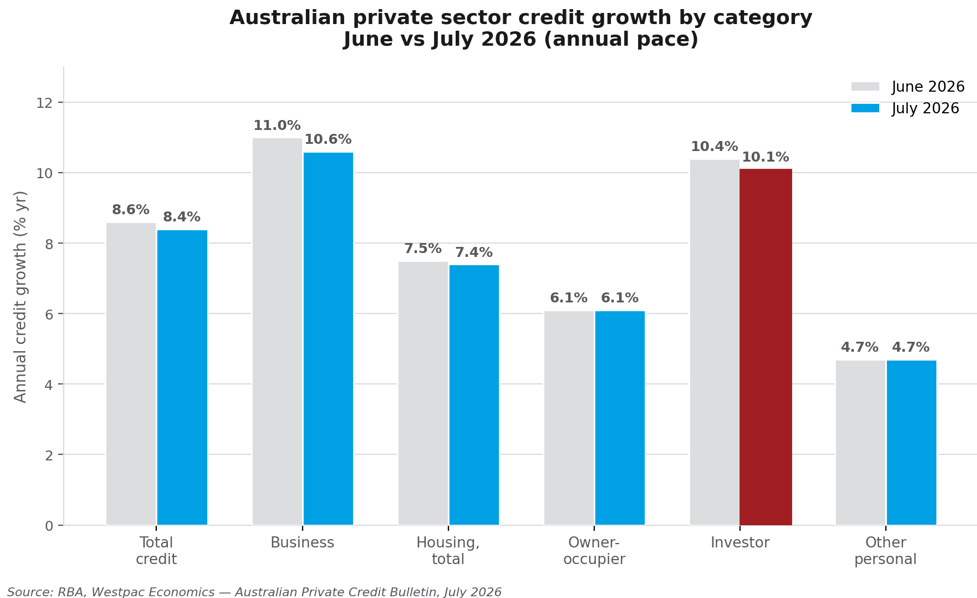
Housing credit, which accounts for 62% of total credit outstanding, grew 0.5% in July, a 0.1 percentage point slowdown on June's pace.
Investor lending falls
The clearest sign of stress came from investor credit, which dropped from 0.8% in June to 0.5% in July – its slowest pace in two years. Owner-occupier credit growth held steady at 0.5%, essentially unchanged from the prior month, leaving investors as the primary source of the housing credit slowdown.
Westpac senior economist Mantas Vanagas attributed the divergence largely to tax changes affecting investment properties, which took effect in the wake of May's Federal Budget announcement.
Vanagas noted the timing of the shift – roughly two to three months after the budget – was consistent with the typical lag between a policy change and its flow-through into credit data, and pointed to higher interest rates and softer house prices as compounding factors.
Higher rates, weaker house prices and the investment property tax changes will likely continue to flow through in the coming months, pushing housing credit growth lower still, while business credit growth is expected to remain comparatively bouyant.
Business credit still doing the heavy lifting
Business credit remained the standout performer, growing 0.9% in July – a slight easing from two consecutive months of growth above 1%, but still strong by historical standards. The annual pace moderated to 10.6%, down from 11% in June.
Read more: Commercial broking in a post-budget reset
Vanagas said the pace suggested businesses were continuing to borrow for both working capital and investment, including spending tied to AI-driven technology adoption, and pointed to rapid growth in corporate debt issuance as a further sign that larger firms were not hesitating to borrow.
Growth in other personal credit, the smallest of the three major categories, moderated to 0.3% in July after a 0.9% jump in June, settling back in line with its average pace over the past year. The annual rate was unchanged at 4.7%.
The Westpac data lines up with what brokers have already been reporting on the ground. Loan Market Group figures show investor mortgage applications plunging since the Budget tax reforms took hold, with investor lodgements falling more sharply than any other borrower category tracked.
Separate research from Right Property Group has found that borrowing capacity has become the top constraint for seasoned property investors, with more than half citing it as their single biggest challenge.