Westpac, NAB, CBA, ANZ and Macquarie all expect a hike before Christmas - here's why

Australia’s largest mortgage lenders have torn up their ‘rate hikes are done’ narrative in recent weeks, with every major bank forecaster now expecting the Reserve Bank of Australia (RBA) to lift the cash rate to 4.6% before the end of 2026.
NAB, ANZ, Commonwealth Bank of Australia (CBA), Westpac and Macquarie engaged in a synchronised about-face following the Australian Bureau of Statistics' (ABS) July inflation print, which showed headline inflation easing to 3.5% but trimmed mean inflation – the RBA's preferred measure of underlying price pressure – holding steady at 3.6%, still above the central bank's 2–3% target band.
Momentum for a hike accelerated further after Andrew Hauser, deputy governor of the RBA, appeared on the ABC's 7.30 program this week.
Hauser said the economy was in reasonable shape – unemployment near record lows, solid GDP growth – but flagged “one big problem and that's inflation”. He framed the RBA's task ahead as deciding whether the three rate increases already delivered this year have been enough, or whether more tightening is required.
The only question left before the Monetary Policy Board meets on 29 September is timing.
NAB backs September move
NAB was first to revise its call on 27 August, with the bank anticipating a 25-basis-point increase to 4.6% later this month.
The bank’s economists pointed to the RBA's own recent signalling that its Monetary Policy Board would act if upside risks to inflation materialised, though they flagged that the risk "is biased towards an additional hike in November, especially if activity data shows resilience in coming months”.
Westpac reverses hold call
Westpac was the last of the big four to move, reversing its long-held no-further-hikes position on 8 September – having already flagged growing conviction in an earlier hike back in July. 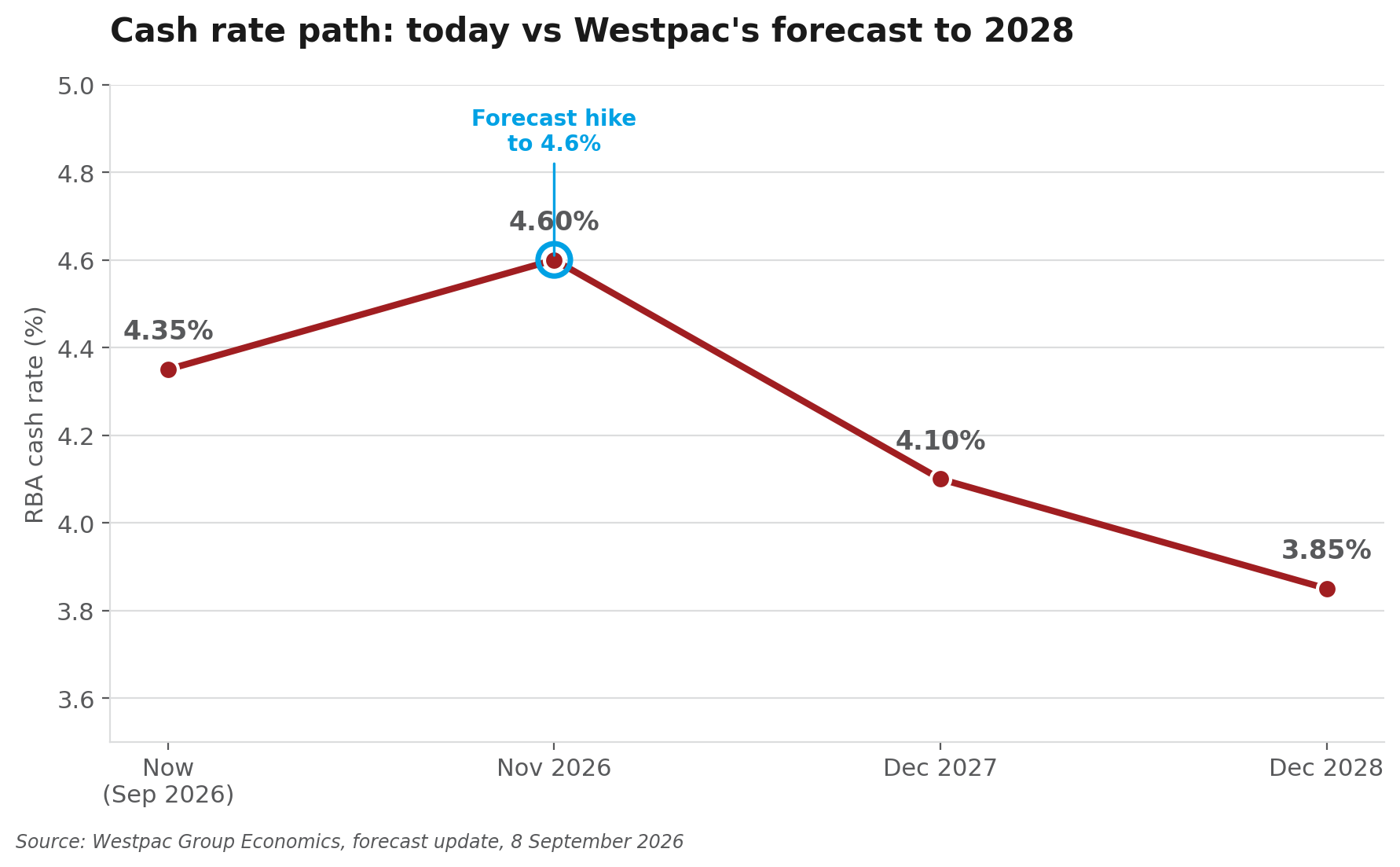
Westpac Group Chief Economist Luci Ellis said that "the likelihood of an additional rate hike has risen enough to make a November hike the base case again”. She attributed the shift to "growing evidence of a more resilient household sector, and a larger-than-expected impetus from the spillovers from the data centre boom”, adding that Westpac believes "RBA leadership would strongly favour a November hike over September" – though she cautioned "the probability of the September scenario is not zero."
Westpac's updated forecasts have the cash rate peaking at 4.6% before easing to 4.1% by the end of 2027 and 3.85% by the end of 2028, with three 25-basis-point cuts pencilled in from August 2027.
September a live risk, says CBA
CBA switched its call on 27 August, the day after ANZ, with CBA head of Australian economics Belinda Allen expecting the November meeting to be the most likely timing for a 0.25 percentage point increase.
Allen said: "Putting the evidence together, we think the case has grown for tighter monetary policy in the Australian economy … We see the 2–3 November meeting as the most likely point for a rate rise."
CBA still expects rate cuts to resume in 2027.
ANZ lands on a November hike
ANZ was the first of the big four banks to revise its forecast, switching to a November call within hours of the CPI release. ANZ's economics team described the July data as "uncomfortably high" but said it wasn't quite enough on its own to justify a September move: "We don't think there is a strong enough case to justify a September hike."
ANZ economists reckon an additional increase "should be sufficient to slow activity enough to mitigate against further inflation risks”.
Macquarie joins NAB
Macquarie broke from the other three major banks to side with NAB's earlier timing. The fifth pillar of Australia’s major banks believe stubbornly high inflation has made a 25-basis-point increase later this month "the most likely outcome”, noting that trimmed mean inflation has spent 17 of the last 20 quarters above the RBA's 2–3% target band.
What comes next
The synchronised about-face all comes back to one stubborn number: July's trimmed mean inflation, stuck at 3.6% for a second straight month, well above the RBA's 2–3% comfort zone.
Headline inflation cooled, but the number the RBA actually watches didn't budge, and that was enough to spook five separate economics teams into an almost synchronised about-face.
Westpac's Luci Ellis adds another wrinkle: households are spending more freely than expected, and the data centre construction boom is pumping extra heat into the economy just as the RBA hoped things would cool off.
Whether the hike comes on 29 September or 3 November, borrowers should brace for 4.6% well before the Christmas turkey goes in the oven.