Both first-home buyer and investor cohorts post sharp declines in September

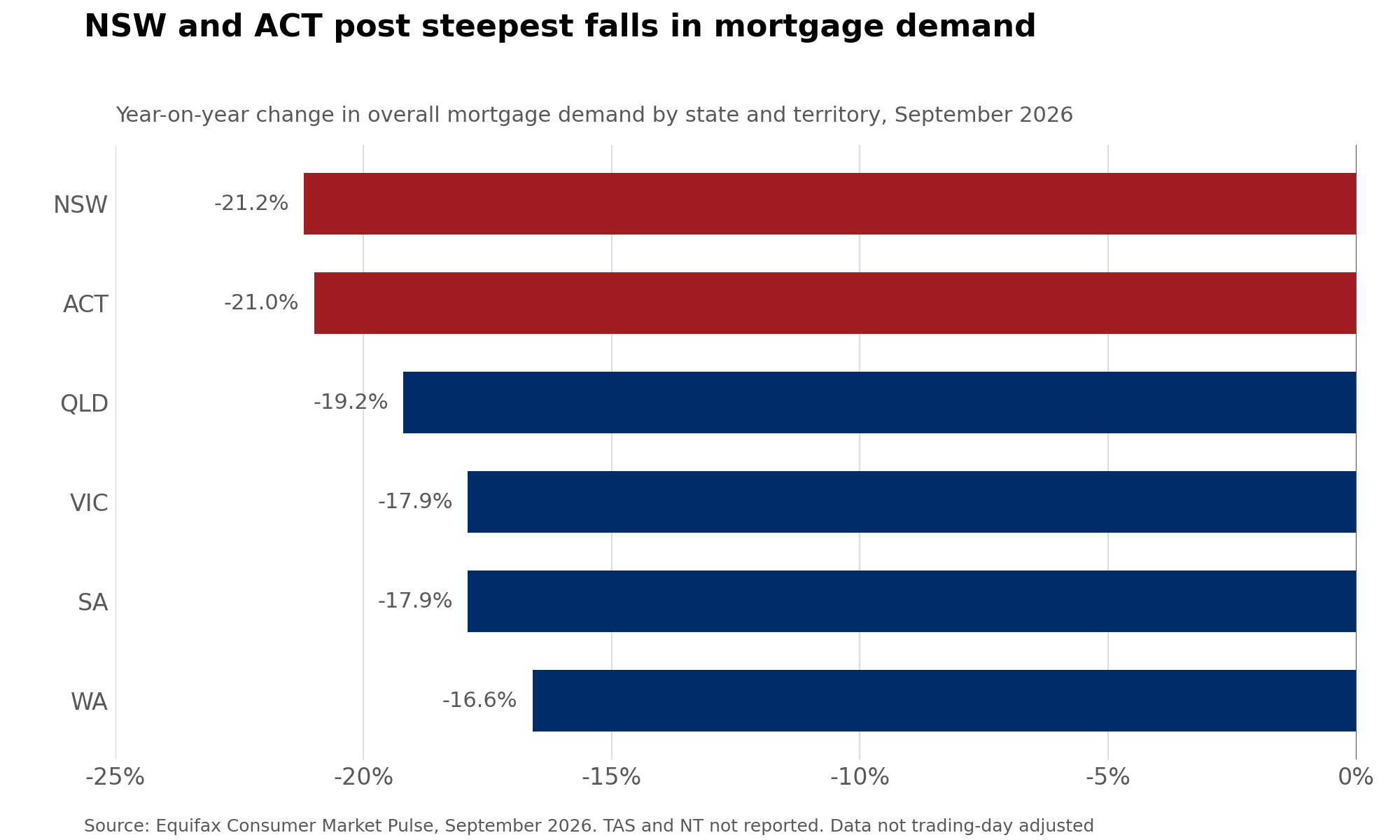
Australian mortgage demand fell 19.2% year on year in September, the sixth consecutive month of decline and the weakest reading since October 2022, according to Equifax's latest Consumer Market Pulse data.
The slide deepened after a brief pause in August, when demand was down 14.1%, and the pullback was led by younger borrowers. Applications from 18-25 year olds fell 25%, while those from 26-35 year olds dropped 22.5%.
The Australian Capital Territory and New South Wales recorded the steepest falls in overall mortgage demand, followed by Queensland, Victoria, South Australia and Western Australia.
Kevin James, chief solution officer at Equifax Australia, said the August result had proved a false floor.
"The Equifax Consumer Market Pulse data for September 2026 reveals a notable shift in Australian borrowing behavior. While August provided a brief moment of pause where mortgage demand appeared to find a temporary floor at -14.1% YoY, September data indicates that the underlying market contraction has resumed with greater intensity, dropping to -19.2% YoY.
“Rather than taking on expanded debt commitments in a sustained high-rate environment, Australian households are taking a decisive step back.”
First-home buyer demand plummets
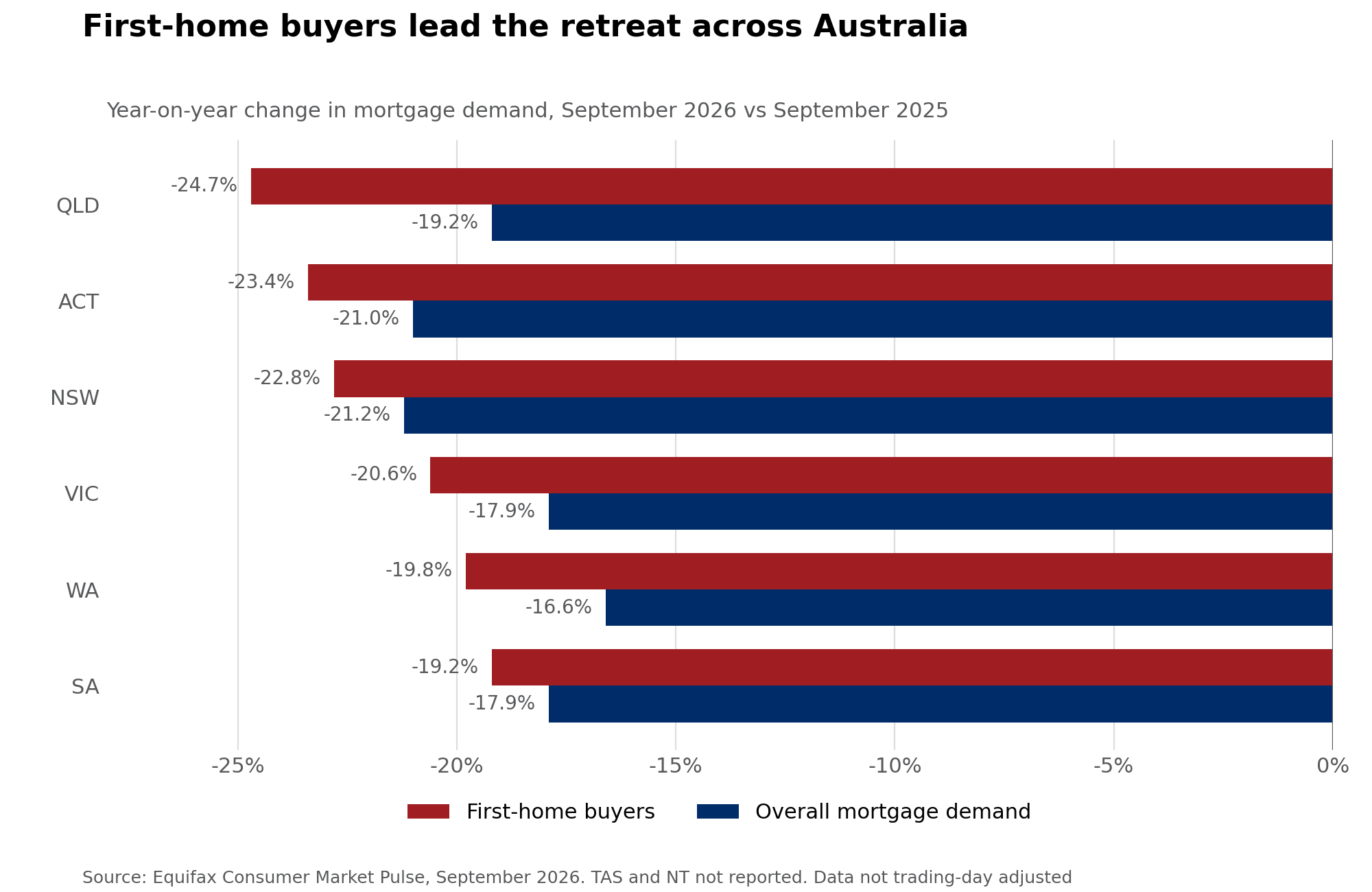
First-home buyers remain the weakest segment of the market. Mortgage demand from that cohort fell more than 22%, following falls of 19.2% in July and 20.1% in August. It was the largest annual decline in first-home buyer demand since December 2022.
Queensland led the retreat, followed by the ACT and NSW. Victoria, Western Australia and South Australia followed.
The reversal is stark against the momentum seen late last year, when the expanded 5% Deposit Scheme sparked a jump in Gen Z mortgage activity. Loan sizes have not come down with demand. The average first-home buyer mortgage sits at a record $743,000, with averages of $634,000 for 18-25 year olds and $736,000 for 26-35 year olds.
"Younger buyers in the 18–35 demographic are facing compounding pressures. Even though we've seen some property value dips recently, baseline prices still remain high – with average first-home buyer mortgage sizes hovering at record levels of $743,000. Combined with strict serviceability testing, high interest rates, and broader cost-of-living inflation are eroding confidence. For many prospective entrants, bridging the deposit and repayment threshold is likely becoming increasingly difficult without institutional or familial support," James said.
Why are borrowers struggling to refinance?
Refinancing also lost ground. External refinancing – where a borrower switches to a different lender – fell 8.8% year on year, reversing a near-flat August result. NSW was the weakest state, while Tasmania was the only state to grow (and only barely, at 1.5%).
Internal refinancing, where borrowers restructure or reprice with their existing lender, recorded the steepest fall of any mortgage segment at 28%. NSW fell 31.3%, and demand dropped most among 26-35 year olds.
James linked the switching slowdown to serviceability, whereby lenders regulated by the Australian Prudential Regulation Authority (APRA) must assess new loans at a rate three percentage points above the product rate.
"In the current economic climate, strict regulatory serviceability assessments appear to be holding borrowers in place. Many existing mortgage holders wanting to shop around for a better rate are likely finding themselves unable to clear the serviceability needed, effectively locking them into their current arrangements," he said.
Investor demand slides
Demand from potential investors fell 18% year on year in September, down from -11.4% in August and -15.1% in July.
The September data largely predates the Reserve Bank of Australia (RBA)'s decision to lift the cash rate by 25 basis points to 4.6%. It was the central banks's fourth increase this year, and its statement noted that new housing loans had declined noticeably and housing prices had fallen in most capital cities.
Unsecured credit moved the other way. Credit card demand rose 10%, driven by a 36.3% jump among Australians aged 56 and over. James attributed the surge largely to card switching ahead of the RBA's 1 October interchange fee cap reduction, as issuers flagged changes to rewards and fees.