Macquarie Bank records the biggest rise in consideration in YouGov's latest Australian bank rankings

Australians rate the major banks well on quality but are less convinced they offer value for money, according to YouGov’s Australia bank rankings 2026, published on 23 November.
The study is based on surveys of more than 12,000 Australian adults between November 2025 and October 2026, and measures which banks people would consider the next time they need a financial product. It covers a year in which the Reserve Bank of Australia (RBA) raised the cash rate several times.
CBA tops the bank rankings
Commonwealth Bank of Australia (CBA) is the most considered bank by a wide margin. At 28%, it sits more than nine points ahead of ANZ, while ANZ, NAB and Westpac are separated by just one point in the race for second.
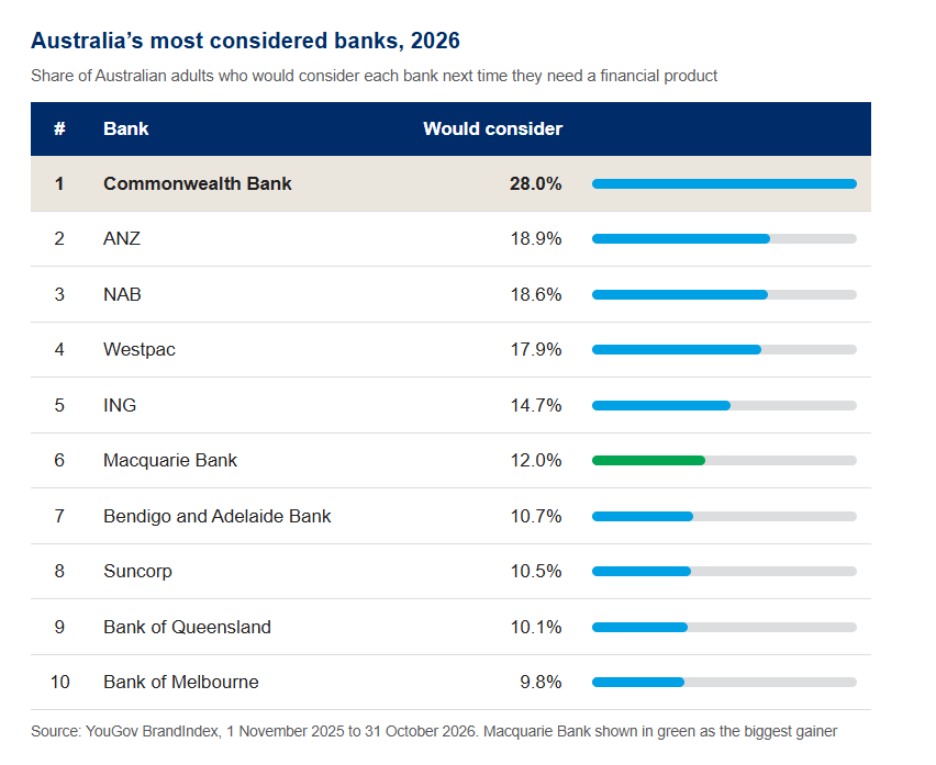
Outside the big four, ING ranks highest in fifth place at 14.7%, followed by Macquarie Bank at 12%. Bank of Melbourne, a Westpac brand with branches only in Victoria, makes the top 10 with much of its support coming from its home state, where 17.3% of adults would consider it.
Macquarie gains the most
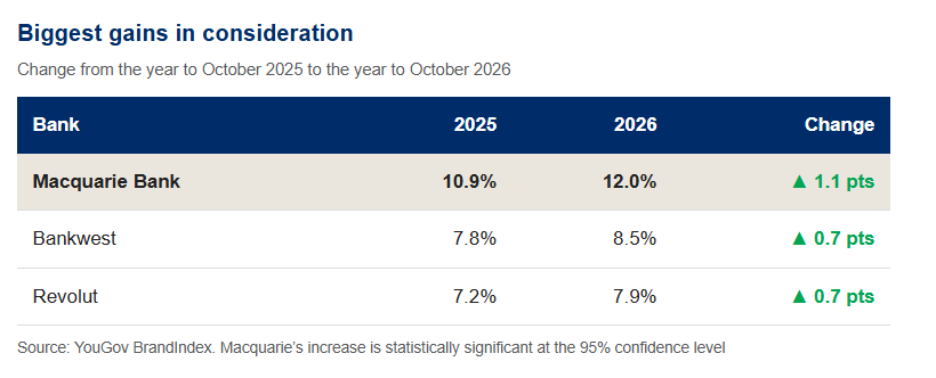
Macquarie recorded the biggest year-on-year rise in consideration, up 1.1 points to 12%, an increase YouGov said was statistically significant. Bankwest and Revolut each gained 0.7 points, with Revolut’s rise following the Australian Prudential Regulation Authority (APRA)’s decision to grant it a banking licence in July 2026.
The result lines up with Macquarie’s growth in home lending. The bank writes more than 95% of its home loans through brokers, and its home loan book grew 28% to more than $181 billion in the year to 31 March 2026, as MPA reported in its story on Macquarie’s broker-led home loan book growth.
It also won six of 10 categories in MPA’s Brokers on Banks 2026 survey, its fifth year as brokers’ top-rated bank, as covered in our report on how Macquarie won the Brokers on Banks survey.
Quality versus value
YouGov also asked people to rate each bank on quality and on value for money, using net scores, which are positive ratings minus negative ratings. Every bank scored higher on quality than on value, but the size of that gap varies widely.
ING has the most even result, leading on value with a gap of just 3.3 points between its two scores. CBA sits at the other end. It has the highest quality score of the banks compared, but a gap of 9.3 points, so people rate the brand more highly than its value for money.
ANZ and Westpac have the weakest value scores in the group and were beaten on value by two smaller lenders, Bank of Queensland and Bank of Melbourne.
What the rankings mean for brokers
The results point to a gap brokers deal with every day. Clients often start with a big-name bank but don’t see those banks as the best value, so a client who asks for CBA may be putting more faith in the brand than in the rate.
Smaller lenders face the opposite problem. Bank of Queensland and Bank of Melbourne score well on value, but only about one in 10 adults would consider them, so it often falls to the broker to raise them.
Brokers also judge lenders on different terms. MPA’s Brokers on Banks 2026 survey found credit policy, speed and business development manager support mattered more to brokers than price. Most consumers won’t weigh these factors when they name a preferred bank, yet they can decide where a loan ends up.
After the RBA’s 3 November 2026 decision, Macquarie said it would lift its variable home loan reference rates by 0.25 percentage points from 19 November. As repayments rise, more clients are likely to ask whether their bank still offers good value, which makes now a good time for brokers to look at existing loans.
Brokers are well placed to have those conversations. They settled a record 81.6% of new home loans in June 2026, according to the Mortgage & Finance Association of Australia (MFAA), and the bank that gained the most consideration this year relies on them for almost all of its home loans.
Overall, the rankings show that a well-known name still decides which banks Australians think of first, but not which ones they see as good value. With rates rising, that gap gives brokers a clear role in helping clients look past the familiar names and compare lenders on price, policy and service.
Our daily newsletter is FREE and keeps you up to date with the world of mortgage. Please complete the form below and click on SIGN UP to receive daily e-newsletters from Mortgage Professional Australia.