Global bond rout makes higher mortgage rates could arrive in days

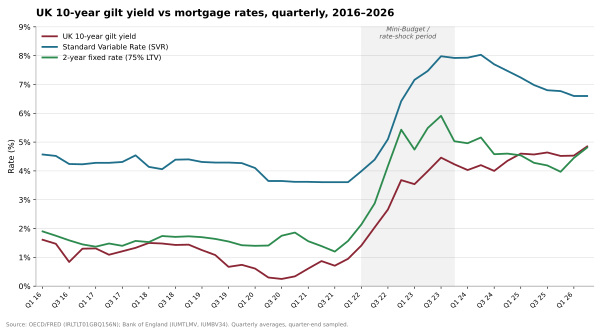
UK government borrowing costs have jumped to their highest level since the 2008 financial crisis. A worldwide sell-off in bonds pushed up the funding costs that underpin fixed-rate mortgage pricing, just eight weeks before Chancellor John Healey delivers his first Budget. And as you can see in our chart below – that’s really bad news for borrowers.
The yield on 10-year gilts, the benchmark the Treasury uses to price its own borrowing, rose to 5.21%, an 18-year high, as investors around the world demanded higher returns to hold government debt. For brokers, the number matters far beyond Westminster. Lenders lean heavily on gilt and swap movements to set the fixed rates they offer clients, so a sharp move like this one tends to filter through to mortgage pricing within days.
It's the latest leg of a rise in UK borrowing costs that has been building for months.
Read next: UK gilt yields hit multi-decade highs as political and inflation risks mount
Why does this matter for mortgage borrowers?
Gilt yields don't set mortgage rates directly – lenders price fixed-rate products off swap rates, which move in the same direction but react even faster to shifting expectations for Bank Rate. Every time gilts have spiked this year, the pattern has repeated: swaps rise first, and high-street names from NatWest and Barclays to Nationwide and Halifax follow within a day or two, pulling and repricing products with little warning.
That's been the story of 2026 so far. Sub-4% fixed deals largely disappeared from best-buy tables back in March as swap rates climbed, and lenders have reprised the same playbook every time tensions in the Middle East have flared. Given today's move, brokers may want to flag to clients in the pipeline that current pricing may not hold for long.
Read next: Demise of sub-4% fixed mortgages as lenders reprice on higher swap rates
It’s not just the UK
Tuesday's move wasn't confined to the UK. Borrowing costs rose in tandem across major economies, suggesting investors are repricing risk everywhere at once rather than reacting to anything specific to Britain's public finances.
Japan's 10-year bond yield pushed above 3% for the first time in roughly three decades, a level that matters because it now roughly matches the government's own assumed long-run cost of funding. Further rises there would start to bite directly into the country's finances.
The US 10-year Treasury yield, the world's most-watched benchmark, climbed to its highest level since early 2025 after Federal Reserve chairman Kevin Warsh used his first Jackson Hole address to argue that inflation isn't cooling fast enough and that the central bank still has work to do. Germany's 10-year bund yield touched a 15-year high on Monday, and Australia's equivalent hit levels last seen in 2011.
Two things are driving the move. Brent crude has climbed to around $91 a barrel, its highest level in months, after the US and Iran exchanged strikes over the weekend, reviving fears that a wider conflict could squeeze energy supply and keep inflation elevated for longer.
On top of that, there's simply a lot more debt chasing the same pool of buyers. Governments funding widening deficits and defence commitments are competing for investor cash with technology giants such as Nvidia, Microsoft and Alphabet, which are borrowing heavily to fund AI infrastructure.
The Budget backdrop
Higher borrowing costs are an unwelcome complication for John Healey as he prepares to deliver his first Budget as Chancellor on 28 October, under Prime Minister Andy Burnham's government. Every extra basis point on gilt yields adds to the government's own debt-servicing bill, tightening the fiscal headroom Healey has to work with even before any tax or spending decisions are announced.
For the mortgage and property sector specifically, the run-up to the Budget already carries its own set of questions for brokers to walk clients through – tax now shapes far more client conversations than it used to, from landlords weighing up rental income changes to buyers factoring stamp duty into affordability.
Read next: Government's growing reliance on property tax is reshaping client behaviour, brokers warn
What this means for advice conversations
None of this changes the fundamentals of good advice, but it does add urgency to conversations brokers are already having. Clients close to completion, or with a rate hold about to expire, may want to lock in sooner rather than later, given how quickly lenders have reacted to swap moves earlier this year.
The choice between fixed and tracker deals is a genuinely live one too: trackers have looked more attractive at points this year precisely because fixed pricing moved so far, so fast, though that gap can close quickly once the Bank of England signals a hike is imminent. Landlords and portfolio clients have Budget-related tax questions to weigh alongside the near-term rate risk.
Nicholas Mendes, mortgage technical manager at London broker John Charcol, has previously pointed out that mortgage pricing doesn't wait for the Bank of England to act, and that lenders are likely to keep repricing in advance if markets continue pricing in higher rates. That's a pattern brokers have seen play out repeatedly since March, and it's worth flagging to clients who assume today's headline rate will still be on offer next week.
Read next: Brokers urge borrowers to act now ahead of Bank of England rate decision
What happens to mortgage rates next
Markets are now pricing in a real chance of further Bank of England tightening before year-end, a reversal from the rate-cut expectations that prevailed for much of the past year. Bank Rate has held at 3.75% since December, and the next decision will be announced on the17 th of September, around the same time the Bank of Japan is expected to raise its own rate again. Whichever way both central banks lean, brokers should expect swap rates, and mortgage pricing behind them, to keep moving before either meeting takes place.
Want to be regularly updated with mortgage news and features? Get exclusive interviews, breaking news, and industry events in your inbox – subscribe to our FREE daily newsletter. You can also follow us on Facebook, X (formerly Twitter), and LinkedIn.