Homes sell almost as quickly as last year, buyer enquiries recover, and price growth stays modest
The UK housing market has shown resilience in the face of conflict and higher mortgage rates, with the average home taking only one day longer to sell than a year ago, according to the latest Zoopla House Price Index.
The property portal said agreed sales were 3% below last year’s level, while buyer enquiries had recovered after the Easter break. It added that lower mortgage rates and a ceasefire in the Middle East had supported renewed activity among buyers.
Annual UK house price growth stood at 1.3%, compared with 1.8% a year earlier. The average UK home was valued at £271,700.
Zoopla said the market remained active among households that needed to move, although conditions varied sharply by region. Homes were selling at a similar pace to last year in more than half of UK regions, while sellers in London and nearby commuter areas faced longer waits.
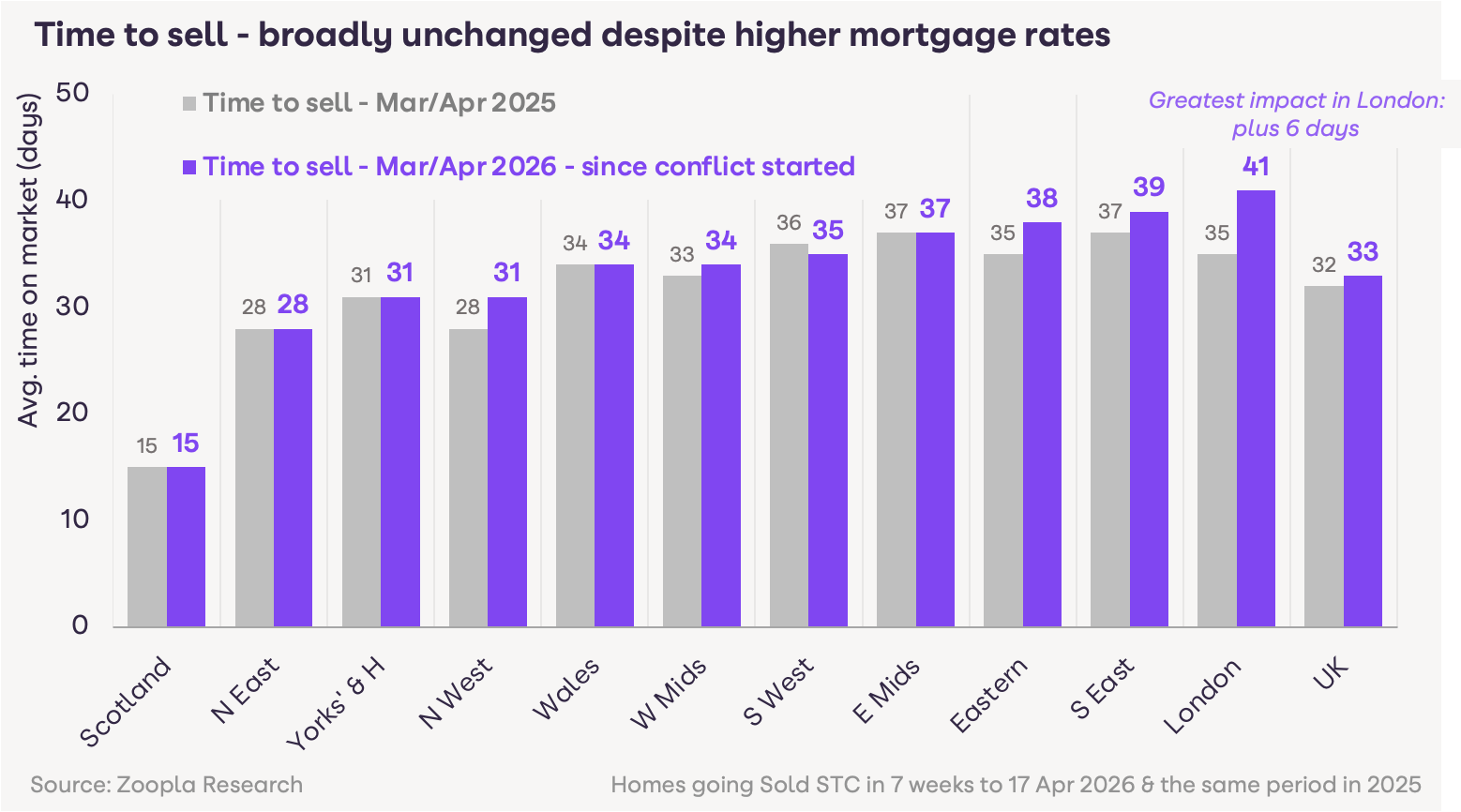
The pressure was most visible in first-time buyer markets in and around the capital. The average time to sell in London rose by six days, with similar increases in some more affordable commuter locations.
Zoopla said the largest increases were not concentrated in central London, but in outer areas more reliant on first-time buyers. These buyers are more exposed to mortgage rate movements and, in London, often face higher stamp duty costs than first-time buyers elsewhere in England.
In the Harrow postcode area, the average sale time rose to 54 days from 33 days a year earlier. South East London increased to 43 days, East London to 36 days, while Uxbridge and Bromley recorded rises of about seven days.
The pattern was also seen beyond the capital. Dartford rose to 37 days, Peterborough to 48 days and Slough to 46 days.
Zoopla said four in five first-time buyers in London pay stamp duty equal to about 3% of the purchase price. Outside London, fewer than one in 10 first-time buyers in England pay the tax, and usually at a lower cost.
The data also pointed to a continuing North-South split. Scotland remained the fastest-moving market, with homes taking an average of 15 days to sell, unchanged from a year earlier. Northern English regions were close to last year’s pace, supported by fewer homes for sale and firmer price growth.
“Homes are taking just one day longer to sell than this time last year,” said Richard Donnell (pictured right), executive director at Zoopla. “That is a strong result given increased uncertainty and mortgage rates rising sharply in March.
“Buyer enquiries have rebounded after Easter and with mortgage rates starting to fall, we expect the market to remain active through the rest of the year. Households who need to move are getting on with it though market conditions vary widely between North and South.
“For sellers, the message is clear - well-priced homes are still finding buyers in the same time as last year across much of the country. For buyers, mortgage rates are drifting lower and there is greater choice of homes for sale. The best-value homes are moving quickly, particularly in northern cities and Scotland whereas the room for negotiation is greater across southern regions.”
Meanwhile, Northern Ireland recorded the strongest UK house price growth at 6.7%. In Great Britain, the North East rose 3.2%, the North West 3.1% and Scotland 2.6%. Liverpool posted growth of 4.5%, while Manchester and Newcastle were both up 3%.
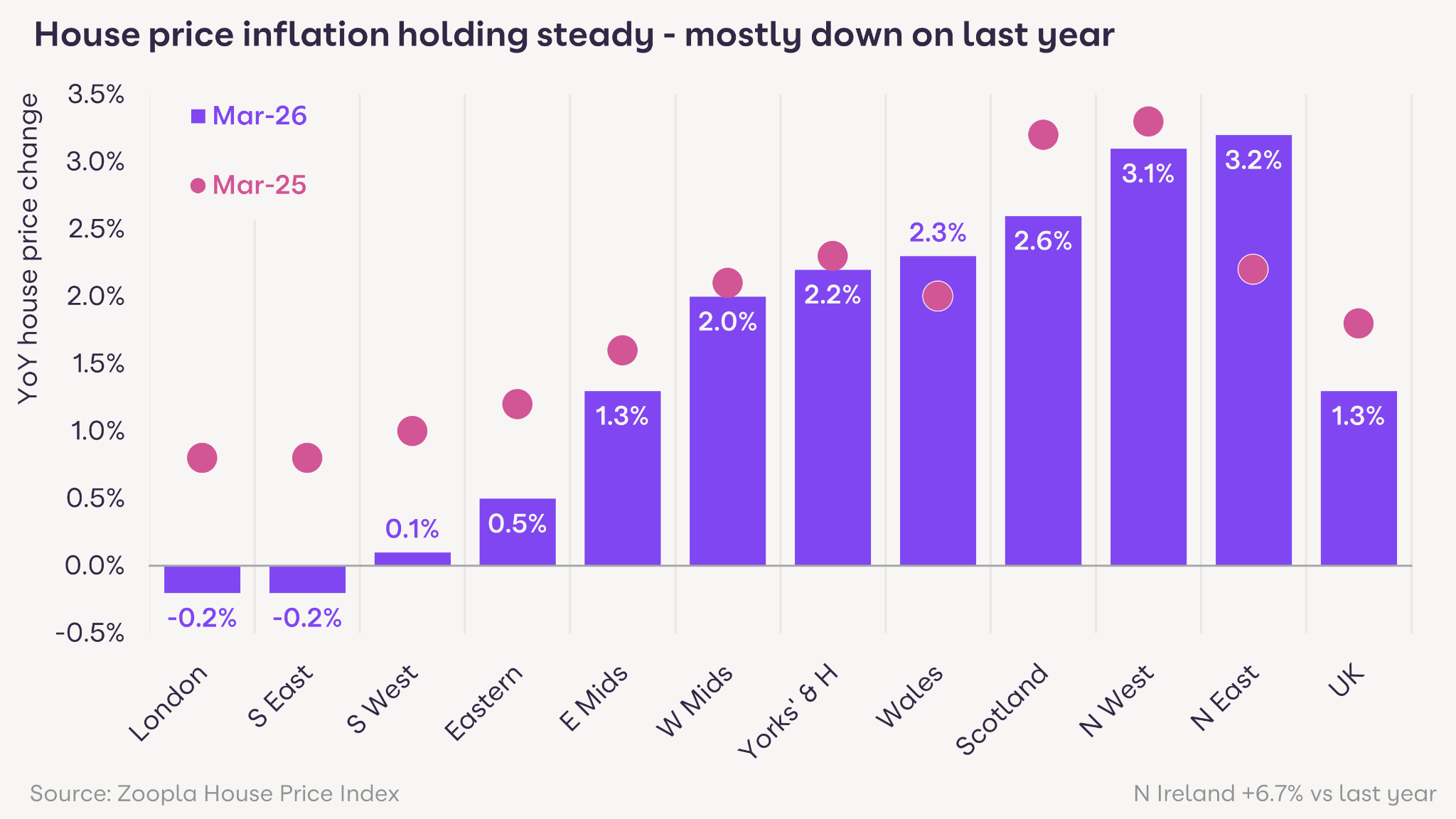
By contrast, London and the South East each recorded annual price falls of 0.2%, while the South West rose by 0.1%. Bournemouth fell 1.7%, Brighton declined 1.1% and Cambridge was down 0.9%.
 “Housing market activity is proving more resilient than we dared hope as war in the Middle East continues for longer than originally anticipated,” said Jeremy Leaf (pictured right), north London estate agent and former RICS residential chairman.
“However, the amount of available property in our offices – particularly flats – is keeping prices under control and resulting in more protracted transactions as buyers flex their muscles.
“Worries about the direction of travel for interest rates and the cost of living means more price-sensitive purchasers are taking their time before submitting offers in expectation the after-effects will linger for considerably longer even if hostilities end soon.”
Want to be regularly updated with mortgage news and features? Get exclusive interviews, breaking news, and industry events in your inbox – subscribe to our FREE daily newsletter. You can also follow us on Facebook, X (formerly Twitter), and LinkedIn.