Younger workers are searching for income cover and saying they plan to buy it. Very few have done so yet, and brokers are well placed to close that gap

Gen Z has a reputation for spending its money on takeaway coffee and streaming subscriptions. When it comes to protecting their pay, though, younger workers now look more cautious than their parents. For brokers, the challenge is getting from that interest to a policy that is actually in force.
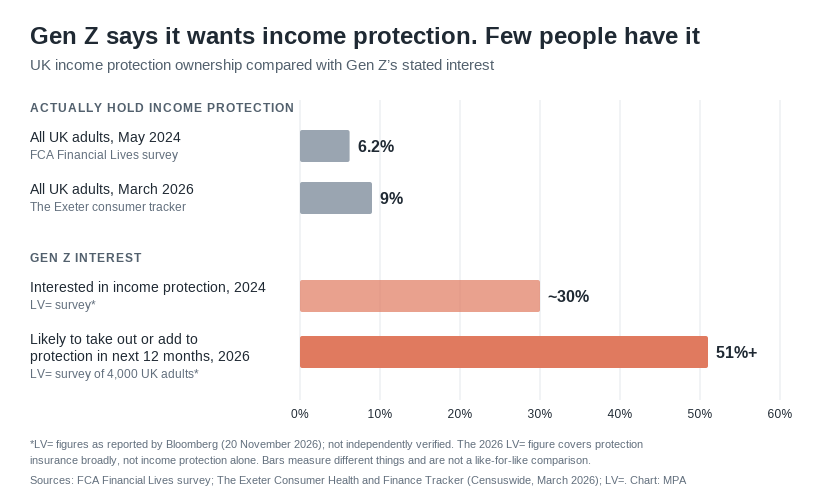
Consumer research this month found that just over half of Gen Z workers expect to take out or add to protection insurance in the next 12 months. The figure comes from a survey of 4,000 UK adults commissioned by LV= in May. Two years earlier, LV= found that roughly three in ten Gen Z respondents were interested in income protection.
Search data shows the same thing. The Exeter's analysis of Google Trends found UK searches for income protection rose 30% in the 12 months to 10 July. Searches for "income protection cost" and "how much is income protection" grew more than fiftyfold over the same period, so the people searching want to know what it will cost them.
Read next: Why income protection has become impossible to ignore
Very few of those searches, however, have turned into policies yet. The Exeter's Consumer Health and Finance Tracker puts income protection ownership at 9% of UK adults. The FCA's Financial Lives survey found that only 6.2% of UK adults held income protection in May 2024, against 28% with life cover.
It’s not as if insurance isn’t needed or that people are unaware -the same tracker found that 18% of people had taken at least four weeks off work through illness, injury or mental health problems in the six months to March 2026.
Jamie Page, head of protection distribution at The Exeter, has urged advisers to put income protection at the centre of mortgage advice, building it into the affordability picture from the start. Awareness on its own, he has said, doesn't make anyone more financially resilient. That only happens when a policy is in place.
Read next: Why younger buyers need a mindset shift on home protection
Why younger workers feel exposed
Living costs explain much of this. Office for National Statistics figures show average UK private rent rose 3.8% to £1,406 a month in the year to September 2026. Job security is a worry too: Mortgage Advice Bureau research found that more than a third of Gen Z would-be buyers count job and income insecurity among their biggest concerns.
Statutory sick pay got a little more generous this year. Since April, under the Employment Rights Act 2025, SSP has been paid from the first full day of absence, and the lower earnings limit has been scrapped. The amount is still low. Acas guidance puts it at £123.25 a week, or 80% of average weekly earnings if that is lower. A renter paying the national average would have about half their rent covered and nothing for anything else.
Renters are an untapped market
Most advisers raise protection when a client buys a home. Many Gen Z clients will have spent years renting before that, with no cover at all. Research from Aviva found fewer than one in ten people would consider income protection when moving into a rented home. Three-quarters of Gen Z respondents without a policy still said they would like to know more about it.
So brokers can start the protection conversation long before a client applies for a mortgage. Referrals, existing clients' adult children and check-ins while someone saves for a deposit are all ways in.
Cheaper if you start young
Age is the easiest selling point. Premiums go up as people get older and pick up medical history. One protection specialist told Bloomberg about two clients in the same profession with similar cover. The one in her 20s pays around £24 a month, and the one in her 50s pays around £75. "The key is to get the cover in young," the adviser said.
Some of the interest is turning into sales. The Exeter reported a 21.6% rise in income protection new business premiums in 2025.
Claims need careful handling
Brokers should be upfront about claims. ABI and GRiD figures show income protection paid £880m across 18,469 new claims in 2025, with 79% accepted, well below the rate for life cover. The Association of British Insurers said a record £209m went out on individual income protection claims last year, with the average claim up 7% to £10,700. A third of those claims were for musculoskeletal problems such as back and neck pain.
That acceptance rate makes good advice more important. Whether a claim pays out often depends on full disclosure, the right definition of incapacity and a deferred period that matches the client's sick pay. A 24-year-old buying cover online is unlikely to get any of that right without help.
Read next: Many young homeowners lack financial protection, study finds
Three questions to ask a Gen Z client
1. What happens to your pay if you're off sick for a month? For six months? Plenty of younger clients have never read the sick pay section of their contract. The answer determines the deferred period, which has the biggest effect on price.
2. What do you have to pay every month, whatever happens? Include rent or mortgage, bills, loan repayments and anything else they can't cut. That sets the level of cover.
3. How are you paid? An employee, a freelancer and someone with a second job will each be entitled to very different things if they can't work. A recent move from the public to the private sector can make a big difference too.
Not every young worker needs income protection straight away. A healthy 23-year-old with no dependants and low fixed costs might sensibly build up some emergency savings first. But Gen Z is still set on buying a home, and the income that will pay that mortgage needs protecting. Ideally, brokers have that conversation before the mortgage application.
Read next: Homeownership for the young: harder than ever, but not out of reach