
Latest quarterly data points to slower completions despite steady adviser enquiries

Equity release lending declined in the first quarter of 2026, with total advances falling to £574 million, according to the Equity Release Council.
The figure was 9% lower than the £632 million recorded in the previous quarter and 14% below the £655 million reported a year earlier.
Total equity release lending, by quarter 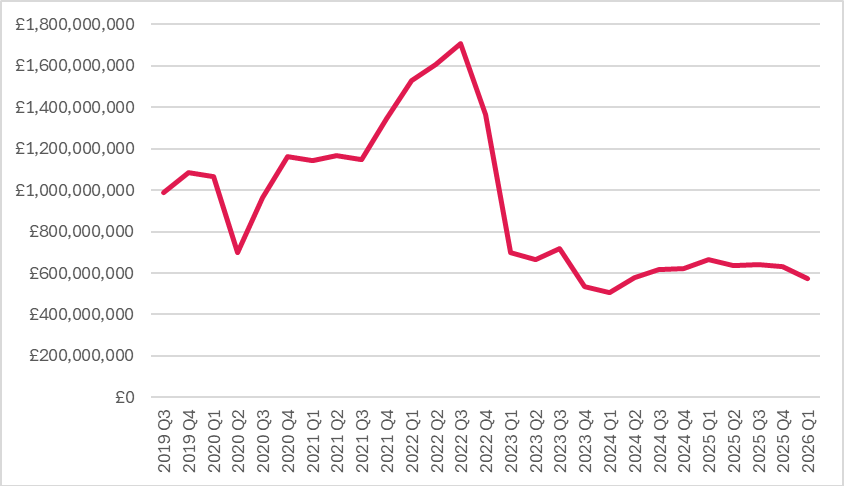 Source: Equity Release Council
Customer activity also weakened. The council said 12,958 new and returning customers accessed property wealth during the quarter, down 7% from the previous three months and 10% year on year.
The fall came despite signs of continued customer interest. Adviser feedback showed 45% of firms saw enquiries rise compared with the previous quarter, while 33% reported a decline.
Applications also improved for some firms, with 38% reporting an increase during the quarter. A smaller proportion, 34%, said applications had fallen. The figures suggest more customers are considering equity release, but fewer are moving to completion.
 “It’s disappointing to see activity fall in Q1, particularly given the significant uplift in enquiries,” said David Burrowes (pictured right), chair of the Equity Release Council. “However, like other parts of the mortgage market, it’s clear the uncertainty dominating the UK and global economies, driven by the conflict in Iran, is contributing to higher interest rates and borrowing costs – while tighter loan-to-value availability is further slowing consumer decision-making, delaying completions.
“What we’re seeing is not a lack of demand – enquiries are up – but a delay in cases coming through. Advisers are reporting strong levels of interest, but customers are taking more time and, in some cases, pausing decisions altogether.
“It could well be that we are set for an uplift as conditions stabilise and delayed cases begin to complete. Over the longer term, the underlying drivers of demand remain in place, and housing wealth continues to play an important role in supporting financial resilience later in life.”
New plan numbers dropped 8% quarter on quarter to 4,868. Returning drawdown customers fell by 2% to 7,019, while further advance activity saw the sharpest fall, down 27% to 1,071.
Average borrowing also reduced across most product types. New lump sum lending was £121,196, down 2% on the quarter and 5% year on year. Initial drawdown lending fell to £62,633, 8% lower than the previous quarter and 10% below the same period last year.
Average drawdown reserve facilities moved in the opposite direction, rising 6% quarter on quarter to £61,307.
Adviser expectations for the second quarter were more positive. The council said 46% of firms expected enquiries to increase in Q2 2026, while half expected applications to rise. By contrast, 20% expected enquiries to fall, and the same proportion expected applications to decline.
 “Broker forecasts point to a strengthening pipeline, with adviser feedback suggesting demand is being deferred, rather than disappearing,” said Jim Boyd (pictured right), chief executive of the Equity Release Council. “As uncertainty starts to ease, we expect more of this activity to feed through, supporting a recovery in the months ahead.
“Releasing equity will inevitably become a mainstream part of retirement planning as advice and products become less siloed and retirement finance inadequacy worsens. Almost four in ten (38%) of future retirees are on track to fall below the Pensions UK ‘minimum standard’.
“With demographic and economic pressures building, demand is likely to grow, supported by product changes that make the secure but flexible financing options provided by modern equity release products increasingly attractive for consumers.”
Want to be regularly updated with mortgage news and features? Get exclusive interviews, breaking news, and industry events in your inbox – subscribe to our FREE daily newsletter. You can also follow us on Facebook, X (formerly Twitter), and LinkedIn.


