
Early figures suggest landlords are adjusting to periodic tenancies by spacing out increases rather than raising rents more often

The Renters' Rights Act, which came into force on 1 May, has coincided with a notable decline in the proportion of sitting tenants in England facing rent increases, according to analysis of Connells Group data by Hamptons.
In May, the number of tenants whose rent was raised was 23% lower than in May 2025 and 16% below the five-year May average for 2021–2025. The legislation converted most fixed-term tenancies in England to periodic, or rolling, arrangements, under which landlords may raise rents no more than once per year.
Data from January to April 2026 showed rent increases running 3% below the equivalent period in 2025, suggesting landlords did not move to front-load increases ahead of the legislative change.
If the May 2026 rate of increases were sustained for the remainder of the year, Hamptons estimates that 31% of tenants would see their rent rise within any given 12-month window — down from 40% in the 12 months to May 2025 and a peak of 50% in the 12 months to January 2024, when newly agreed rents were rising at double-digit annual rates.
Share of tenants who would see a rent increase over a year 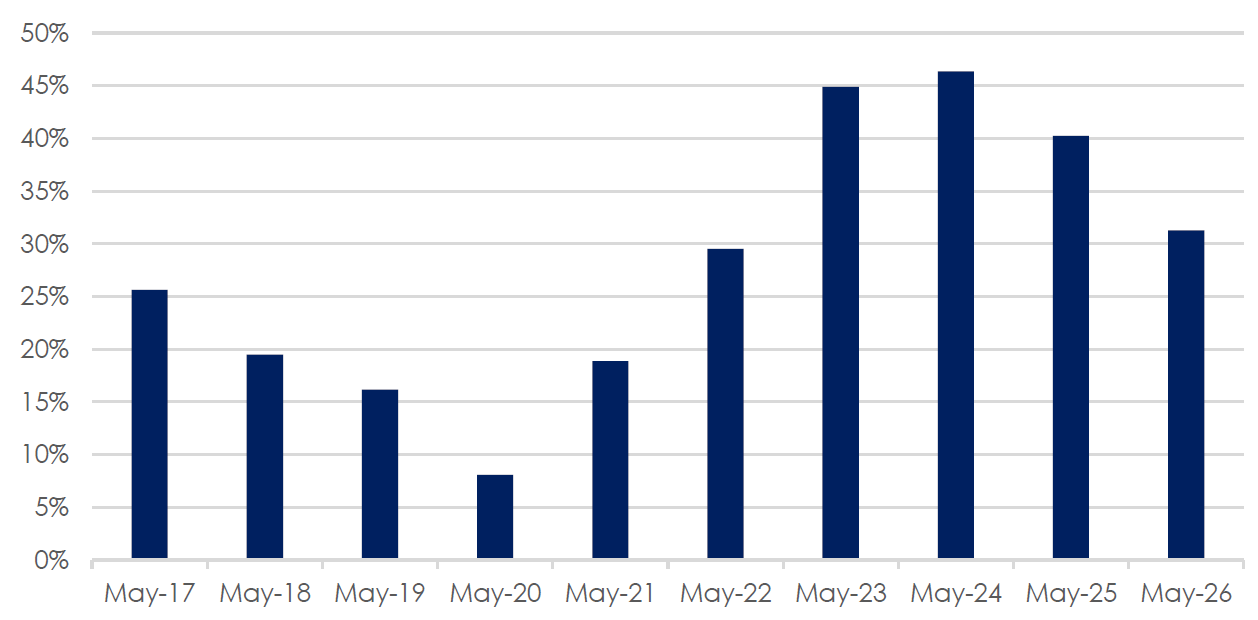 Source: Hamptons using Connells Group data
Hamptons said the trend points to a structural shift rather than merely a cooling market. Under the previous framework, rents were commonly reviewed at tenancy renewal, enabling more frequent incremental adjustments. Under the new rules, landlords are expected to space increases over longer intervals.
Evidence from Scotland — where periodic tenancies have been in place since 2017 — indicates this approach tends to produce fewer increases overall, but larger adjustments when they do occur. Scottish rent controls capped annual increases at 3% until April 2024, when the cap was removed. The sharp rises recorded in Scotland during 2024 and 2025 reflected rents returning to market levels. The Scottish experience may foreshadow how rents in England adjust under the new regime.
Among tenants who did receive an increase in May, the average annual rise was 5.4%, unchanged from April and marginally below the 5.5% recorded in May 2025. At their peak, average increases reached 7.3%. Scotland recorded the highest regional average in May at 7.7%.
Average rent change among those tenants who saw their rent change 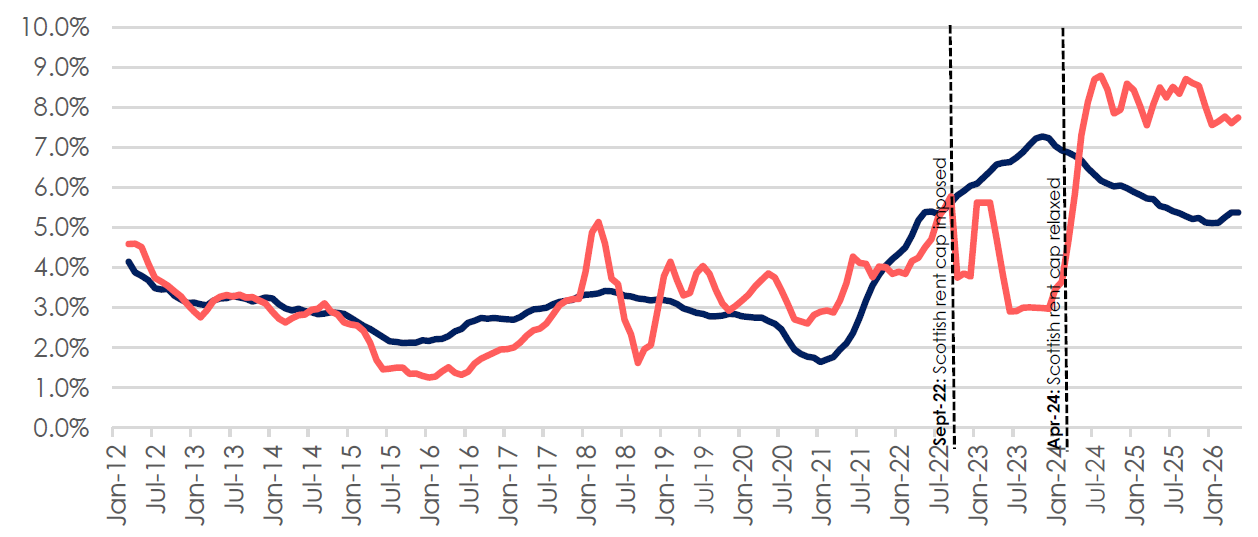 Source: Hamptons using Connells Group data
These figures remain above the 1.1% year-on-year growth recorded for newly agreed lets in Great Britain in May 2026, down from 1.2% in April. Hamptons attributed the divergence to catch-up adjustments, whereby landlords raise existing tenants' rents to align with prevailing market rates after extended periods without revision. The average rent on a newly agreed let across Great Britain stood at £1,382 per month in May.
Regionally, average rents in the South East of England reached £1,500 per month in May — a 2% annual increase and the first time any region outside London has crossed that threshold. London rents currently stand at £2,294 per month; the capital last recorded £1,500 per month in June 2012.
 "One of the first impacts of the Renters' Rights Act has been a reduction in the number of existing tenants seeing their rent rise," said Aneisha Beveridge (pictured right), head of research at Hamptons. "While this partly reflects a backdrop of slower rental growth, falls suggests landlords have, at least initially, been less likely to increase rents than under the previous system where changes predominantly coincided with a tenant signing a new contract.
"If the pattern seen in Scotland plays out in England, tenants may see their rent rise less often going forward. However, the size of the increase may be larger, bridging the gap that can build up between what tenants are currently paying and the prevailing market rate. Last month, the average rent increase in Scotland was 7.7%, higher than in any other region in Great Britain.
"While rental growth on newly agreed lets remains cool by recent standards, landlords appear to be taking a more cautious approach when selecting new tenants. Many are showing a willingness to wait for the right tenant rather than accept the first offer, which has reduced the number of homes let and helped to keep a lid on rental growth for new tenants."
Want to be regularly updated with mortgage news and features? Get exclusive interviews, breaking news, and industry events in your inbox – subscribe to our FREE daily newsletter. You can also follow us on Facebook, X (formerly Twitter), and LinkedIn.


