As banks face scrutiny over mismanaged offset accounts, MPA examines what's really at stake for brokers and their clients

Australia's mortgage offset accounts are now the subject of a formal Senate inquiry, referred to the Economics References Committee on 15 September, after a damning Australian Securities and Investments Commission (ASIC) review found banks representing more than 70% of the country's home loan market had failed to properly set up, link or monitor the accounts for customers.
The regulator's review, covering eight banks and detailed in Report 837 (REP 837), Offsets, out of mind: Banks fall short on mortgage offset account promises, examined loan-level data for 204,000 home loans settled between March and August 2025.
It found banks had paid out more than $55 million in customer compensation for offset failures reported between September 2023 and August 2025 – a figure ASIC expects to keep rising as remediation continues.
Of the failure types identified, 55% involved an offset account that had been opened but never linked to the home loan, while a further 22% had never been opened at all despite being requested.
The scale of what's at stake is considerable: almost 3.3 million Australian households hold a mortgage, and Australians had $349.1 billion sitting in offset accounts as of March 2026 – up 28% over two years.
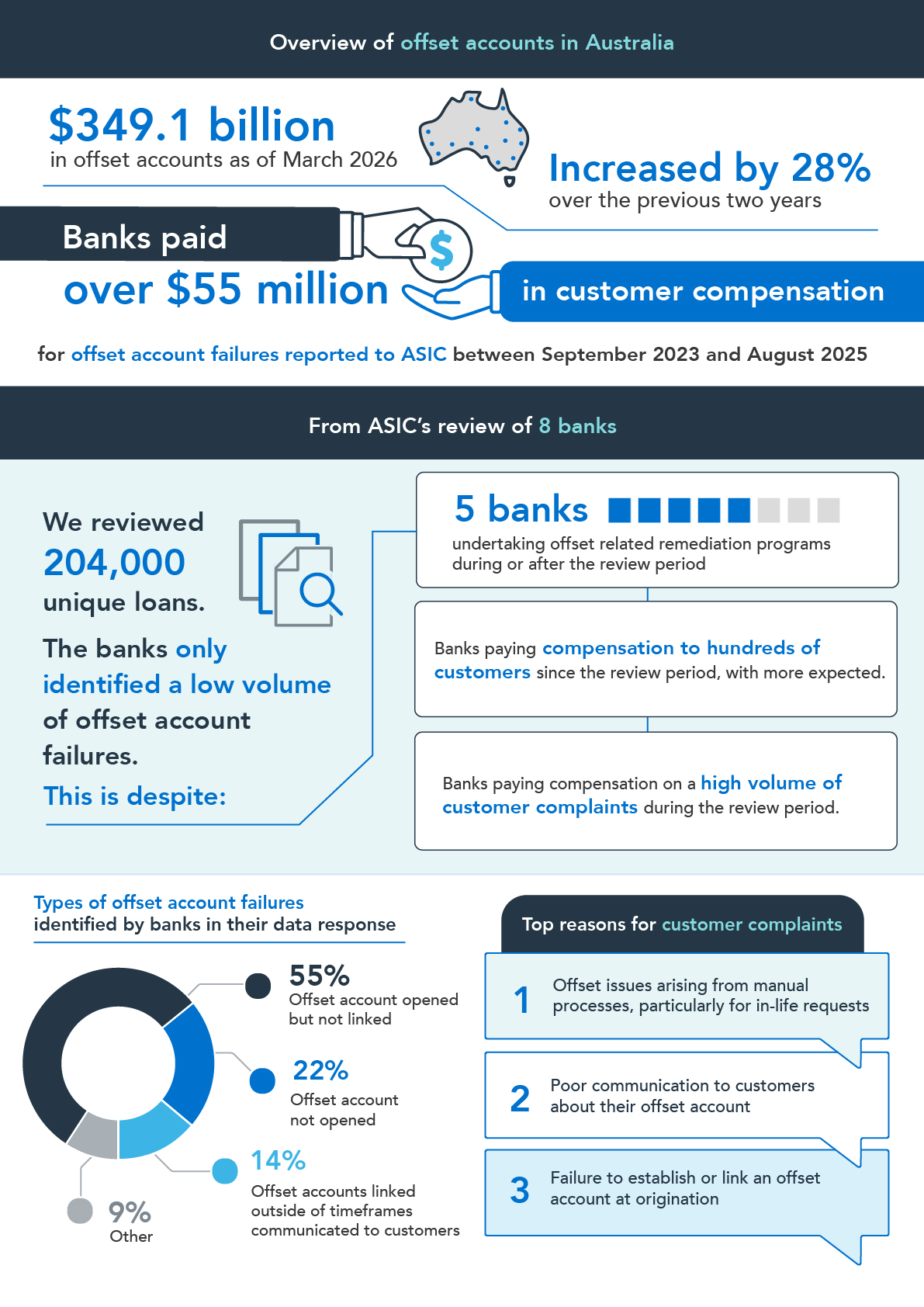
Image credit: ASIC
ASIC Chair Sarah Court said the harm from a mismanaged offset account is often invisible to the customer, since "loan repayments stay the same, while customers unknowingly pay more interest and take longer to repay their loan." In several cases, she noted, failures went undetected until the regulator itself started asking questions.
The inquiry, due to report by 7 June 2027, will examine everything from how offset accounts are established through to whether affected customers are being adequately compensated – and it lands at an awkward moment for the banking sector, which is already grappling with the product's cost to its own bottom line.
Onset of offsets
Jarden Research analyst Matthew Wilson argues the mortgage offset account ranks among the banking industry's costliest strategic missteps of the past four decades.
The offset traces back to the early 1990s, when the MLC Building Society introduced a deposit account earning the deposit rate – then 4% – against a home loan rate of 8.75%.
Westpac scaled the idea into a full offset package with its ‘Options’ product in 1994, and NAB followed with the ‘National Loan Trimmer’.
Wilson calls it "a classic case in our view of the product and marketing department trumping finance and economics" – a design that created a negative-spread product carrying full capital freight from the outset.
The numbers, per Jarden's analysis of company and APRA data, show why that early decision still bites.
Offset balances have grown to roughly 12% of home loans, or $308 billion system-wide (as of August 2025). Jarden estimates this costs the big four banks a combined $6.76 billion a year in lost spread income – 7% of their home loan revenue – with CBA carrying the largest hit at $2.4 billion, followed by Westpac at $1.52 billion, ANZ at $1.6 billion and NAB at $1.24 billion.
Layered on top is $9 billion in "stranded" capital, or 42 basis points of CET1, tied up under capital adequacy rules because of how offset balances are treated. Combined, Jarden puts the total drag at roughly 13% of the majors' core profits.
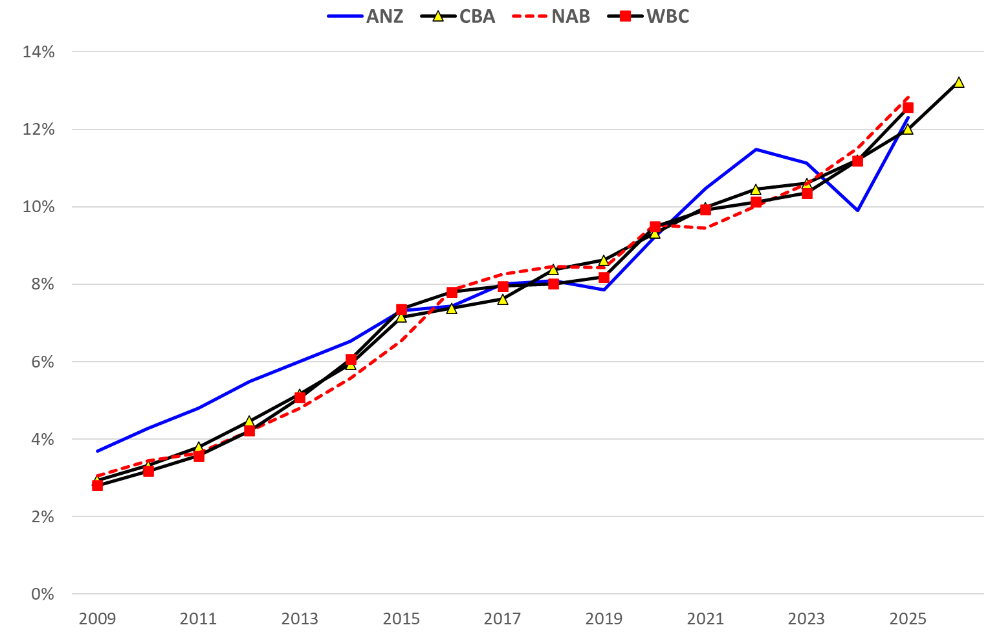
Image credit: Jarden
The figure has risen considerably since offset accounts came into their own in the 2000s. Since 2009, the proportion of offset account balances to home loans has risen from around 3% to 13%, per Jarden analysis.
It stands to reason that the banks, beholden to their shareholders, would like to reclaim some of this lost revenue.
Wilson's prescription isn't to unwind the product, but to reprice it: rather than chasing lost distribution margin from the broker channel, bank effort would be better spent "reverting the economics of the HL (home loan) offset account back into the shareholders' favour" – through fees, limits and account charges.
But herein lies the tension – while Wilson’s prescription might make sense from a shareholder perspective, the Economics References Committee is questioning "the impact of costs and fees versus benefits of offset accounts for customers”.
ASIC's own review gives that consumer-side question some weight. REP 837 found that "many borrowers pay for offset features through higher interest rates, account fees, or both" – without always being able to confirm they were actually receiving the benefit they were paying for.
In other words, some of the fee and margin structures already built into offset products are among the practices ASIC flagged as poorly disclosed or poorly monitored, not additional charges yet to be introduced.
In even simpler terms, the offset practices that make sense for the banks fiscally could be creating harm for customers.
This is the question being tackled by the inquiry, which is looking into, among other things:
-
the impact of costs and fees versus benefits of offset accounts for customers
-
the identification of account failures and internal incident reporting and escalation
-
remediation for customers affected by account failures
-
compensation for customers experiencing account failures
-
the impact on mortgagees and implications for home ownership including increased interest costs, effects on mortgage repayments and sustainability of home ownership
Liberal senator Andrew Bragg has framed the inquiry around a straightforward principle: Australians should have control over how their own money is used, including toward home ownership, and he argues banks have failed to honour that principle in practice, leaving customers paying more interest than they should have.
“Our inquiry will examine how mortgage offset accounts are established, linked, managed and monitored, including their costs and benefits for customers,” says Bragg. “It will also examine how failures are identified and remedied, whether customers are properly compensated and the impact on interest costs, repayments, focusing on the implications for home ownership.”
“The major banks are not above reproach,” Bragg adds. “We expect to hear from their top brass. Australians should not be left paying more interest because an offset account was not properly established, linked or managed.”
Offsets, not brokers, causing margin pressure
Despite a renewed interest in proprietary home loan distribution among the major banks, Wilson vehemently defends the economic rationale of distributing home loans through the broker channel, despite the cost of commission.
“Whilst the industry is currently fixated on winning back the supposed lost distribution margin from the third-party HL broker channel… allowing the third-party channel to form, flourish and own the customer wasn't the biggest misstep,” says Wilson. “HL offset accounts appear to be. Exiting wealth is probably the third, and we expect the industry to re-enter that product segment at some stage in the future.”
From a shareholder perspective, winning back the third-party distribution margin in search of better shareholder returns is logical, but “it's akin to trying to put toothpaste back in the tube”.
Customers have voted with their feet and overwhelmingly choose brokers to service their home lending needs.
“We think bank effort would be better spent reverting the economics of the HL offset account back into the shareholders favour,” says Wilson.
But the banks should expect an uphill political battle to get there.
Why brokers like offset accounts
“When brokers guide clients toward a product with an offset account, it’s because they have run the calculations that show that package is suited to their financial habits and goals,” says Loan Market chief executive Sam White (pictured, top of page, left). “Clients who have a steady savings pattern to regularly contribute to the offset, or a lump sum they still want access to, could save thousands over the life of the loan by using their offset account. It isn’t right for everyone, but for many it has proven a useful way to save money on interest.”
For Beau Flanders (pictured, top of page, right), founder of Sunshine Coast mortgage brokerage and financial planner Zion Financial, offset accounts are an essential part of the broking toolkit.
Rather than treating an offset as a single savings bucket, he sets clients up with multiple linked sub-accounts against one loan – some lenders, like Macquarie, offer up to ten – to separate day-to-day bills, holiday savings and investment funds while still reducing the interest charged on the full loan balance.
It's a structure that lets clients organise their money the way they would with ordinary transaction accounts, without giving up the offset benefit on any of it. There is also a tax benefit at play – interest earned on a saving account is subject to income tax at the marginal rate. So an offset account let borrowers effectively get a better after-tax return on their cash than a taxable savings account would, simply by parking it against the mortgage rather than in a term deposit.
Roughly 90–95% of loans in Flanders' book carry an offset account, reflecting how central the structure has become to his broader client strategy.
He's also seen demand accelerate, with take-up of offset-linked products up an estimated 30% over the past couple of years, a trend he attributes to rising interest rates making the benefit more visible, alongside heavier bank marketing of the feature.
When comparing lenders, Flanders says the number of offset sub-accounts on offer matters more than the annual fee, which typically ranges from $295 to $395 – a cost he considers negligible in the context of the interest saved.
As a rule of thumb, on a $600,000 mortgage with a $400 annual fee, he estimates a client needs roughly $6,500 sitting in the offset to break even; balances above that start delivering a genuine benefit, while clients holding less than around $5,000 may find the fee outweighs what they save.
So not every client is well served by an offset, and Flanders warns that the product's heavy promotion can create a "magic pill" perception that doesn't hold for everyone. The Ozempic of mortgage finance, if you will.
“Offset accounts aren’t right for everyone,” agrees White. “If you don’t have much money in the account or you aren’t regularly putting money into it, the potential benefits may not outweigh the fees that come with having the feature. It pays to have a broker run the calculations to determine whether you will end up better off with it, or if a more basic loan – potentially with a redraw facility instead - is better suited.”
How to keep offsets on track
Given the scrutiny offset administration is now under, Flanders builds ongoing checks into his service model rather than treating setup as a one-off task.
He runs client check-ins at the three, six and 12-month marks specifically to confirm the offset has been linked and is applying correctly, and that clients are actually using the account as intended.
He hasn't personally seen cases of banks mismanaging offset accounts, and suggests the complaints driving regulatory attention may reflect a vocal minority rather than a widespread failure – but the routine check-ins exist precisely because it isn't something he's willing to leave unverified.