New quarterly data shows affordability strain deepening despite a slower quarter

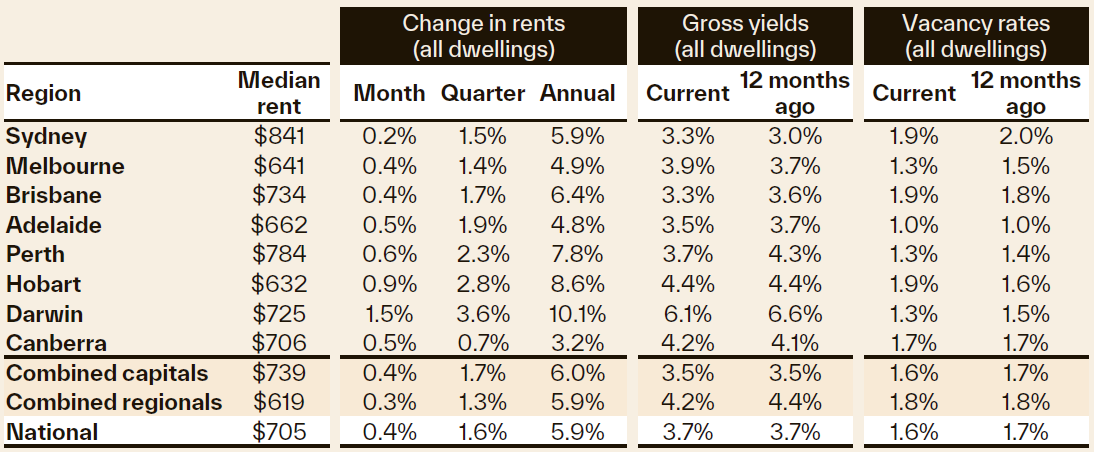
National rents climbed 5.9% in the year to June 2026, up from 5.7% in the previous quarter, according to Cotality's Rental Review for Q2 2026.
Quarterly growth eased to 1.6% in the three months to June, down from 2.1% in the March quarter. The annual rate has risen steadily since a cyclical low of 3.4% in mid-2025, taking the median national dwelling rent to $705 a week.
Over the past five years, national rents have risen 40.6%, adding $204 a week to the typical household's rental bill. By comparison, rents rose just $55 a week, or 12.2%, between June 2016 and June 2021.
 According to Cotality Australia head of research Gerard Burg (pictured right), rental growth is now outpacing household incomes, adding to pressure on tenants.
“We are seeing a profound shift in affordability across the market,” Burg said. “In March this year, the typical household was allocating roughly one-third of their gross income to rent, compared to around 27% just five years ago.
“While quarterly rental growth has eased slightly, the underlying supply deficit means conditions remain incredibly challenging for tenants.
“We are approaching a threshold where rental affordability acts as an increasing constraint on further growth, particularly in regional areas where lower median incomes mean households are spending upwards of 35% of their income on rent.”
Listings shortage keeps market tight
A shortage of available stock remains the main driver of rent increases nationally.
The national vacancy rate held at 1.6% in the June quarter, unchanged from March and still below the five-year average of 1.8%.
Total listings at the end of June sat 16.7% below their five-year average. Darwin recorded the largest shortfall, 26.1% under the long-term average, followed by Sydney at 24.1% and Melbourne at 18.4%.
Every capital city recorded a vacancy rate under 2%. Sydney and Brisbane posted the highest readings, at 1.9%, while Adelaide remained the tightest market in the country at 1%.
 Source: Cotality
“With vacancy rates compressed so tightly, tenants are left with very little leverage,” Burg said. “Capital city rents rose faster than regional markets this quarter, reversing a trend of regional outperformance seen between late 2024 and early 2026, largely because regional markets are hitting severe affordability ceilings.”
Capital city gap narrows as houses outpace units
Sydney remained the most expensive capital for renters in June, at $841 a week, though strong growth in Perth ($784) and Brisbane ($734) has narrowed the gap. Darwin, despite having the lowest dwelling values of any mainland capital, posted the fourth-highest median rent at $725 a week. Melbourne remained the cheapest mainland capital at $641 a week, $200 below Sydney, while Hobart recorded the lowest rent of all capitals at $632 a week.
House rents outpaced units in the June quarter, rising 1.7% against a 1.2% gain for units. This marks a reversal from March, when units rose 2.5%, ahead of houses.
“Over the longer term, unit rents have grown faster than houses, rising 46.3% over the past five years compared to 38.5% for houses,” Burg noted. “This was largely driven by a post-pandemic recovery, particularly in Sydney and Melbourne.”
“However, the latest quarter shows diverging trends. Darwin led house rent growth at 4.1%, followed by Hobart at 3.1%, while Canberra recorded the softest house rent growth at 0.9%. For units, Darwin again led at 2.8%, while Sydney unit growth slowed significantly to just 0.9%.”
Yields edge higher amid investor policy shift
Gross rental yields have begun to lift, reflecting sustained rental growth alongside falling home values. The national yield rose to 3.7% in June, up from about 3.5% at the end of 2025, though it remains below pre-pandemic levels.
Darwin held the highest yield at 6.1%, though this has softened as home values there rise faster. Hobart (4.4%) and the ACT (4.2%) followed, both edging higher over the quarter. Sydney and Melbourne yields rose to 3.3% and 3.9% respectively, driven by steeper falls in home values.
Burg said the investment environment remains complex following recent tax policy changes.
“Given the changes to investor taxation policy in this year's Federal Budget, most notably the removal of negative gearing for existing housing stock purchases from 1 July 2027, it is critical to note that gross yields remain well below the cost of capital,” Burg said. “There are relatively few locations across Australia where a local investor could achieve a positively geared property under typical leverage rates.
“Looking ahead, we expect gross rental yields to continue moving higher across major capitals over the near term, driven by deteriorating home value growth and sustained rental demand. However, with affordability boundaries stretched to their limits, the pace of rental growth in the coming quarters will increasingly be dictated by what tenants can realistically afford to pay.”
Want to be regularly updated with mortgage news and features? Get exclusive interviews, breaking news, and industry events in your inbox – subscribe to our FREE daily newsletter. You can also follow us on Facebook, X (formerly Twitter), and LinkedIn.