
National rental supply remains severely constrained

Asking rents have risen 7.8% over the past year as Australia's residential vacancy rate held at 1.2% in May for the second consecutive month, according to SQM Research data.
Total vacancies rose from 35,258 to 37,844 dwellings over the month, though the increase reflected seasonal patterns rather than any meaningful easing in supply.
The national combined rent average now stands at $700.04 per week, with the capital city average reaching $797.37 per week. House rents rose 0.5% for the month and 8.2% annually, while unit rents were up 0.3% and 7.3% respectively.
Sydney's vacancy rate increased to 1.5% from 1.3% in April, with 10,820 dwellings available — broadly in line with the same period last year. Combined rents eased 0.1% for the month but remained 7.6% higher year-on-year, with house rents averaging $1,154.51 per week.
SQM Research's figures also showed that Melbourne recorded a vacancy rate of 1.6%, up from 1.5%, with 8,446 vacancies. Combined rents rose 0.8% for the month and 6.7% annually.
Residential vacancy rates, capital cities 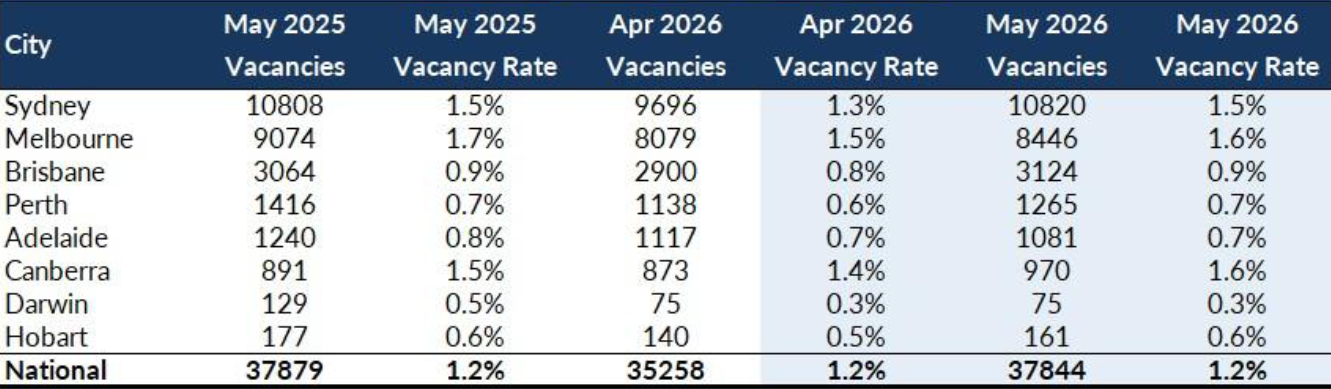 Source: SQM Research
Brisbane's vacancy rate edged up to 0.9% from 0.8%, with 3,124 dwellings available. Combined rents increased 0.8% over the month and 9.1% over the year, among the strongest annual growth rates of the major capitals.
Perth recorded a vacancy rate of 0.7%, up from 0.6%, with 1,265 dwellings available. Combined rents rose 1.0% for the month and 6.8% over the year.
Adelaide held steady at 0.7%, with 1,081 dwellings available. Combined rents were up 0.1% monthly and 4.9% annually, with unit rents outperforming houses.
Canberra's vacancy rate rose to 1.6% from 1.4%, with 970 vacancies recorded. Combined rents increased 0.1% for the month and 4.5% over the year.
Darwin remained the tightest market in the country at 0.3%, with just 75 dwellings available. Combined rents surged 5.1% for the month and 14.0% annually — the strongest monthly and annual growth of any capital.
Hobart recorded a vacancy rate of 0.6%, up from 0.5%, with 161 dwellings available. Combined rents were broadly flat over the month but 12.3% higher year-on-year.
 "Vacancy rates remain exceptionally low by historical standards," said Louis Christopher (pictured right), managing director at SQM Research. "Brisbane, Perth, Adelaide, Darwin, and Hobart are all still recording vacancy rates below 1%, indicating that rental supply remains severely constrained.
"At the same time, national asking rents are continuing to rise, up 7.8% over the past year. Strong rental growth in cities such as Darwin, Hobart and Brisbane demonstrates that demand is still outpacing available supply.
"Sydney is marginally tighter than it was a year ago, and Melbourne, while the most balanced of the major capitals, has also tightened over the past twelve months.
"Australia's rental market remains fundamentally undersupplied. Without a substantial increase in housing construction and rental stock, and/or a meaningful decrease in population growth rates from current levels, affordability pressures are likely to persist through the remainder of 2026 and into 2027."
Want to be regularly updated with mortgage news and features? Get exclusive interviews, breaking news, and industry events in your inbox – subscribe to our FREE daily newsletter. You can also follow us on Facebook, X (formerly Twitter), and LinkedIn.


