Overseas regulators and lenders see Australia’s broker channel, trail commissions and aggregation model as a benchmark, a new industry study shows

Australia’s mortgage broking model is more highly regarded overseas than it often is at home, according to fresh research from the Mortgage & Finance Association of Australia (MFAA).
The association’s new Global Insights Report 2026 found that regulators, lenders and broker groups across five overseas markets consistently expressed strong respect for the Australian industry. Many saw it as one of the world’s leading broker markets, rather than one trying to catch up.
That outside view contrasts with how the model is often discussed domestically, where broker pay – trail commission in particular – remains a recurring subject of policy debate.
The report found Australia is one of the few jurisdictions where ongoing trail remains a standard part of broker pay. In many overseas markets, brokers are paid mostly at origination, with little or nothing once the loan settles.
Several international participants viewed trail as a strength rather than a flaw. In Australia’s largely variable-rate market, it supports the regular reviews, refinancing conversations and long-term client relationships that are uncommon where long-term fixed rates dominate.
But the research also found that no single pay model guarantees better outcomes. The Netherlands banned commissions on mortgages in 2013 and moved to client-paid advice, yet brokers there still write about 80% of home loans. Consumer trust in the Netherlands is driven by transparency, professionalism and the quality of advice, rather than remuneration mechanics.
Australians often underestimate how unusual their high levels of repeat business and ongoing client engagement are. And while there is a common perception that innovation happens elsewhere first, several overseas participants pointed to parts of the Australian broker ecosystem as leading in the tech space.
The MFAA set out to find lessons Australia could borrow from abroad. It concluded that the exchange of ideas runs both ways, with Australia increasingly a market others look to.
The report compared Australia with the US, Canada, the UK, the Netherlands and Germany. It drew on more than 30 stakeholders across 15 organisations, including the US Consumer Financial Protection Bureau (CFPB), the UK Financial Conduct Authority (FCA) and the Dutch Authority for the Financial Markets (AFM).
It found no single winning formula: strong broker markets operate under very different pay and regulatory settings.
“Our conversations overseas reinforced many of the strengths of the Australian industry, from our sophisticated aggregation model to the ongoing relationships brokers build with their clients,” MFAA chief executive Anja Pannek (pictured, top of page, left) said.
The timing suits the industry. Brokers facilitated a record 81.6% of new residential home loans in the June 2026 quarter, according to MFAA market share data compiled by Cotality, and brokers settled 838,815 residential loans worth almost $496 billion in 2025.
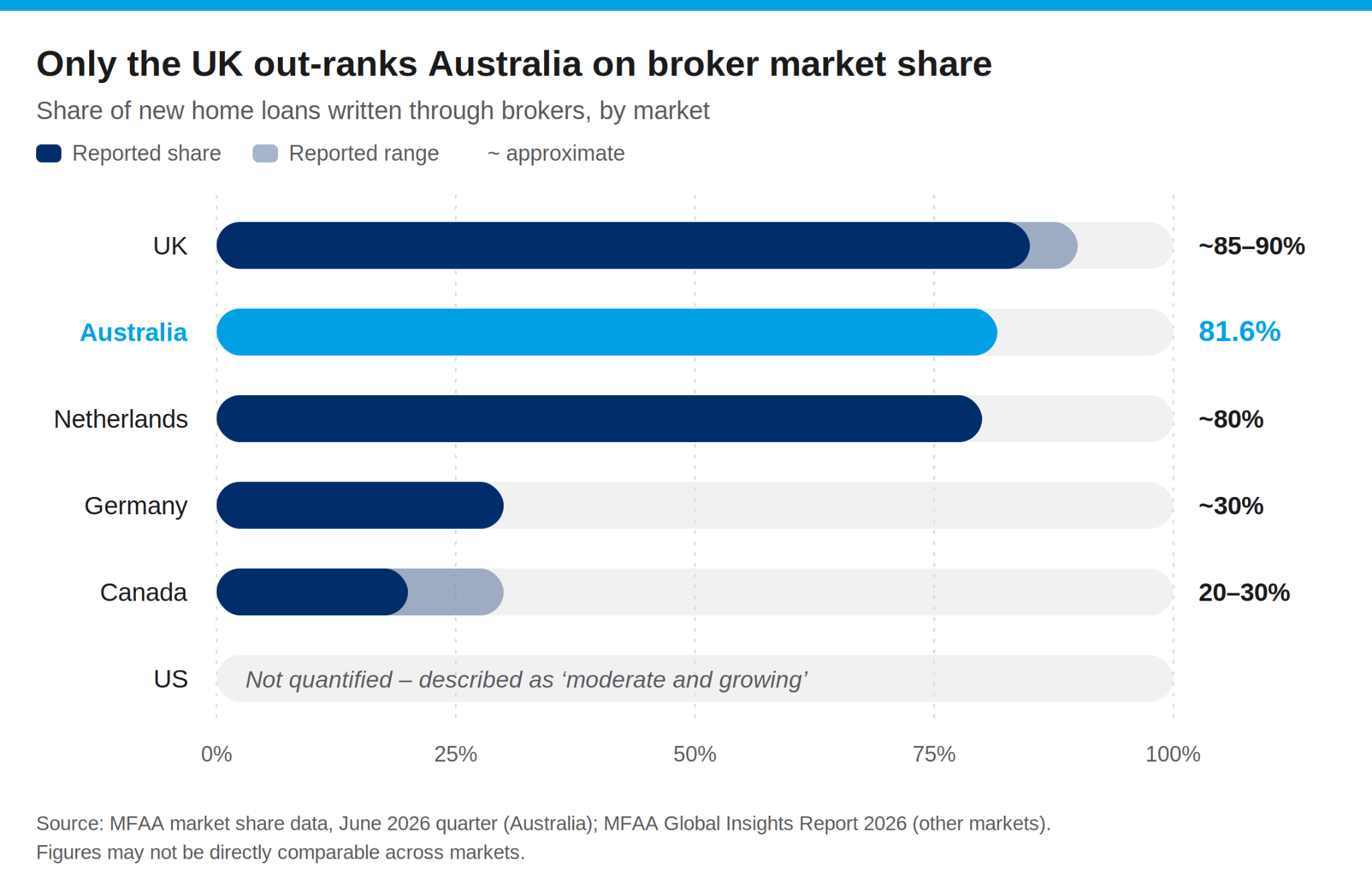
Broker market share: Australia versus five overseas markets
Only two markets in the study rival Australia for broker penetration, with the caveat that market share figures are not directly comparable, because each country defines and measures its broker channel differently.
The UK is the most broker-centric market examined, with brokers writing an estimated 85–90% of mortgages. Advice is embedded in regulation through the Mortgage Market Review and the FCA’s Consumer Duty. Advisers are paid by lenders, but many also earn income from protection and insurance products, and can charge clients fees. Loans are predominantly fixed rate.
Brokers hold about 80% of the Dutch market despite a full ban on commissions for complex financial products, including mortgages, which took effect in 2013. Consumers now pay advisers directly, and lenders must also charge separately for advice. Some advisers left the industry during the transition. The market is highly digitised, built around the shared Hypotheken Data Network (HDN).
Brokers hold only around 30% of the German market. Regulated by the Federal Financial Supervisory Authority (BaFin), advisers are paid by lender commission or client fee. Many sit inside broader financial services businesses and advise across several product lines.
Brokers write an estimated 20–30% of Canadian mortgages. Canada shares a common law framework and lender-funded pay with Australia. But it is regulated province by province, loans are predominantly fixed rate, and open banking is still in its early stages.
The report did not put a number on US broker share, describing it only as moderate and growing. Brokers compete with banks, credit unions and mortgage banks in a large wholesale lending channel shaped by the Dodd-Frank Act, passed after the Global Financial Crisis. Loans are predominantly long-term fixed rate, typically 30 to 40 years, and open banking is market-led rather than legislated.
Why Australia’s broker model works – and what it can still learn
The report credits Australia’s strength to a combination no other market in the study shares. Because most home loans are variable, brokers stay involved long after settlement – reviewing rates, refinancing and restructuring – and trail funds that ongoing service. In fixed-rate markets, the adviser relationship tends to end with the transaction.
Regulation adds to the appeal. Australia’s framework – national licensing, responsible lending obligations under the National Consumer Credit Protection Act 2009 (NCCP Act), external dispute resolution and the mortgage broker best interests duty set out by ASIC – is broadly consistent with international best practice. And with the national broker population now past 24,000, aggregators give the channel a level of digital connectivity many overseas markets have not reached.
But Australia can learn a thing or two from the overseas markets.
In the UK, the Netherlands, Canada and Germany, brokers increasingly act as broader mortgage advisers, covering insurance, protection and retirement planning; Australia’s more specialised model has the potential to move further in that direction.
Fraud is a shared pressure point across the jurisdictions. Stakeholders in every market reported more sophisticated schemes, including synthetic identities and digitally altered documents, and said no single lender or broker group can tackle them alone. No market has solved housing affordability either.
Read more: Fraud is getting smarter. How can brokers stay one step ahead?
Technology was seen as an aid rather than a threat, with stakeholders across all five markets viewing AI as a productivity tool, not a replacement for advisers.
“We saw opportunities for technology to reduce administrative work and give brokers more time to understand their clients’ circumstances and support their decisions,” Pannek said.
A three-part video series featuring Pannek and MFAA executive – policy and legal Naveen Ahluwalia (pictured, top of page, right) began on 21 October, with further instalments due fortnightly.
“While each market faces unique economic, regulatory and cultural circumstances, many of the underlying challenges are remarkably similar,” Pannek added. “Housing affordability, rising consumer expectations, increasing regulatory complexity and the need to improve productivity are common issues being addressed globally.”
The research “will help inform our advocacy, education and work with industry stakeholders as we continue supporting members through change”.