Chief distribution officer Brad Cramb reflects on 25 years of disruption of the nation's mortgage finance landscape

IN THE early 2000s, a mortgage broker was, in Brad Cramb (pictured)'s words, part of "an alternative distribution channel" – something borrowers might stumble upon rather than actively seek out.
How times have changed. Brokers in Australia now write more than eight in every 10 new residential home loans, one of the highest ratios in the entire world.
For Cramb, Aussie's chief executive of distribution, what's most striking is how the broker channel has evolved from an outlier to the de facto way of getting things done.
Cramb argues the shift is as much cultural as commercial. Borrowers, he says, stopped wanting a purely transactional lending experience somewhere along the way.
"They want guidance, choice and confidence in what is often one of the biggest financial decisions of their lives. That shift has elevated the role of the broker from loan writer to trusted adviser."
Underpinning that trust has been a steady professionalisation of the industry itself – education standards, compliance frameworks and governance that have all been raised over the past two-and-a-half decades. "What has emerged is a channel made up not just of brokers, but of business owners, community leaders and long-term advisers who play a genuinely important role in the financial lives of Australians," says Cramb.
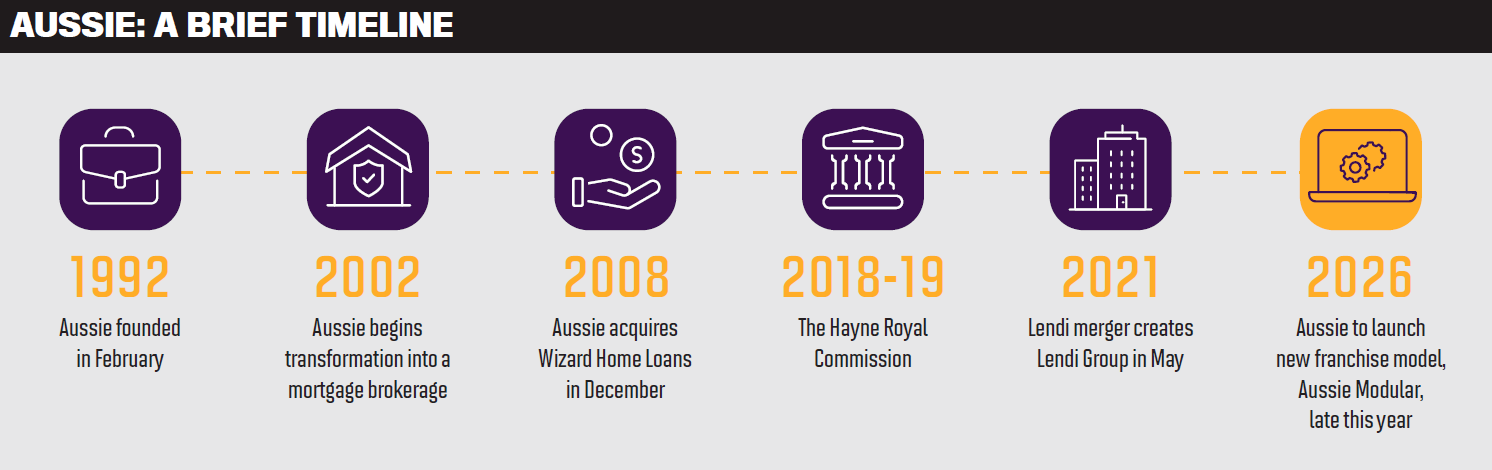
Few brands are more tied to that transformation than Aussie. Founded by John Symond in 1992 and now part of the Lendi Group, the brand built its identity on challenging the major banks' grip on home lending by offering cheaper loans, which it managed to do through securitisation.
Symond built the Aussie brand on the slogan 'We'll save you', offering borrowers lower rates and free advice at a time when circumventing a bank branch was still a novel idea. In 2002, Aussie pivoted its business model to become a mortgage brokerage.
Symond stepped down as chairman in 2020 after nearly three decades at the helm. By then, Aussie had grown into the country's largest retail mortgage broking network, and today, Symond is credited as one of the individuals most responsible for breaking the banks' hold on Australian home lending.
Cramb traces a direct line from Symond's original disruptive intent to where the industry sits today. He says, "Aussie's legacy starts with challenging the traditional banking model and putting customer choice at the centre of the conversation. That was a significant shift at the time, and it helped change expectations across the broader market."
Building the mainstream broker brand
Beyond the original disruption, Cramb points to Aussie's franchise network – now spanning more than 1,300 brokers across upwards of 210 stores, having supported over 1.5 million Australians with home loans – as a defining structural contribution to the industry.
Building Australia's largest retail mortgage broking franchise network "created a pathway for entrepreneurial brokers to move into business ownership and build something sustainable over the long term," says Cramb.
"At scale, it allowed businesses like Aussie to combine the consistency and trust of a national brand with the strength of local ownership. That is a powerful combination because customers get confidence in the brand while still dealing with someone who is deeply connected to their local market and community."
Surviving the royal commission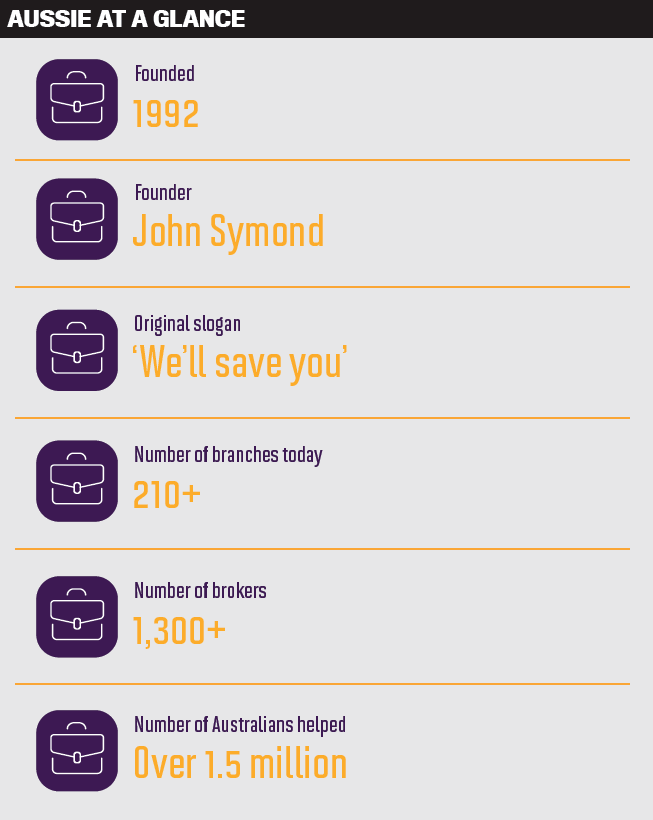
No retrospective on the past 25 years can skip past 2018 and 2019, when the Hayne royal commission put broker remuneration and conduct under a level of public scrutiny the industry had never faced.
Cramb views the period as a turning point rather than a setback. "I do believe the broker channel emerged stronger," he says. "It came through with a clearer sense of purpose, higher professional standards and stronger public credibility. When an industry can withstand that level of scrutiny and continue to grow, it says a lot about the strength of its underlying value proposition."
But if regulation defined the last decade, Cramb reckons technology will define the next. He points to the shift from manual digital lodgement as one of the most disruptive changes to the industry to date. "It dramatically reduced turnaround times, removed a huge amount of manual administration and lifted both speed and accuracy across the process," he says, but he also sees AI as the next wave of disruption to break over the industry.
Cramb doesn't see AI as a threat to the broker's role. The opportunity is not to replace the broker, "but to remove low-value administrative work and create more time for higher-value conversations," he says. "Our view is that the future is human-led and tech-superpowered. Technology should strengthen the broker-customer relationship, not diminish it."
"We are proud of what we have achieved, but we are more driven than ever to keep innovating and enhancing the experience for both customers and brokers" – Brad Cramb, Aussie
What's still unresolved
For all the channel's gains, Cramb candidly acknowledges that the industry's work isn't done. Simplifying the customer and broker experience without unwinding the compliance gains of the past decade remains, in his view, an ongoing challenge, with inconsistent lender policies and application processes ripe for better alignment.
He also flags talent as a live concern for the next 25 years, not just the last, noting that the industry must concentrate on attracting and developing the next generation of brokers. "If the industry can solve for simplicity, consistency and talent, it will be in a very strong position for the next 25 years," Cramb says.
Investing in the next chapter
While Aussie's influence in Australian mortgage broking is undeniable, Cramb stresses that the brand is looking forward, not backward.
"We do not rest on legacy. We are proud of what we have achieved, but we are more driven than ever to keep innovating and enhancing the experience for both customers and brokers. That challenger mindset has never really been about being disruptive for the sake of it. It has been about staying relevant, listening to customers, and continuing to evolve with the market," he says.
"That is still true today. We are no longer just talking about the home loan transaction. We are building a broader platform that helps customers find, buy and own property, and that shows the challenger mindset is still very much alive. It is just being applied to the next phase of the customer journey."
That evolution is already playing out at store level, where Aussie is investing heavily in its retail network, repositioning branches as end-to-end property hubs where customers can research, finance and settle a purchase, rather than simply walking in for a home loan.
The franchise model is evolving alongside it. The launch of Aussie Modular – a new offering built for ambitious mortgage business owners – is giving the next generation of franchisees a more flexible route into the network.
Aussie Modular offers up to 90% pass-through on self-generated business, with returns rising as books grow. Paired with flexible, modular support and tools like embedded buyer's agents and conveyancing attachments, Aussie Modular is designed to reward top performers and give ambitious brokers a clearer, more compelling path into scalable business ownership.
Like all of Aussie's ventures to date, it's just another example of the country's largest retail broking network moving forward with, not being left behind by, the times.