Industry veteran Gerald Foley reflects on tech, regulation and the steady maturation of Australian mortgage broking

IN THE early 2000s, following stints at ANZ and Mortgage Choice, Gerald Foley was in the process of establishing National Mortgage Brokers (nMB), the aggregator he still runs 25 years later.
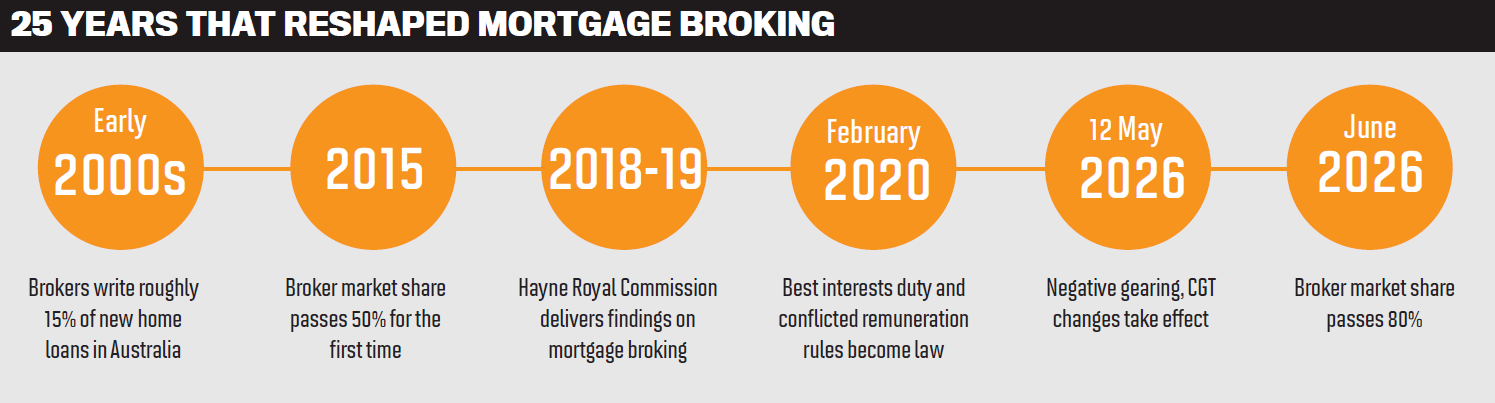
Broking was still the exception to the rule back then, the challenger to banks that wrote roughly 15% of new home loans. Foley had a front row seat as that number surpassed 50% in the mid-2010s, before steering past 80% in 2026.
MPA caught up with Foley to look back on the highs and lows of the broking profession amid a happy coincidence – just as this publication turns 25, nMB is also celebrating 25 years in the business.
Even Foley underestimated how far the industry would come. He says, "In the first five to 10 years of this journey, I remember saying to a broker audience, my view would be if we do everything right, we'll get to two-thirds" – a number he privately suspected was already ambitious. "Next thing, we're into high 60s, low 70s, and now starts with an eight."
What strikes him most, though, isn't the number itself but what it represents: banks no longer set the terms of engagement, brokers do. "The truth is the big banks wish we weren't around at all," he says. "But we're not here because brokers think it's a good idea. We're here because consumers think it's a great idea" – a distinction, he argues, that has quietly stripped banks of the ability to distribute loans purely on their own terms.
The Hayne reckoning
Asked to name the single most consequential event of the past 25 years, Foley doesn't hesitate: the fallout of the Hayne Royal Commission.
Conducted in 2018–19, the Hayne Royal Commission delivered pointed criticism of mortgage broking, flagging conflicted remuneration and a lower duty of care to clients than the financial advisory sector. Commissioner Kenneth Hayne recommended phasing out lender-paid trail commissions and introducing a broker best interests duty enforceable by civil penalty.
Government ultimately stopped short of banning commissions, but the BID and new conflicted remuneration rules passed into law in February 2020, requiring brokers to prioritise borrowers' interests. It marked the industry's most significant regulatory overhaul to date. But rather than framing it purely as a threat, Foley describes it as the moment competing aggregators found common cause.
Read more: What ASIC’s BID review means for mortgage brokers
"There was a lot of camaraderie among aggregators, and then as we all started to build our businesses, we became more competitive," he recalls of the industry's early days. "The Royal Commission certainly brought it back to camaraderie... which was really, really good to see." That cooperation produced the Combined Industry Forum and its Value of Mortgage Broking report, reissued by the MFAA as recently as last year.
Foley is candid that BID wasn't negotiated so much as forced onto the industry, but he rejects the idea that it exposed brokers with something to hide. "I think most brokers, most of the time, have always had the customer at heart," he says. "Mortgage broking became accepted because people generally had a good experience... (BID) sort of forced the maturity of the market to a degree."
"We're not here because brokers think it's a good idea. We're here because consumers think it's a great idea" – Gerald Foley, nMB
Today's policy shocks
As for challenges today, Foley reckons it's not necessarily coming from the banks or regulators – it's coming from Canberra. "We got an absolute bombshell of an announcement from the government," he says, referring to the sudden move to scrap residential SMSF lending. "Fo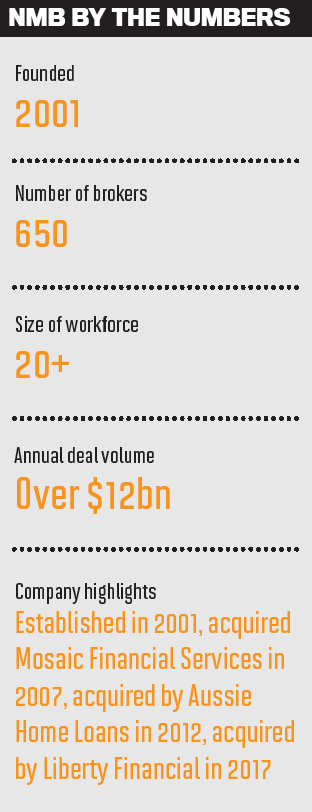 r me, it kind of came out of nowhere." Lenders and brokers who had built entire service lines around SMSF lending were given just 45 days to revisit their offerings – a notice period that Foley considers inadequate.
The implementation of highly controversial negative gearing changes was hardly any better. Effective from Budget night on 12 May, the policy caught buyers mid-transaction. "We saw examples where contracts were in the process of being executed – the purchaser had signed, the vendor hadn't, until the next day after the Budget, and negative gearing was no longer available," Foley says. "That's just ridiculous. You can't run it that way."
Foley frames his frustration as one of process, not principle, accepting that housing policy must legitimately balance homeownership aspirations against housing as an investment asset. His objection is to the assumption underpinning the changes to negative gearing and SMSF lending.
"I personally think government has got it horribly wrong in presuming that everyone's ambition in life is to own a property to live in," he says, pointing to borrowers who rent where they want to live and buy where they can afford to get a foothold in the market – an option he believes has now been closed off.
From fax machines to AI
If regulation forced the industry to grow up, technology has forced it to keep moving.
One story captures Foley's philosophy better than any other. Years ago, some lenders were at pains to move on from faxed loan applications – but it was easier said than done.
"A lot of brokers just wouldn't stop doing it the way they always had," Foley recalls. When a friend at ANZ complained he couldn't get brokers to stop faxing deals through, Foley's advice was blunt: "I said to him, 'Just unplug it.' And guess what? Brokers started lodging deals online." As he tells it, brokers were never going to stop doing business over a submission method.
Foley applies the same logic to automation and AI today. As an aggregator, nMB now leans heavily on automation to keep pace with lender compliance and vetting demands. "It's a force for good, it makes things easier," Foley says. Despite nMB's progressive stance on technology, the human touch remains "such an important decision to buy a house and to borrow money".
Foley describes trying out new direct-to-lender platforms whenever they launch, and hitting the same wall every time: "You just get to a point when you think, 'Who am I sending this to? Where's it going? I want to talk to someone.'" That, he believes, is why digital, self-service mortgages have been slow to take off – not distrust of the technology itself, but the need to hold someone accountable if things go pear-shaped.
"The fundamental of consumers being time poor or information poor hasn't really changed, and brokers have always been there to fulfil that need" – Gerald Foley, nMB
Passing it on
Through all of broking's ups and downs, twists and turns and tech transformations, "the fundamentals haven't really changed," says Foley. "The fundamental of consumers being time poor or information poor hasn't really changed, and brokers have always been there to fulfil that need."
Now, as the profession reaches the end of its first working generation, Foley increasingly finds himself advising brokers on how to hand their businesses over to the new guard.
He cites Melbourne fruit-and-vegetable magnate Frank Costa's staged succession as a model: front of the Christmas photo one year, then the middle of the team, then the back, over a three-year cycle, so clients gradually absorb the change.
"It can't all be about you," Foley warns long-established broker businesses. The goal should be for clients to start relating to the business itself, not just the individual broker, so that when a file changes hands, it doesn't feel like starting over.
As a business leader who's been involved from the beginning, Foley offers insights that the industry would do well to heed.